Spondylosis



Spondylosis is a degenerative musculoskeletal disease, a degenerative lesion of the vertebrae and intervertebral discs. Spondylosis causes the discs to flatten and the space between the vertebrae to narrow. This places increased stress on the vertebrae, which develop bony ridges, outgrowths, beaks and staples (spondylophytes).
It mostly affects middle-aged people, usually with calcifications affecting 3 vertebrae of the spine. It is important to stress, however, that the majority of lesions detected are not symptomatic and that there is no strong correlation between the severity of confirmed spondylosis spondylarthrosis and symptoms.
Causes of spondylosis
The causes of spondylosis can be primary, age-related, or secondary, which can be the result of static abnormalities, overloading, injuries and diseases of the spine over a long period of time.
Secondary spondylosis is the most common underlying cause:
- Doing heavy physical work
- One-sided load, sedentary work
- Bad posture
- Muscle imbalance
- Previous trauma
- Spinal diseases
- Metabolic disorders may be
Symptoms of spondylosis
The onset of symptoms caused by a lesion is usually less dependent on the extent of the lesions and more on the location of the bony degenerations. In addition, a minor trauma can trigger the onset or worsening of symptoms. In the majority of cases, this causes localised pain that does not radiate to the limbs. Reflexively, it causes contraction of the dorsal muscles adjacent to the spine, or postural dysfunction, with changes in the normal curvature of the spine.
Types of spondylosis
Spondylosis spondylolisthesis can be divided into 3 groups based on the spinal segment affected. Thus we can talk about cervical, back and lumbar spondylosis. The location of the lesion greatly influences the onset and intensity of the symptoms, so it is easy to group the problem according to the symptoms.
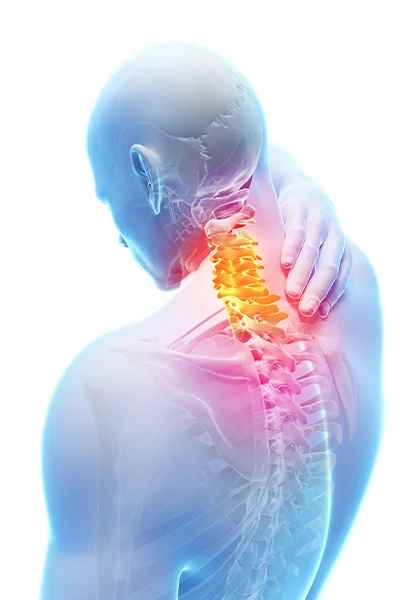
Cervical spondylosis
The spondylosis lesion in the cervical part of the spinal column. Typical symptoms include:
- Neck pain (dull, sharp or shooting)
- Difficult, restricted neck movement
- Tight, stiff, crampy neck muscles
- Stuck neck
- Pain radiating into the shoulder, arm
- Headache
Spinal spondylosis
The spondylosis lesion in the dorsal segment of the spinal column. Typical symptoms include:
- Rigid movement
- Pressure sensitive, sore muscles
- Restricted movement
- Pain radiating to the side
- Stabbing pain between the shoulder blades
Lumbar spondylosis
The lesion is in the lumbar (lower lumbar) part of the spinal column. Typical symptoms include:
- Lower back pain in the morning and evening
- Lower back pain increases when bending forward
- Increased when sitting and leaning forward
- Restriction of movement at the waist
- Radiating pain towards the sacrum and hip

Investigating complaints
In the case of spondylosis, the path to diagnosis starts in a specialist rheumatology or orthopedics outpatient clinic. Based on your complaints, the specialist will perform a physical examination and may also recommend other imaging tests.
The basics of a successful investigation are based on the BMM patient journey protocol:
- Anamnesis, i.e. detailed interview and history taking. Based on the complaints and symptoms reported orally, the specialist can further examine the patient in a targeted way.
- A thorough physical examination by a specialist. On the basis of the physical examination, a specialist will determine the need for any diagnostic imaging tests. Diagnostics tests can help to visualise and measure anatomical structural changes and reveal the true cause of the complaint.
- X-ray examination bony lesions can be confirmed. X-rays are usually taken of the spine, hip joints, knees and feet. This is often necessary for isolating purposes related to diagnostics. X-ray examination is available at our private clinic in Óbuda.
- The condition of the soft tissues, discs, articular cartilage, muscles and tendons is accurately assessed by the radiograph.
- In some cases, a CT (computer tomography) scan or an MRI (magnetic resonance imaging) scan is also needed to make an accurate diagnosis. MRI scan is available at the St. Magdalene Private Hospital by appointment.
- In the case of nerve involvement, neurophysiological testing, ENG or EMG is required to determine the extent of suspected nerve damage. Neuroconductive neurophysiological examinations (ENG/EMG) are available at BMM's clinics in Pest and Óbuda.
If an ultrasound examination or CT scan is required, we can arrange these at an external location of our partner institutions for an additional fee.
Treatment methods
Conservative treatment is the most common treatment for spondylosis to relieve symptoms. The treatment plan is tailored by a rheumatologist or an orthopaedic traumatologist on the basis of an accurate diagnosis. Conservative therapy may include the use of non-steroidal anti-inflammatory drugs, muscle relaxants, regular and professional physiotherapy and physical therapy. Occasionally, balneotherapeutic treatments may be considered, and in severe cases (abnormalities in neurology) surgical intervention may be the solution. Spondylosis surgery is performed by a neurosurgeon.
Spondylosis can usually be treated well with conservative methods and regular physiotherapy.
In case of complaints, please contact our excellent rheumatologists or orthopedic specialists!

Most Common Complaints Treated by Spine Medicine Center Specialists
- lower back pain
- lower back pain
- scoliosis
- nerve compression
- back pain
- neck pain
- stiff neck - neck stiffness
- osteoporosis
- spinal pain
- spinal stenosis
- back pain
- lumbar spine pain
- gluteal muscle pain
- poor posture
- sacrum pain
- shoulder blade pain
- morning lower back pain
- neck pain
Our Spine Medicine Specialists

Dr. Dóra Mihola
Rheumatologist specialist

Dr. Attila Pataki
Chief Orthopedic-Traumatologist

Dr. Flórián Szeles
Rheumatologist general practitioner

Dr. Balázs Török
Assistant Professor of Orthopedics and Traumatology

Dr. Bence Moravcsik
Orthopedic-Traumatologist

Dr. Gréta Sterba
Rheumatologist specialist

Dr. Éva Bordán
Rheumatologist general practitioner