Soft Laser Treatment
The rehabilitation period can be shortened following injuries and surgeries with the use of soft laser!
It is also used for certain dermatological and otolaryngological conditions, as well as for treating dental and oral mucosa diseases.
What is soft laser used for?
Lasers can be divided into two groups in medicine based on their biological effects: high-power “hard lasers” – or surgical lasers, and low-power “soft lasers” – or therapeutic lasers. High-power lasers are used for various surgical interventions and operations due to their strong thermal effect. The Soft Laser device is a “gentler” version of the high-energy laser, belonging to the therapeutic “soft laser” group (medical device). The photochemical effect of laser light is used to initiate beneficial biological processes.
Through biostimulation, the laser beam initiates and stimulates healing and regeneration: soft laser devices typically emit red and infrared wavelengths, their light reaches the mitochondria deep within the cell, thereby influencing cellular processes, resulting in the mitochondria producing more energy. Cell division becomes more active (“accelerates” cell function), self-healing processes are initiated, it stimulates cell regeneration, blood vessel formation, and activates the immune system. It increases endorphin production (the body’s natural pain-relieving substance), thus reducing pain. The absorption of the laser beam is accompanied by heat release, warming the treated tissues. With accelerated blood circulation, the removal of breakdown products and inflammatory toxins begins. It also makes lymphatic circulation more efficient, thus reducing soft tissue swelling and tension. For pain relief, joint treatment, and anti-inflammatory purposes, we use 800–900 nm wavelength (infrared) lasers, which can penetrate up to 6-8 cm deep. The Safe laser 500 is one such device.

Tímea Szentpétery
Physiotherapist
In which areas and for which complaints is soft laser used?
We use the soft laser device independently and/or as complementary therapy:
- Following injuries/trauma: bone fractures, muscle-tendon strains, muscle-tendon ruptures, hematomas, contusions.
- In various degenerative conditions: joint and cartilage degeneration, to reduce rheumatic pain/inflammation and spinal pain/inflammation (lumbago).
- In conditions involving overexertion: periostitis occurring at muscle origins or insertions due to overexertion. For example, in tennis elbow, tendinitis and gradually developing periostitis at the attachment point of the forearm extensor muscles on the outer side of the elbow due to overload.
- To reduce tendinitis, bursitis, myositis, and muscle pain.
Contraindications:
- “Irradiation” of the lower abdomen is prohibited in pregnant women due to the (potentially dangerous) increase in blood congestion!
- The device is also prohibited for use in individuals suffering from severe blood clotting disorders!
- Soft laser use is prohibited on: tumor areas, the thyroid gland (if overactive) and the chest area, fungal or infected skin surfaces, and the region above an implanted pacemaker.
- “Irradiation” of pigmented moles is prohibited, as they should be considered precancerous conditions.
- Do not “self-treat” without an accurate medical diagnosis, as soft laser can reduce pain but cannot always eliminate its cause and may (temporarily) mask symptoms of more serious diseases!
How is soft laser treatment performed?
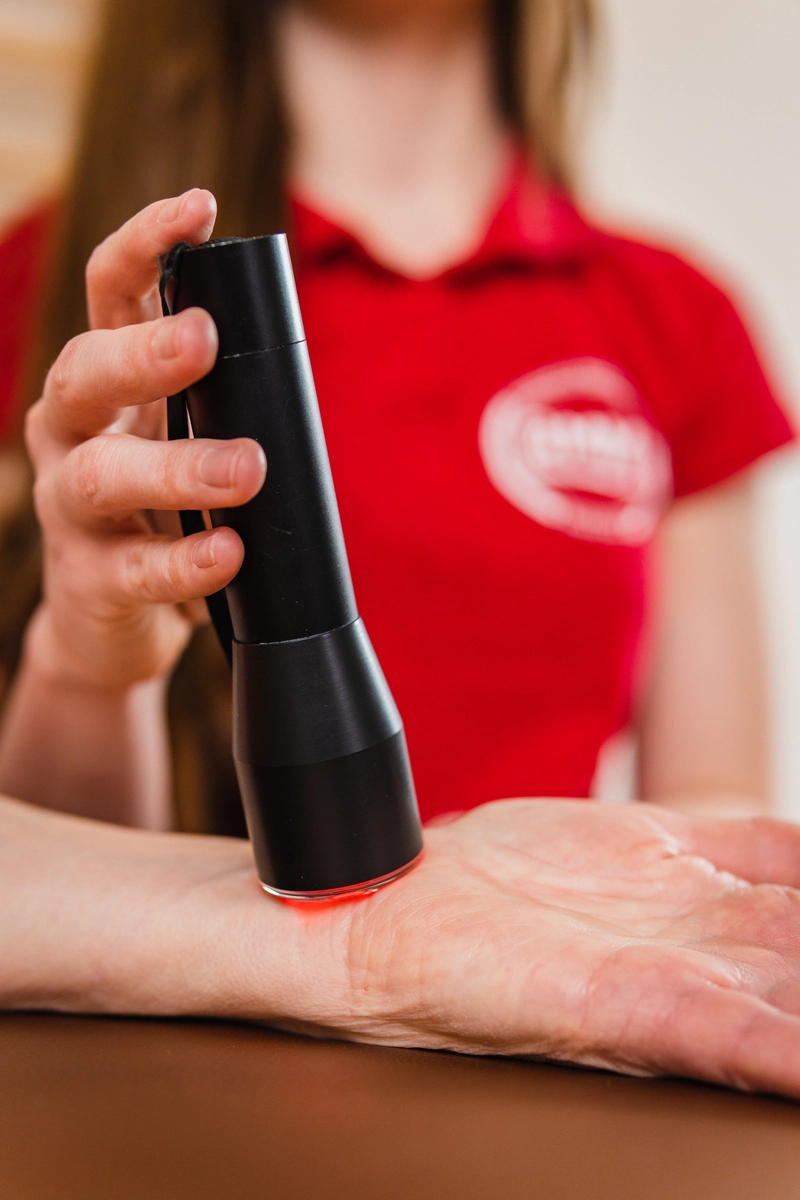
The soft laser device should be placed—in contact with the skin—on the painful point and the area should be illuminated for the specified treatment duration, then moved to the next point. We typically treat pressure-sensitive points.
How long does soft laser treatment take?
Soft lasers are laser types that, due to their “low” power, do not cause visible changes in the irradiated tissues, and the expected positive effect usually appears only after multiple treatments and after a longer period. For certain conditions and diseases, we treat with different energy amounts to increase effectiveness. We can ensure higher energy input (Joules) with longer treatment duration. The duration of laser irradiation is typically 1-5 minutes, depending on the expected effect.
The frequency of treatments depends on how long the particular problem or disease has been present.
- For acute conditions (within 6 weeks) and postoperative (post-surgical period) cases:
Treatment should be applied daily for 1-2 weeks, followed by 3 times per week until symptoms resolve. - For chronic conditions (beyond 6-8 weeks):
Long-standing conditions are treated less frequently. The laser device is used 3 times per week until symptoms resolve or significantly decrease. For long-standing (chronic) conditions, healing may take longer (days, weeks, or even months).
During/after the first treatments, mild warmth or tingling may be felt. In some (especially chronic) cases, pain may intensify a few hours after treatment due to the body’s response to treatment, but this is only temporary.
In cases of a history of malignant tumors, an oncologist’s recommendation is required for physical therapy treatments, regardless of the region.

Book an appointment by phone

Online Appointment Booking