
Physiotherapy for children with disabilities
Physiotherapy for children with disabilities
Author Marketing BMM | 11 October 2022.
Abnormal health conditions can develop as a result of developmental disorders, accidents, or other illnesses. In such cases, our main goal is to achieve full recovery as soon as possible, regain the previous state of health or the closest possible condition, and attain the highest possible level of independence. The therapy must be chosen based on the extent of the disorder or damage and the current functional, mental, and motor status, and short- and long-term goals must be set, just as we would for adults.
How can physiotherapy help children with disabilities?
The motor development of children with disabilities can often deviate from healthy development from the earliest age. Often, it stops at a level characteristic of an early stage of life, or progresses only minimally. The child’s automatic control of their body encounters problems, and the adequate movements characteristic of infancy do not develop, or develop pathologically. Development is a very long process, requiring a lot of time and energy for both the child and their environment. However, to achieve the highest possible independence, they require continuous development. It is important to maintain the child’s motivation at the highest level, as this will be an indispensable condition for success. Continuous motivation and the desire to meet new goals will drive progress. Essential prerequisites for this include age-appropriate play and entertainment, and the continuous joint setting of smaller, more easily achievable goals.
Before starting home-based movement development, it is worth considering whether we can perform it safely. If we do not have sufficient knowledge and experience regarding the anatomical and pathophysiological background of the child’s motor condition, we could cause minor or major accidents. Therefore, before starting a home exercise program, it is advisable to seek guidance from a physiotherapist or other specialist on what to do and what not to do. Ask for advice and help regarding safe and optimal body positions and the correct handling techniques required to move the child. Furthermore, it is important to proceed cautiously and continuously when performing movement-related tasks, as the child’s current motor condition can fluctuate, and what we could easily stretch today, we might not be able to do at all the next day. Of course, the ideal solution would be for a specialist to conduct the therapy, and for the home program to take place under their guidance. In such a case, the therapist demonstrates and teaches the partial tasks to be performed at home, passive mobilization, massage, methods of changing body and posture necessary for daily activities, and also helps to make care tasks as easy as possible.
Without development, motor development and nervous system development can slow down or even stop.
This also increases the likelihood of secondary consequences, such as muscle contractures, deformities, or pathological compensations appearing in the posture of individual spinal segments, the pelvis, and the movement of the head, neck, and tongue.

What is the goal of physiotherapy sessions for children with disabilities?
The most important task is to improve the quality of life, which fundamentally involves posture correction, thereby finding and creating a safe resting position and situations that can increase the joy of experiencing the world for our child with disabilities. For example, the supine position can often result in severe tension, known as opisthotonus, for severely and multiply disabled children, whereas a stable side-lying position can help inhibit pathological reflexes. Subsequently, during the tasks, we set goals that can facilitate daily living.
Often, as a result of injuries sustained in infancy or even in the womb, sensorimotor disorders can develop, meaning that in addition to motor function impairments, sensory problems also occur, such as communication disorders, perception and sensory processing issues, and problems with acquiring experience. We can influence the development of these during therapy. Through continuous somatic stimuli (touch, sight, hearing), the child discovers their body, its boundaries, and also discovers and learns to establish a connection with their environment. These are all prerequisites for the development of body schema and motor coordination.
What helps in physiotherapy sessions for children with disabilities?
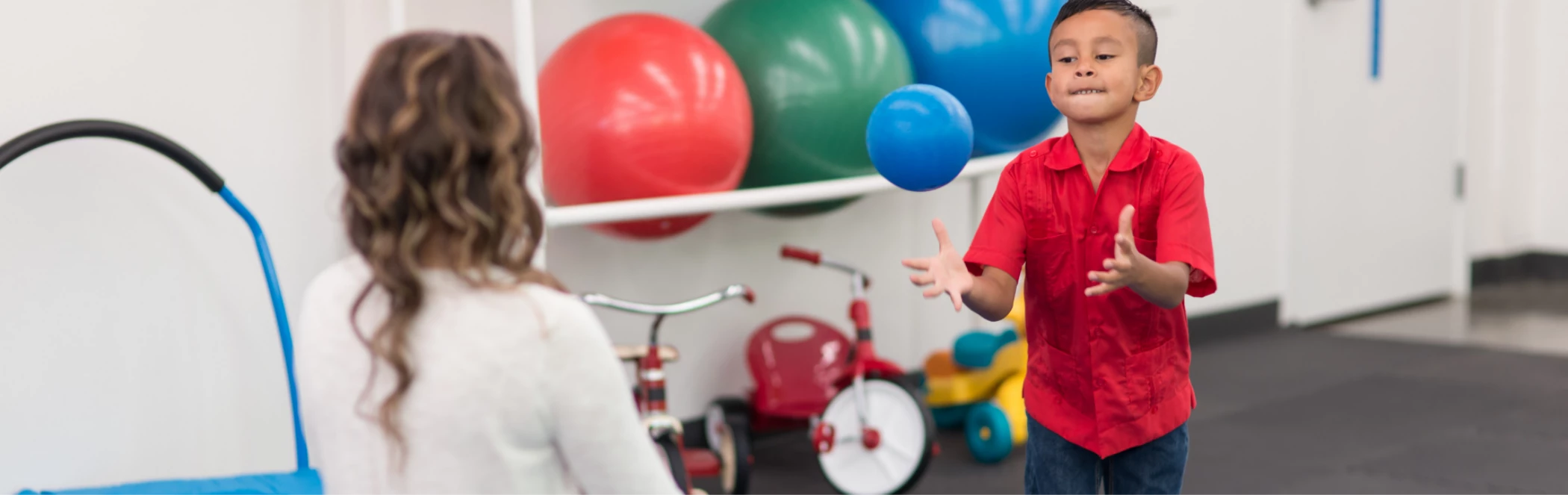
During developmental sessions, we offer children various exciting play activities through which they can develop their underdeveloped or improperly functioning nervous system with their own active participation. We do not apply a rigid training program; we adapt to each child’s individual developmental level and current mood. With the help of diverse and varied tools, we strive to create an environment for the child in which we can encourage even children who have difficulty coordinating their own body parts, have an immature nervous system, and are accustomed to failures, to engage in joyful movement. Furthermore, development includes passive mobilization, massage, manual techniques for tense muscles, and active exercises that help separate arm and leg movements, contralateral limb movements, strengthen or relax muscles, teach correct postures, and improve coordination.
In summary, our goal is to improve the quality of life, physical and mental condition (habilitation, rehabilitation) of injured and disabled children, assist their families, and promote their fullest possible social integration.

Book an appointment by phone

Online Appointment Booking