Schroth – Therapy at BMM
Schroth therapy
The Schroth method is currently the most effective physiotherapy method for treating scoliosis and Scheuermann’s disease. It is important to emphasize that it is applicable in cases of structural scoliosis.
What is structural scoliosis?
Scoliosis can be divided into 2 main groups:
Group 1 is the group of so-called functional scoliosis:
the lateral deviation of the spinal column is not accompanied by deformity of the bony structures, ribs, or vertebrae. It usually develops due to poor posture or, for example, limb length discrepancy. In this case, we perform symmetrical trunk muscle strengthening exercises.
Group 2 is the group of structural scoliosis:
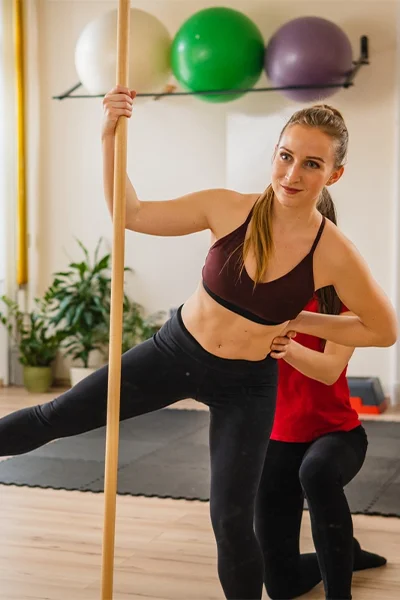
the lateral deviation of the spinal column is also accompanied by deformity of the bony structures, leading to the formation of rib humps, lumbar humps, rib valleys, and lumbar valleys. In this case, Schroth therapy is applicable.
The method allows for 3D correction of the spinal column.
The essence of Schroth therapy
The essence is the maximum active stretching of the spinal column, maximum correction of trunk asymmetries, and muscle strengthening and stretching in the corrected position. Schroth therapy is not just a set of physiotherapy exercises, but a mindset that also provides the patient with practical advice regarding posture.
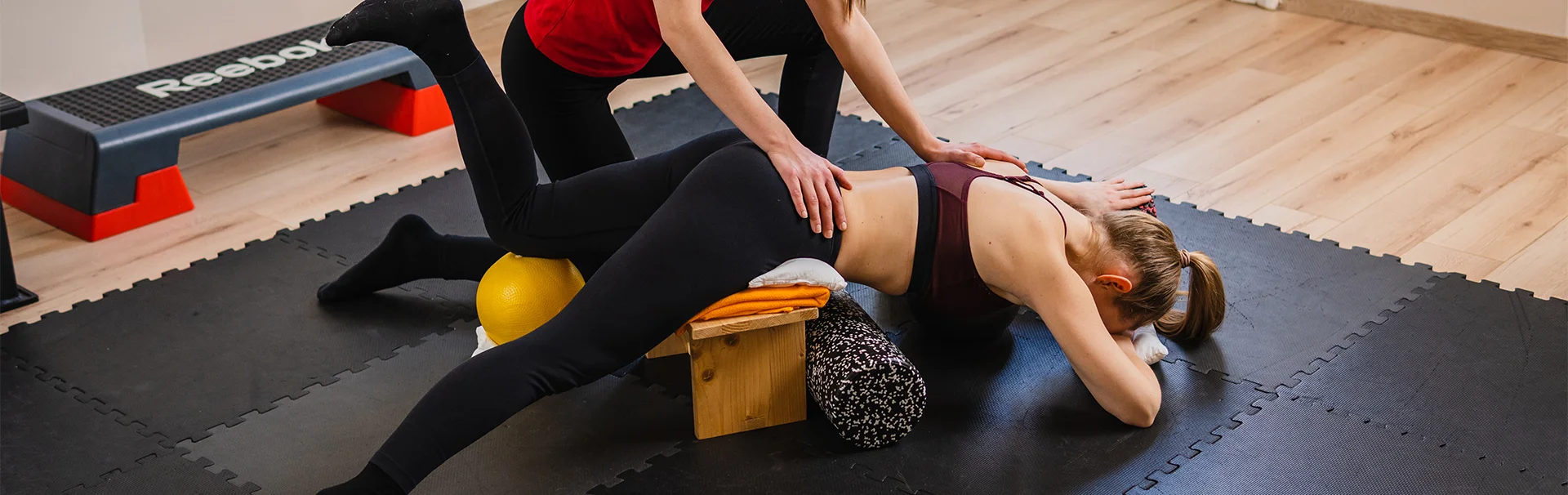
Various tools help us with the correction: pillows, balls, rollers, mirrors.
Practical advice for those starting Schroth therapy
- In all cases, an X-ray of the entire spinal column, taken in a standing position (AP, lateral), is required! Without this, therapy cannot begin!!!
- During the first session, we evaluate the X-ray, and measure the degree of the curves.
- A detailed musculoskeletal examination is performed: Posture analysis, mapping the position of bony structures, examination of muscle condition, etc.
- It is advisable for a minor child to be accompanied, and for the parent to actively participate in the physiotherapy, as without the parent seeing the treatment, there will be no help at home, which is very important in the initial stage.
- Following this, the essence of the method and its theoretical background are discussed. We strive for logical thinking, so we understand what we are doing and why.
- The special exercises and posture correction movements are gradually learned.
How does the Schroth method work?
Long-term therapy is always necessary. The exercises must be performed daily at home and at least once a week under the guidance of a physiotherapist to achieve beautiful and lasting results. During practice, by utilizing the tools of sensorimotor posture correction, we help the patient recognize incorrect posture with proprioceptive and exteroceptive stimuli.
During therapy, in Schroth-specific positions, in the three-dimensionally corrected position of the spinal column, we achieve a relative increase in muscle activity and the conscious awareness and reflex-like adoption of the corrected position. In this three-dimensionally corrected position, we use special rotational breathing, which is important for achieving derotation and reducing rib humps.
What is the effectiveness of the Schroth method?
The Schroth method is one of the most effective therapies for treating scoliosis and postural disorders. It can also be used with excellent results for functional and structural scoliosis, as well as Scheuermann’s disease. However, due to its complexity, it cannot be used under the age of 10.
At the beginning of the 20th century, Katharina Schroth developed the Three-Dimensional Scoliosis Therapy. The method not only treats the lateral curvature but also corrects the rib hump caused by the twisting of the vertebrae, which is why it is called three-dimensional. The method is based on dividing the trunk into three blocks based on the anatomical properties of the spinal column, which in cases of scoliosis are displaced and twisted relative to each other, leading to deformation. As a result of the bony changes, the vertebrae can become wedge-shaped, the mobility of the ribs is restricted, and consequently, respiratory volume decreases.
Indications for Schroth therapy:
- Scoliosis
- Scheuermann’s disease (vertebral growth disorder occurring in adolescence)
- Pre-operative mobilization
- Post-operative rehabilitation
- Other vertebral deformities and postural problems
Core elements of Schroth therapy:
- Teaching individual corrections
- Postural control
- Breathing therapy
- Body awareness development
- Teaching self-correction, self-control
- Teaching progression-preventing direction of daily activities
- Brace treatment – habituation, weaning
Our physiotherapists
Tímea Szentpétery
Physiotherapist
Sándor Dorottya Lilla
Physiotherapist
Rita Major
Physiotherapist
Krisztina Tatai
Physiotherapist

Book an appointment by phone

Online Appointment Booking