Rotator Cuff Syndrome
What is the rotator cuff?
The rotator cuff is the tendinous attachment of 4 muscles originating from the shoulder blade to the humerus.
The four muscles that stabilize the shoulder joint and assist in rotating and lifting the arm are:
- Supraspinatus
- Infraspinatus
- Teres minor
- Subscapularis
What is the function of the rotator cuff?
This well-structured and coordinated muscle group performs 2 main functions:
Centralization
The rotator cuff muscles create counterforce, partly against each other and partly against the deltoid muscle, and hold the humeral head in the joint socket. If this function is significantly impaired, the shoulder's lifting function becomes difficult or ceases completely.
Movement
The rotator cuff muscles contribute to the arm's rotational and lateral lifting movements. The supraspinatus muscle primarily supports lateral arm elevation, the infraspinatus and teres minor support external rotation of the arm, while the subscapularis muscle supports internal rotation.
Rotator cuff injury can limit arm movement and cause pain, which can significantly affect the patient's daily activities and quality of life.
What are the most common rotator cuff diseases and injuries?
Rotator cuff problems can be diverse. Due to its complexity, numerous diseases and injuries can impair its movement. Their investigation and diagnosis require specialist medical assistance.
Although the cuff can indicate many different conditions, the following disorders are the most common:
Rotator cuff rupture
During a rotator cuff injury, one or more tendons of the cuff stabilizing the shoulder joint partially or completely tear. Rotator cuff rupture causes shoulder pain, weakness, and in more severe cases difficulty lifting, rarely—when multiple tendons are involved—shoulder dislocation.
This injury most commonly affects the supraspinatus muscle.
The causes of the injury can vary:
- Overuse – Develops particularly with repetitive movements, such as various sports activities, throwing, or overhead lifting and work.
- Age-related degeneration – Tendons and muscles weaken and wear out with advancing age.
- Trauma or injury – Occurs due to falls, sports, or other accidents
The most common symptoms resulting from the injury:
- Shoulder pain: Occurs during daytime activities and often worsens at night and during shoulder movement (lifting, rotation).
- Arm weakness.
- Limited active shoulder movement.
To determine personalized treatment, the physician considers numerous factors. The most important consideration is the severity of the injury and the patient's overall health status.
- Surgical intervention – The most ideal outcome is achieved by suturing the torn tendon back, which the surgeon performs arthroscopically. If conservative treatment is initiated for a rotator cuff rupture (see below) and proves unsuccessful, surgical intervention may also be considered (biceps long head release, superior capsule reconstruction). In severe cases (inability to lift the shoulder), shoulder prosthesis implantation may be necessary as a possible treatment option.
- Conservative therapy – Sometimes a torn tendon cannot be sutured (e.g., due to old rupture, atrophied, fatty muscle) or is not advisable to suture (e.g., due to poor tendon quality, advanced age, etc.). In such cases, rest, physiotherapy, anti-inflammatory medications, and steroid injections can help.
Rotator cuff calcification
Rotator cuff calcification, also known as calcific tendinitis, is a condition where calcium deposits (calcium salts) form in the tendons comprising the rotator cuff. This disease often leads to chronic shoulder pain and limited mobility.
Possible causes of its development:
- Repetitive (micro)injuries.
- Overuse caused by repetitive movements.
The listed causes may occur frequently, but the exact trigger and mechanism are actually unknown. It is important to know that rotator cuff calcification is often associated with chronic inflammation, which further intensifies the symptoms.
The most common symptoms of calcification:
- Chronic pain: The shoulder "aches," but with certain movements the pain intensifies, shoots through, and also disrupts nighttime rest.
- Acute pain: Sudden onset, excruciating pain (one of the most painful shoulder complaints), which subsides in approximately one week.
- Chronic and acute painful periods alternate at certain intervals.
- Limited mobility
Treatment:
Treatment depends on the severity and duration of symptoms.
- Conservative treatment – For milder, chronic pain, rest, anti-inflammatory medications, physiotherapy (soft laser, shockwave therapy), and injection treatment (steroid) can help. For acute pain, diclofenac-containing preparations, icing, rest, and even immobilizing the shoulder for a few days can help.
- Surgery – For prolonged symptoms and regularly recurring acute symptoms. Minimally invasive, arthroscopic surgical procedure (evacuation and removal of calcium deposits) can provide healing.

Before surgery
- Following recognition of the rotator cuff rupture and establishment of the surgical plan, our surgeon discusses in detail with the patient the steps of the surgery, rehabilitation, and expected time to return to work and sports.
- Within one month prior to surgery, an anesthesiology examination is performed with the necessary medical reports (laboratory test, ECG, chest X-ray).
- Medication modification (e.g., discontinuation of anticoagulants) may also be necessary before surgery.
Doctor-performed ultrasound
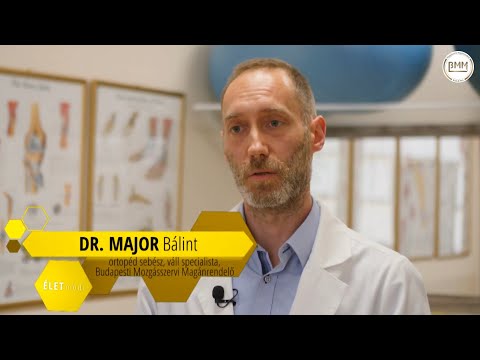
Diagnostic imaging is required to establish an accurate diagnosis and select appropriate treatment. X-ray imaging is available at our clinic, and during Dr. Bálint Major's shoulder specialist consultation, ultrasound examination of the shoulder joint is also part of the examination, which in many cases can already confirm rotator cuff injury. If the possibility or necessity of tendon suture arises, we recommend an MRI scan.
We note that we do not consider it ideal for the patient to decide where the MRI scan should be performed, as for the same price, very variable and unfortunately often unusable quality examinations are performed. At our clinic, we are happy to assist in selecting an appropriate quality MRI facility! The ultrasound examination is part of the orthopedic consultation and is not charged separately.
What is rotator cuff surgery?
Rotator cuff rupture surgery is usually performed using arthroscopic methods, which is a minimally invasive procedure.
- The intervention most commonly takes place under general anesthesia, often with supplementary cervical anesthesia.
- The physician inserts a small camera and instruments into the shoulder through small incisions.
- At the tendon attachment site, the surgeon embeds anchor screws into the bone, then sutures the torn tendon to the bone using threads threaded through them.
- After suturing the torn tendon back, the skin is closed with sutures.
- The surgery typically takes 1.5-2 hours.
- After the intervention, the limb is immobilized in a shoulder brace.
After surgery – How do I recover?
- In most rotator cuff surgeries, the patient can leave the hospital the same day or, if necessary, the next day.
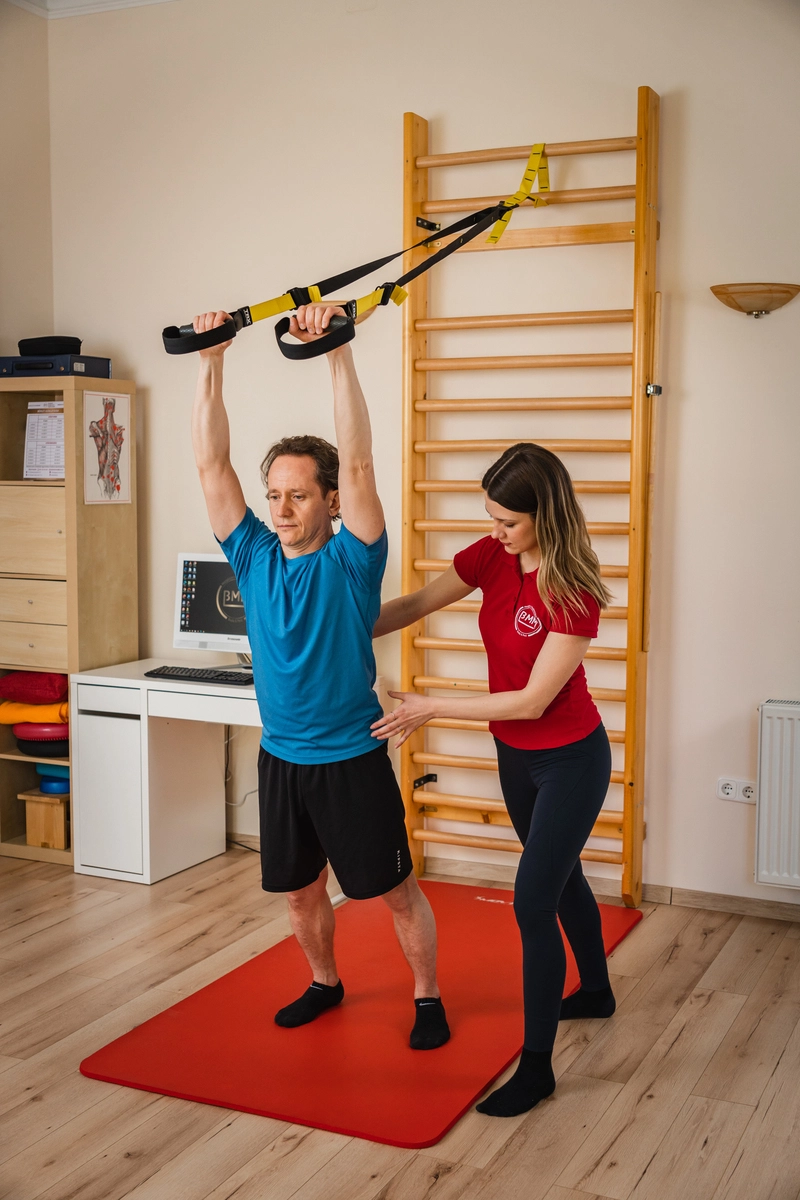
- From the day after the intervention, rehabilitation can begin with previously learned passive movements (performed without straining the shoulder), which must be performed continuously under the supervision of a physiotherapist in the weeks following surgery.
- During the 2 weeks after surgery, care must be taken to keep the wound dry. This is particularly important to avoid infections and other complications.
- During the 6-week follow-up, the brace is removed and active movement exercises begin (using the shoulder in daily life under the supervision of a physiotherapist).
The recovery process after rotator cuff surgery can take up to 4-6 months. The goal is for the patient to be able to live a full life again, if possible.
Possible complications of rotator cuff surgery
It should not be overlooked that rotator cuff rupture surgery, like any surgical intervention, may rarely have unexpected consequences:
- Recurrence of rotator cuff rupture
- Weak shoulder function
- Nerve damage
- Risk of infection
- Bleeding
- Persistence of a certain level of pain
Most common complaints treated by our shoulder specialists:
Patient Testimonials
Our shoulder specialist physicians

Dr. Bálint Major
Shoulder Specialist Chief Orthopedic Traumatologist
Dr. Balázs Gloviczki PhD
Chief Orthopedic-Traumatologist, Shoulder Specialist
Dr. György Kocsis PhD
Orthopedic-Traumatologist, Chief Hand Surgeon, University Assistant Professor, Wrist, Elbow, and Shoulder Surgeon, Upper Extremity Specialist

Dr. Ferenc Tompai
Chief Orthopedic and Trauma Surgeon

Book an appointment by phone

Online Appointment Booking