Sports Rehabilitation at BMM
After every sports injury, recovery and professional sports rehabilitation are paramount. During our sports rehabilitation treatments, we provide comprehensive care from the early stage of rehabilitation until the injured patient’s return to sport.
By utilizing the full range of manual therapy, we accelerate the healing process: Barvichenko, Mulligan manual therapy, fascia release manual therapy, FDM, dynamic soft tissue manual therapy, scar treatment, trigger point therapy, fascia knife treatment, instrumental manual therapy.
We also have numerous physiotherapy treatment methods available to reduce our patient’s complaints: shockwave therapy, ultrasound, laser, TENS, selective electrotherapy, galvanic current, Hypervolt treatment, iontophoresis.
We can shorten the healing process with supplementary treatments: TAPE application, cupping, flossing, myofascial release.
Tímea Szentpétery
Physiotherapist
Sports Rehabilitation – Joint by Joint
Gray Cook’s joint-by-joint approach guides our sessions. According to the American physiotherapist’s approach, every joint in our body has its own primary function: stability or mobility. Starting from the basics, our foot arch is stable, ankle joint mobile, knee joint stable, hip joint mobile, lower back stable, thoracic spine mobile, cervical spine stable, shoulder girdle stable, shoulder joint mobile.
If a deficit occurs in the function of any joint, it will affect the operation of the surrounding joints. For example, restricted hip joint range of motion can cause lower back pain, and restricted thoracic spine movement can lead to shoulder joint complaints. Stabilizing joints must be strengthened, and mobilizing joints must be mobilized.
We strive to restore full, pain-free range of motion in joints with restricted movement, such as the ankle, hip joint, shoulder joint, and thoracic spine, and to establish stability in areas like the knee joint, lumbar spine, and shoulder girdle.
Functional Training and Functional Exercise
We structure our sports physiotherapy sessions according to the principles of functional training and functional exercise.
Functional training
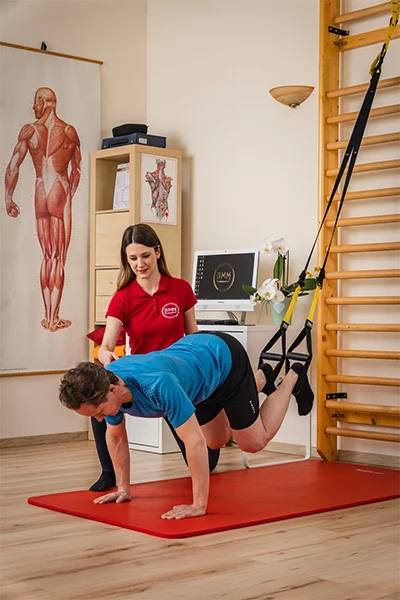
During functional training, we train muscle chains, not isolated muscles. We place great emphasis on strengthening the core and stabilizing muscles, mastering correct breathing techniques, and strengthening individual regions in corrected joint positions. We always start from the basics, and progression to the next level is only possible with correctly executed exercises.
Our goal is to strengthen the deep stabilizing muscles of the trunk in various body positions. Initially, tasks are performed with stable support, followed by increased difficulty using unstable equipment: FIT BALL, Multi Roll, DiscoSport, dynair cushion, soft ball. We progress from supine positions to functional body positions.
Functional Exercise
Functional exercise is currently one of the most accepted methods in sports rehabilitation. Similar to functional training, we train muscle chains, not isolated muscles. Quoting Michael Boyle, the famous strength coach, it is best described as sport-independent rather than sport-specific. One characteristic of this approach is that it seeks commonalities in sports rather than uniqueness. According to sport-independent thinking, sports are more similar than different.
The goal of the training sessions is to increase performance and reduce the chance of injuries. Athletes learn movement patterns and fundamental human movements in the beginning. Precise execution and correct practice of the exercises are extremely important. Once the pattern is correctly established, and only then, can weights such as kettlebells, dumbbells, and barbells be used. An incorrectly learned movement is much harder to correct than to learn without error.
What movement patterns do we work with?
We work with 7 basic movement patterns (there may be variations in the literature):
- Vertical push
- Horizontal push
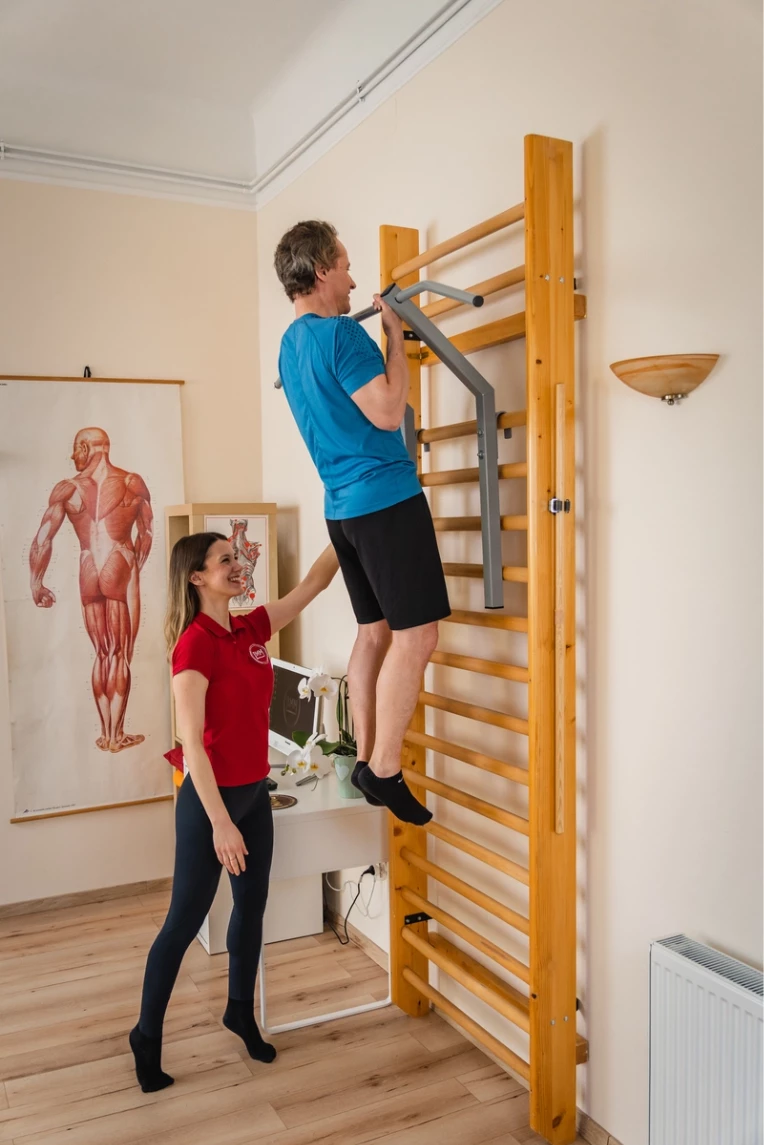
- Vertical pull
- Horizontal pull
- Hip-dominant exercises – deadlift
- Knee-dominant exercises – squat
- Core strengthening exercises
The listed items represent exercise categories, with numerous exercises within each category. During the training sessions, our goal is the balanced development of athletic abilities: strength, endurance, explosiveness, speed, balance, proprioception, rhythm. Explosive / plyometric exercises do not form a separate movement pattern, so we consider them as the final progression of individual movement categories.
Professional Sports Rehabilitation
We pay special attention to joint mobility and muscle relaxation and stretching. Our patients learn the complete practice material for foam rolling, self-therapy for trigger points, and numerous mobilization and stretching exercises.
Equipment used during training sessions: kettlebell, TRX, dumbbell, barbell, pull-up bar, dip station, plyometric equipment. Sports rehabilitation treatments are conducted under specialist medical guidance, always keeping in mind the load-bearing capacity of the injured region.
We warmly welcome sports physiotherapy sessions for patients who wish to live healthier and more consciously but are not drawn to the world of gyms. Our physiotherapist and sports rehabilitation trainer will help you achieve your goals; please contact us with confidence!
Who is sports rehabilitation for?
Patients who have suffered sports injuries. From the initial rehabilitation phase until their return to sport.
Those who want to live and move more consciously – but do not want to do so in gyms.
Those who want to improve their athletic performance.
Sports Rehabilitation –
What are its components?
- Barvichenko Manual Therapy
- Mulligan Manual Therapy
- Fascia Release Manual Therapy
- FDM
- Dynamic Soft Tissue Manual Therapy
- Scar Treatment
- Trigger Point Therapy
- Fascia blade treatment
- Instrumental Manual Therapy
- Shockwave Therapy
- Ultrasound, Laser
- TENS
- Selective Stimulating Current
- Galvanic Current
- Hypervolt Treatment
- Iontophoresis
- TAPE Application
- Cupping
- Flossing
- Myofascial Release
Why is sports rehabilitation beneficial?
- For the rehabilitation of sports injuries
- For functional training, strengthening core and stabilizing muscles
- To increase athletic performance
- Our supplementary treatments improve your health

Book an appointment by phone

Online Appointment Booking