Traumatic Surgical Care for Ankle Injuries
- Have you just started exploring treatment options, or perhaps your general practitioner referred you here? You've come to the right place! With our help, you will receive comprehensive information about non-surgical and surgical solutions for ankle injuries.
Ankle Injuries
Ankle injury is one of the most common traumatological conditions. If your foot twists after a wrong step, jump, or fall, and the ankle joint turns outwards or inwards, it can lead to ligament rupture or even an ankle fracture. Professional traumatic surgical care is essential for quick and complete recovery, as untreated injuries can result in permanent damage to the joint, the surrounding ligament system, and the articular surfaces.
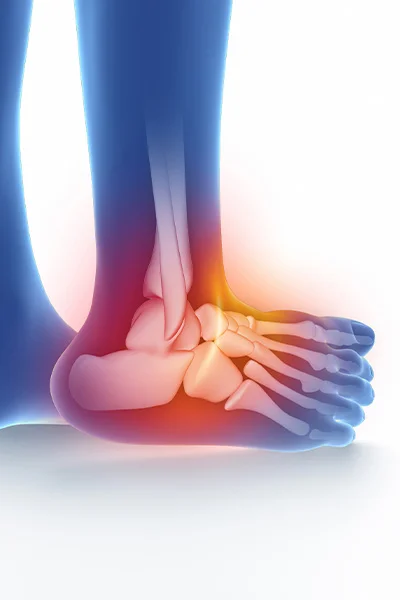
Anatomy of the Ankle Joint
The ankle joint is formed by 3 bones:
- The lateral malleolus: the distal end of the fibula
- The medial malleolus: the distal end of the tibia
- The talus
The bones are tightly connected by ligaments, which ensure the stability of the joint. In addition to the ligament system of the lateral and medial malleoli, the tibia and fibula are also joined by a strong ligament system (syndesmosis).
The healthy articular surfaces are covered by hyaline cartilage, which slides easily over each other. Lubrication is provided by the synovial fluid, which also nourishes the articular cartilage.
If the ankle joint is unstable, it can accelerate the process of joint degeneration.
Most Common Causes and Types of Ankle Injuries
Causes of Ankle Injuries
- Injuries following a wrong step
- Injuries following the foot getting stuck or slipping
- Injuries following a fall
- Twisting or entrapment injuries following a car accident
Types of Ankle Injuries
Ligament ruptures
The ligament system around the ankle ruptures and cannot perform its function.
Significant edema, swelling, and hematoma may develop around the patient's ankle, making the patient's gait difficult and unstable.
Sprains
The ligament system around the ankle stretches or strains. In such cases, the ligament system does not completely rupture, but it can become painfully swollen.
Fractures
A fracture, either non-displaced (fissure) or displaced, occurs in one of the bones forming the ankle joint. The affected joint swells and becomes painful.
- The affected joint swells and becomes painful.
- Moderate or significant deformity is visible around the ankle.
- Smaller or larger blisters often appear on the skin.
- Walking becomes difficult, or the patient becomes unable to walk.
Examination following the injury
Following an ankle injury, the physician examines the patient's healthy, uninjured limb first, then the injured one, while the patient lies on the examination table with the knee bent. This examination extends beyond the painful areas to include the lower leg and foot.
Following the physical examination, the physician may request an X-ray examination and/or ultrasound examination as deemed necessary. The X-ray examination typically involves three views of the ankle, supplemented by X-rays of the lower leg and foot if required. We also examine the soft tissues and ligaments with ultrasound.
If there is an intra-articular injury of the talus, a CT scan is usually performed. If the possibility of articular cartilage damage arises, an MRI scan helps to establish a more accurate diagnosis.
Treatment Options Following Examination
Following the imaging examination, the physician evaluates the results and explains to the patient any abnormalities or injuries found.
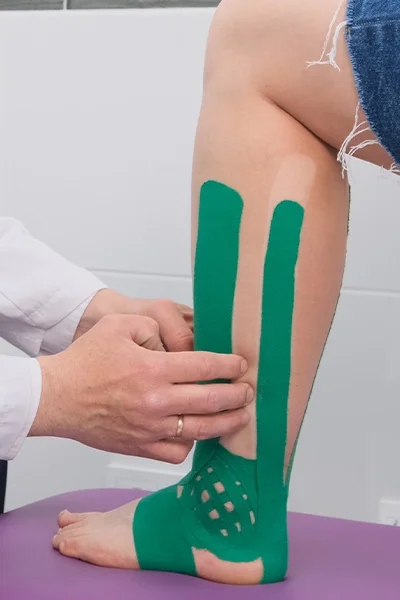
In case of a sprain, if the ankle joint is stable and no significant bleeding is observed, an elastic bandage is applied. With rest and elevation of the limb, icing, and topically applied creams to reduce bleeding, the ankle injury heals quickly.
In cases of ligament ruptures and joint capsule ruptures, an orthosis, or brace, is applied. With an orthosis, up-and-down movement of the ankle is possible, but the brace prevents sideways and twisting movements. Wearing this for 5 weeks leads to healing of the ankle injury in the vast majority of cases. The rare cases where the ankle remains unstable can be treated later with ligament reconstruction.
In case of a fracture, surgical treatment is usually the solution. During surgical treatment, the fractured ends are brought together and fixed with metal implants (usually screws and plates). The goal of the surgery is to restore anatomical structures and achieve a movement-stable position, thus in most cases, plaster immobilization is not necessary.
In cases of non-displaced fractures, or if the patient has many other internal medical comorbidities, and the fractured ends are in an acceptable position in the cast applied after the fracture, conservative treatment, usually plaster immobilization, may be attempted. This initially involves a non-weight-bearing cast, followed by a walking cast after some time.
BMM physicians treating ankle injuries

Dr. György Kocsis PhD
Orthopedic-Traumatologist, Chief Hand Surgeon, University Assistant Professor, Wrist, Elbow, and Shoulder Surgeon, Upper Extremity Specialist

Dr. János Bartha
Chief Orthopedic-Traumatologist, Robotic Surgeon
If you have any further questions about ankle injuries, please feel free to write to us!

Book an appointment by phone

Online Appointment Booking