Anterior Cruciate Ligament Reconstruction

Dr. Péter Doszkocs
Orthopedic-Traumatologist Chief Physician, Hip and Knee Surgeon, Lower Limb Specialist, Robotic Surgeon
Online appointment booking:
Budafoki Road Clinic: Thursday
Bokor Street Clinic: Other days of the week
Please select the service that suits you
The follow-up fee is valid for 3 months after the initial examination for the same complaint.
- 1. Select the requested service from the drop-down menu!
- 2. Use the calendar to choose a suitable appointment time!
- 3. Register by entering your details, or log in with your previous registration!
- 4. If you wish to book on behalf of another person (e.g., your child), please indicate this in the designated field!
- 5. Briefly describe your complaints!
- 6. Select the type of consultation: initial examination, follow-up examination, or prescription.
- 7. Click the button to complete the appointment booking. Thank you for choosing BMM!
If you are unable to attend your scheduled appointment, please notify us of your cancellation at least 24 hours in advance. This allows other patients the opportunity to receive timely medical care. Thank you for your cooperation and understanding!
Cancellation: +36 1 44 33 433
If you cannot find an available appointment for your selected week, please call our call center at +36 1 44 33 433 for further assistance! Our staff will be happy to help you schedule an appointment with your chosen physician or another specialist according to your complaint.
The History of Anterior Cruciate Ligament Reconstruction
The anterior cruciate ligament is one of the four main ligaments of the knee. Its role is to prevent abnormal forward movement of the lower leg relative to the thigh bone.
In case of rupture, the ligament is unable to heal spontaneously, but its function can be restored through ligament reconstruction. With the development of non-invasive examination methods, the predictability of surgery has also greatly improved, and high-resolution, detailed MRI scans are of undeniable importance:
- In identifying concomitant injuries
- In the diagnostics of fractures—not visible on conventional X-rays—without displacement
- In the precise identification of the cartilage covering the joint surface
The advancement of surgical techniques and precise postoperative functional examinations have proven that beyond the choice of graft (a new anterior cruciate ligament formed from a hamstring tendon), its anatomical placement at the origin and insertion points is crucial. Since the 1990s, anterior cruciate ligament reconstruction has been performed in increasing numbers worldwide. Initially, the patellar tendon-bone block – BTB (bone tendon bone) – graft, and nowadays, reconstruction with so-called Hamstring tendons, has become the leading surgical intervention.
Beyond graft selection, the significant differences between surgeries lie in the fixation techniques. The great advantage of the transfixation femoral – i.e., through the thigh bone – fixation technique is the fixation close to the opening of the femoral tunnel, which reduces the movement of the new cruciate ligament within the tunnel, thereby reducing the development of postoperative graft failure due to tunnel widening. Using targeting through the anteromedial portal, the femoral tunnel can be placed at the anatomical origin point. Basic research confirms that the forces acting on grafts placed at the anatomical origin point are similar to those on the original cruciate ligament.
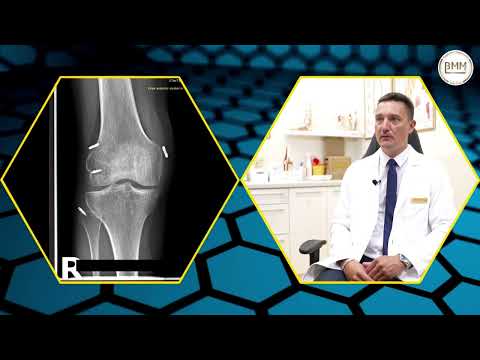
Anatomy of the Anterior Cruciate Ligament
The anterior cruciate ligament – which averages 38 mm in length – originates from the central area of the tibial joint surface, runs backward and laterally, and attaches to the outer-lateral (lateral) aspect of the femoral condyle's inner surface. It consists of two bundles twisting around each other: an anteromedial bundle and a posterolateral bundle. The anteromedial bundle provides stability during flexion beyond 60 degrees, while the posterolateral bundle is responsible for extension and rotational stability. Its blood supply comes from the genicular artery, and its innervation from the tibial nerve. Due to its good blood supply, a significant intra-articular hematoma develops upon rupture.
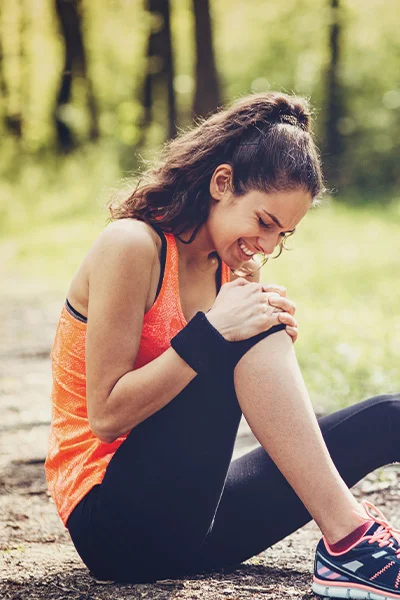
Most common causes of injuries
Anterior cruciate ligament rupture can be caused by:
- Forceful outward rotation, flexion, and lateral displacement of the knee
- Forceful inward rotation, extension, and medial displacement of the knee
- Hyperextension or hyperflexion of the knee
Approximately 70% of anterior cruciate ligament ruptures occur during sports activities:
- Patients most often suffer anterior cruciate ligament ruptures during skiing, basketball, handball, and football.
- The 15-45 age group is most frequently affected. In this age group, the annual incidence rate is 1:1750, which can be considered a very common injury.
- 70% of anterior cruciate ligament ruptures occur through non-contact mechanisms, while the remaining 30% occur during direct contact sports.
- Women suffer anterior cruciate ligament ruptures more frequently than men.
The Procedure of Anterior Cruciate Ligament Surgery
During the surgery, a small longitudinal or oblique skin incision is made on the inner side of the affected knee joint, above the tibia, and two 20-25 cm hamstring tendon pieces are removed.
Subsequently, small incisions are made above the knee joint, through which a tube camera is inserted into the knee joint, along with instruments that allow us to work inside the knee.
We thoroughly examine the knee joint and address any concomitant injuries that may be present.
Then, tunnels are drilled at the anatomical origin and insertion points on the tibia and femur, into which the new anterior cruciate ligament formed from the hamstring tendon is pulled into place and secured with absorbable pins and a screw.
After flushing the knee joint, a drain is left behind, through which accumulated blood in the knee can drain in the postoperative period. This is removed on the first day after surgery.
Suitability for Surgery
During the examination, your treating physician will:
- Inquire about and record your medical history related to the condition.
- Examine the range of motion of both your knee joints.
- Review the X-ray, CT, or MRI scans you have brought. If necessary, additional imaging tests may be requested.
- Draw your attention to the importance of physiotherapy, which is essential after surgery for complete recovery.
The physician's task is to provide you with comprehensive information, and you will make the decision about the surgery based on the information received. The surgical decision can be significantly influenced by:
- Previously applied but ineffective conservative treatment
- Constant, chronic pain, and
- The feeling of instability.
BMM’s Anterior Cruciate Ligament Reconstruction Surgeons
Dr. Péter Doszkocs
Orthopedic-Traumatologist Chief Physician, Hip and Knee Surgeon, Lower Limb Specialist, Robotic Surgeon
Dr. Péter Doszkocs
My motto: diligence, precision, patient-centered care!
Following family traditions, Dr. Péter Doszkocs developed his manual skills at a technical high school in Szeged, then earned his medical degree from the University of Szeged in 2004. The combination of orthopedics and traumatology is an ideal profession for him, which he practices as both a vocation and a passion.
He gained 12 years of experience in Germany treating accident victims, with a particular focus on hip and knee prostheses. He specialized in Karlsruhe, worked with robotic surgery and navigation techniques for five years, then led the orthopedic department of the Freudenstadt clinic as chief physician. In 2022, he returned to Hungary and continued his work at the Traumatology Clinic of the University of Szeged, where he specialized primarily in the treatment of knee ligament and cartilage injuries.
His work emphasizes detailed diagnostics and collaborative therapy planning with the patient, ensuring the patient fully understands their condition and the recommended intervention. He performs hip replacement surgery using minimally invasive "bikini incision" techniques, preserving gluteal muscle integrity. With modern computer-aided planning and robot-assisted surgeries, he strives for the highest precision.
His services include total and partial knee prosthesis implantation, axis correction, cartilage transplantation, cruciate ligament plasty, arthroscopic interventions, and joint-protective injection treatments (e.g., hyaluronic acid), aiming for rapid rehabilitation and lasting improvement in quality of life.
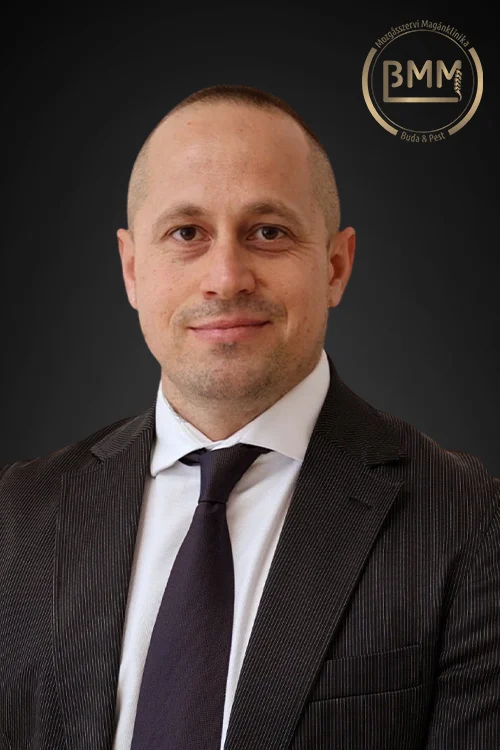
Dr. János Bartha
Chief Orthopedic-Traumatologist, Robotic Surgeon
Dr. János Bartha
A physician should treat their patients as they would treat themselves as a patient, or their beloved parents or children. This encompasses everything from humanity to precise treatment.
My conviction is that healing is not just about the body, but about understanding the whole person. In my work, I strive to achieve genuine, functional recovery for every patient through precise diagnosis and personalized treatment – together.
My curious nature has driven me forward since childhood: even as a child, I questioned stories if I didn't understand something. The questions "why?" and "how?" have always fascinated me, and this strong inner drive – coupled with my perseverance – continuously deepened my thirst for knowledge. At the age of sixteen, I decided to dedicate this interest, my creativity, and the inner strength within me to healing patients.
I completed my medical studies at the University of Medicine and Pharmacy of Târgu Mureș, where I felt early on that orthopedics and traumatology were my path. This specialty combines continuous creative thinking with good manual dexterity, precision, spatial vision, and quick, decisive decision-making – all in a dynamic environment full of challenging situations where I have always found myself.
I worked in Germany for 13 years, where I performed interventions at a high professional level in both orthopedics and traumatology. In 2018, I obtained my specialist qualification, and then in 2019, I was appointed chief physician. Of this, I spent 11 years in the same hospital, 6 years in a chief physician position.
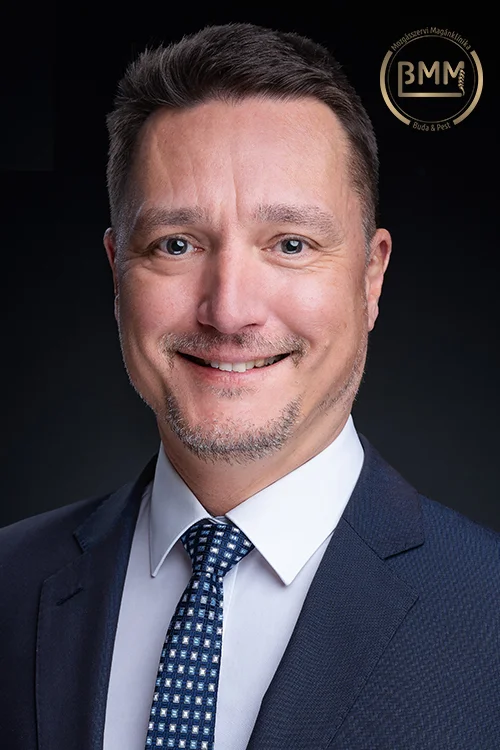
Dr. Szabolcs Gáspár
Orthopedic-traumatologist, head physician, robotic surgeon
Dr. Szabolcs Gáspár
Orthopedic-Traumatologist, Head Physician of BMM Department
He primarily deals with hip and knee joint problems, prosthesis surgeries, and treats patients who have suffered musculoskeletal accidents. In addition, he is a professional soldier and university lecturer, and regularly attends national and international conferences for knowledge and experience exchange. His love for the medical profession dates back to his childhood.
"Even in kindergarten, I wanted to be an accident surgeon, my grandmother told me that. For a while, I gave up on it during my medical studies because it seemed like the hardest part, and I thought I'd rather be an orthopedic surgeon. Eventually, fate had it that I became both, and I don't regret it. These two branches of the medical profession fit together very well. I love to operate, and there's nothing better than doing what you love."
For him, teaching is also an important part of his medical career. "I really enjoy teaching; I see the future in training the next generation so there will always be someone to heal. We need to show medical students how to provide good, professional, and interesting care." Dr. Szabolcs Gáspár implements this in practice based on the following principles:
"The patient is always right; you need to ask them to explain exactly what hurts, what their complaints are. This helps us in making a diagnosis." In his opinion, it is also very important to explain to the patient exactly what their illness is, why it might have developed, and how it will be treated. "I often find that patients come to the clinic with a ready-made diagnosis, having already undergone several successful examinations, yet they don't understand what's wrong with them. Here, however, there is time for all of this. A patient who understands their problem heals faster and more easily."
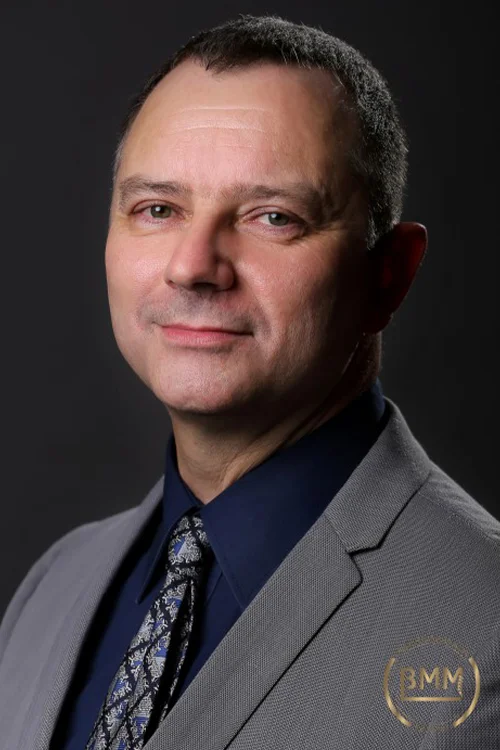
Dr. Péter Molnár
Orthopedic-Traumatologist, Chief Operating Surgeon, Robotic Surgeon
Dr. Péter Molnár
He is equally at home in accident surgery, which requires immediate assistance, and in the longer-term, planned orthopedic field.
His early connection to orthopedics dates back to his university years when he first encountered the specialty as a patient. Later, even stronger ties bound him to it. "The human skeletal system, orthopedics, is based on physics and statics, which I loved very much," explains Dr. Péter Molnár. "In my youth, I even considered becoming an engineer, but then, probably following my father's example, I decided on a medical career. When I experienced the hospital atmosphere in practice, I liked it even more. During high school summers, I worked as a surgical assistant in the hospital where my father practiced. That's when it became certain that I wanted to work in a practical field, in surgery."
At the beginning of his career, he also worked with children at the Miskolc Hospital. His attraction to pediatrics remained later on. "The little ones are always very grateful and kind. Many of them can't even speak yet, but they smile when I examine them. They provide true rejuvenation."
His credo is that if a doctor performs their work humanely, honestly, and conscientiously, the patient will feel that they mean well and will trust them and their knowledge. "It is important to explain to the patient what is wrong with them. We must convey the part of our knowledge related to their illness in a way that they understand. Finding common ground is the first step on the path to recovery."
When his busy clinic and on-call schedule allows, he enjoys swimming and cycling, providing a little relaxation from everyday life. However, as Dr. Péter Molnár put it, "for many doctors, their hobby is also being a doctor. This profession can only be done out of love. This clinic is a good, pleasant place; I feel good here, which is why I come here to consult. I hope patients feel at least as good here."
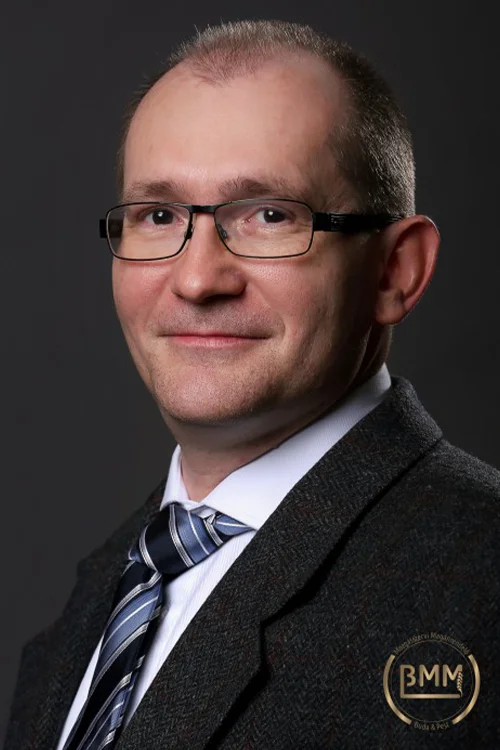
Dr. Zoltán Bejek PhD
Orthopedic Associate Professor, Robotic Surgeon
Dr. Zoltán Bejek PhD
I grew up in a truly cohesive family, where the most important things I learned were the power of love and mutual respect. While my mother taught me the value of selfless love, thanks to my mechanical engineer father, I grew to love mechanics. From an early age, I was interested in how things work. In elementary school, I decided I wanted to be a doctor, so I consciously prepared for it quite early.
My family spent 3 years in a completely different part of the world, Cuba. Here I learned how diverse people can be, and that there are places in the world where cohesion is an important tool for daily survival. I began my medical studies at a university there, which I completed in Budapest.
My love for mechanics directed me towards a field where mechanics/biomechanics plays an important role. For me, this was orthopedics. From my fourth year, I conducted scientific work at the University's Orthopedic Clinic, where I have been working since 1997.
From the beginning, I worked in departments whose main profile was endoprosthetics, so I gradually learned its intricacies, and currently, I lead our institute's endoprosthetics department. In addition, I have worked in spinal surgery and foot surgery departments.
My specialties include large joint prosthetics, revision surgeries, as well as arthroscopic surgeries, ligament plasty, and foot surgeries.
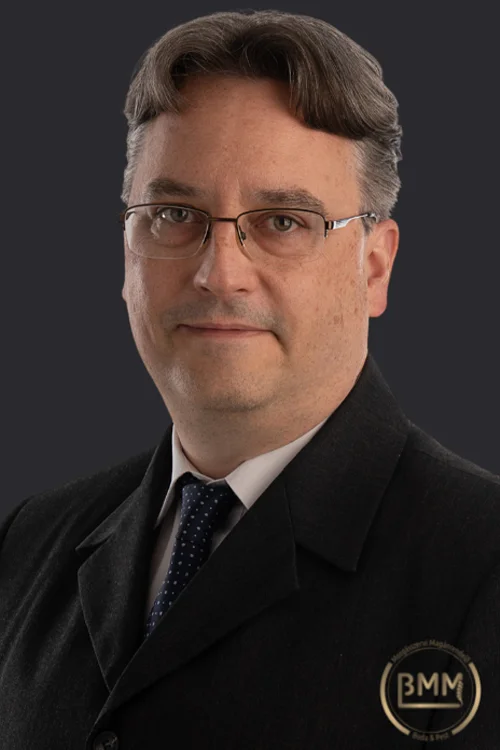
Dr. Gergely Holnapy, PhD
Chief Orthopedic-Traumatology Physician, University Adjunct, Robotic Surgeon
Dr. Gergely Holnapy, PhD
"I strive to approach patients with maximum knowledge and maximum courtesy."
Although he also deals with adult orthopedics, he primarily sees child patients at this clinic. According to him, many children are brought for examination where parents are uncertain about assessing a developmental change. They want professional orthopedic confirmation that this is normal or abnormal growth or change. Fortunately, these changes more often proceed in a normal direction than towards abnormality.
Dr. Gergely Holnapy was already oriented towards manual professions during university, and as a fourth-year student, he wrote a rector's application about a treatment method used in pediatric orthopedics. From there, a direct path led to today, filled with national, European, and non-European conferences and professional scholarships. "I attended Semmelweis University when doors opened that made it easier to travel, not just for tourism, but for professional reasons too. If one wants to explore and learn more in a certain direction, it is necessary to experience other treatment approaches and therapies to develop one's own method. That's why experiences gained abroad and at home were of extraordinary importance."
Outside of work, he enjoys cycling and skiing in winter for exercise. "Physical activity is part of my life, although in this fast-paced world, it's not easy to find time for relaxation. However, in the daily rush, caring for the patient becomes even more valuable," says Dr. Gergely Holnapy.

Book an appointment by phone

Online Appointment Booking