Dupuytren’s Contracture


What is Dupuytren’s contracture?
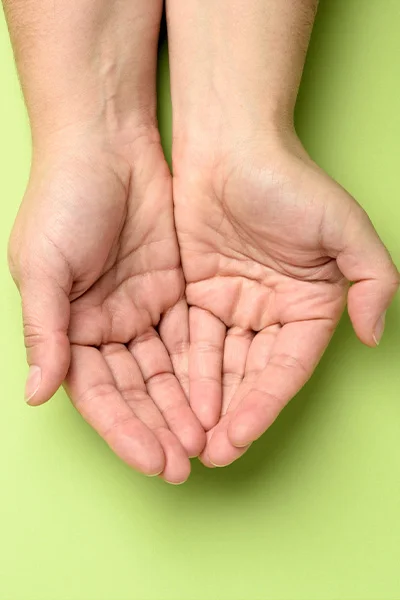
Dupuytren’s contracture is a condition in which the finger(s) of the hand curve inwards. The curvature is caused by thickening and shortening of the fibres that attach the skin of the palm to the strong connective membrane underneath. Since the fibres of the palm in question and the aponeurosis are connected to the tendons involved in flexing the fingers, the shortening also affects the position of the fingers. The lesion of the tendons is caused by an increase in the number of connective tissue cells that make up the tendons, producing large amounts of collagen. At first, knots or nodules form in the connective tissue membrane, which are arranged in the direction of the fingers. These nodules do not initially cause complaints, but may only cause pressure sensitivity when grasped. Later, the extension of the affected fingers is limited. In the final stage, the fingers become locked into a curled constraint, which means that the patient is unable to straighten his fingers. The contracture makes it difficult to carry out everyday activities such as driving, holding hands, playing sports and holding objects.
Examination by a specialist in hand surgery or orthopaedic traumatology
Therapy: hand surgery specialist, orthopaedic traumatologist, physiotherapist-physiotherapist
Reasons for its development
The course of the disease is progressive, worsening over time, unfortunately more rapidly in younger patients, but with spontaneous improvement in about 10% of patients. The cause of Dupuytren’s contracture is not fully understood at the current state of medical science, but hereditary predisposition plays a major role. In the early stages, cautious waiting with regular medical check-ups is allowed. If the function of the finger joints deteriorates further and the constraint worsens, surgery is indicated. From the third day after the operation, you can start exercising the unaffected joints, and slowly you can start active exercise of the affected joints. Permanent healing can be achieved with surgery.
Resolution of Dupuytren’s contracture with minimally invasive intervention
What can we do after the injectio treatment is no longer available?
To resolve Dupuytren’s contracture without surgery, we previously had an injection containing a ‘fibre-dissolving’ enzyme, Xiapex. Unfortunately, the company withdrew from the whole of Europe, making the product unavailable.
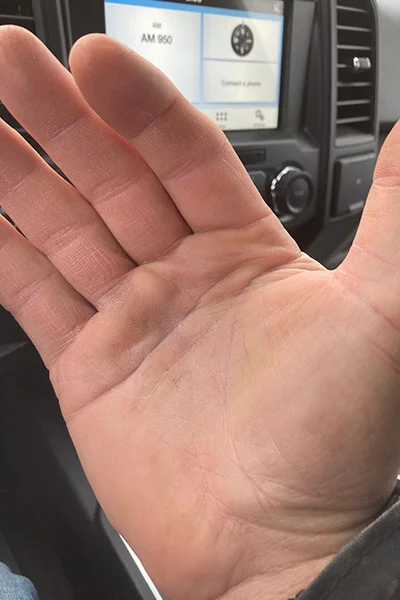
In addition to the extended surgery, there is a procedure under local anaesthesia for the treatment of palmar tuberosity, which can achieve similar results to the injections. During the procedure, an anaesthetic is applied to the skin of the palm and then a thick, strong needle is used to cut away the tight bundles, improving the range of motion of the fingers. After the intervention, as before after the injections, the scarred skin remains in the palm, but by cutting the bundles in the right place, the finger can be stretched. This so-called needle aponeurotomy is performed in an operating theatre as part of day surgery. The next day, we perform a dressing change, wound and function check. As only small puncture wounds are made on the hand, wound healing takes a few days and the hand is back in use very quickly.
The intervention can be performed as a stand-alone operation or, in the case of advanced disease, as a preparation for surgery to remove the entire lining.
Complications can include subcutaneous haematoma, tendon, blood vessel or nerve damage. The risk of these can be minimised with careful surgical technique.
Although needle aponeurotomy is not equivalent to Xiapex injectios, it may be a suitable alternative for those who want a quick movement intervention instead of an extended surgical treatment.
Our Hand Surgery Specialists

Dr. János Bartha
Chief Orthopedic-Traumatologist, Robotic Surgeon