Femoral neck fracture


-
What causes femoral neck fractures in older people and what causes them in younger people? What are the symptoms of the disease? What surgical solutions can be used to treat it? How long will the recovery take?With the help of the specialists at the Budapest Musculoskeletal Private Outpatient Clinic, we have gathered the most important facts about femoral neck fracture.
Causes of femoral neck fracture
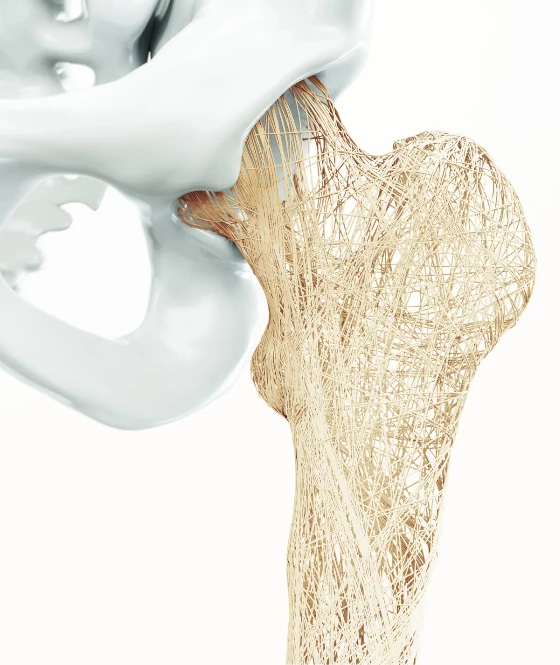
Femoral neck fracture is a very common injury, more common in older people than in younger people. The immediate cause is most often a fall that involves a blow to the hip area. Another factor contributing to the development of a femoral neck fracture is that bone density decreases with age, making the bones more fragile.
After the menopause, this process is more pronounced in women due to a decrease in oestrogen levels, which is why they are more likely to suffer from femoral neck fractures. A diet low in nutrients (such as calcium), sedentary lifestyle, certain digestive disorders and hormonal problems can also contribute to bone loss. And the risk of falling is increased by diseases that negatively affect the sense of balance (such as Parkinson’s disease and stroke).

Dr. Péter Doszkocs
Orthopedic-Traumatologist Chief Physician, Hip and Knee Surgeon, Lower Limb Specialist, Robotic Surgeon
Femoral neck fracture caused by osteoporosis
Osteoporosis also plays a major role in the development of femoral neck fractures. This is a very insidious disease, as it typically causes no pain and is very often left untreated.Osteoporosis is essentially a qualitative and quantitative deterioration or reduction in the organic and inorganic bone stock. It is more common in women, older people and people of thin build. Smoking, excessive alcohol consumption, a calcium-poor diet and a sedentary lifestyle are all risk factors for osteoporosis.
The bone mineral density test gives an accurate picture of the bone mineral mass. The aim of treating osteoporosis once it has developed is to prevent or slow down further bone loss, thereby reducing the risk of a femoral neck fracture. This can be achieved by a complex treatment, including taking calcium, vitamin D and other vitamins, and regular exercise. For the latter, it is advisable to consult a physiotherapist who will design and teach the patient an exercise programme of the right intensity and strength for him or her.
Age-related femoral neck fracture
This injury is more common in older people. It typically occurs when they fall and their hands do not reach their hips before they hit the ground. If an older person falls and has pain around the hip, an x-ray should be taken immediately, as a femoral neck fracture often requires surgery as soon as possible to avoid further complications.
Femoral neck fracture in juveniles
Femoral neck fractures can also occur in young people, although much less frequently than in older people. It typically occurs in car accidents, when the dashboard “hits” the driver, causing a very hard blow to the knee, and the axial load can cause a femoral neck fracture. In such accidents, it is not the femoral neck but the pelvis that is injured, with the femoral head “knocking out” the rear edge of the femur.
Symptoms of a femoral neck fracture
The symptoms of a femoral neck fracture are typical. The leg is twisted and shortened almost immediately after the fall. The patient is unable to lift or move the limb and develops a complete inability to walk, accompanied by severe hip pain. There is also swelling and bruising on the hip.
There is a much rarer form of this injury, called a wedged femoral neck fracture. In this type, there is no fracture of the femoral head relative to the femoral neck; instead, the femoral neck slides into the femoral head, allowing the patient to walk. This type does not have the typical symptoms, which is why if an elderly person falls and has hip pain, it is always advisable to have an X-ray, as a subsequent dislocation can cause serious complaints.
Types of femoral neck fracture
Femoral neck fractures can be dislocated (displaced) or non-displaced (not displaced). One type of displaced fracture is when the bone is only slightly displaced along the fracture, while the other type is when part of the bone is completely separated from the other part of the bone. Femoral neck fractures can be intra-articular and extra-articular.
Treatment of femoral neck fracture
The world has changed a lot in the treatment of femoral neck fractures. In the past, the two fractured bone ends were typically ‘put back together’ by screwing. After this type of surgery, it is important to relieve the weight on the limb. Today, this is more commonly used in younger patients and only when there is not much displacement of the femoral neck. It is important that the broken bone ends are put back into place and fixed as soon as possible to maintain blood circulation and the viability of the femoral head. The much more common solution today is hip replacement surgery, which provides complete pain relief, early full weight bearing and allows the patient to regain the use of the leg in its original function.
Surgical treatment of a femoral neck fracture
In older patients, a hip prosthesis is always implanted for a femoral neck fracture. A very good thing about this method is that there is no need to unload the limb after the implantation, and patients can get out of bed the next day. In younger patients, if the injury allows, they try to heal it with a screw fixation. If the fracture is severe, hip replacement surgery is also the solution for younger patients.
In terms of hip surgery and the surgical technique chosen, young people are typically considered to be under 60, but more recently the quality of bone mass has become more of a factor in determining who is young and who is old. A person aged 75-80 with very good bone structure can have a glueless prosthesis implanted. On the other hand, a 60-year-old patient may have such advanced osteoporosis that a cemented prosthesis is the only option.
Hip Prosthesis Implantation
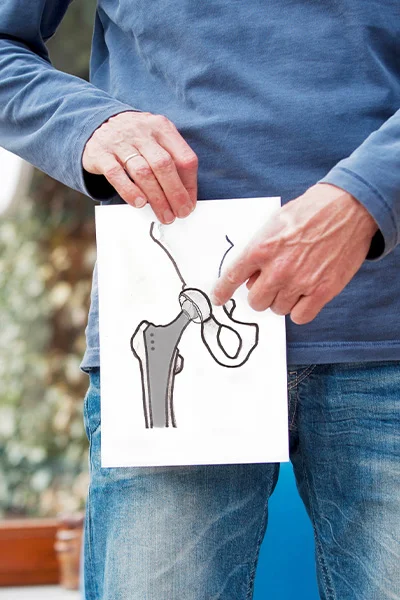
Younger patients are mainly implanted with cementless prostheses, while older patients are typically implanted with cemented prostheses. While cemented prostheses use a bonding agent between the prosthesis and the bone, cementless hip prostheses do not need this because the surface of the prosthesis has a special structure that the bone can grow onto.
When the implant is inserted, the patient’s femoral head is first removed and the cartilage is removed from the pelvic bone and scraped up. Then a hemispherical metal socket is implanted, into which a hardened plastic insert is inserted or a plastic socket is glued with bone cement. The metal stem of the prosthesis is then implanted into the femoral marrow cavity. The stem is then fitted with a metal or ceramic ball head, which moves in the plastic part of the socket, replacing the function of the original joint. Patients do not experience significant pain immediately after hip replacement surgery, thanks to an anaesthetic injection into the wound at the end of the operation. After the hip prosthesis implantation and rehabilitation period, patients who have suffered a femoral neck fracture can regain full use of the limb.
Partial prosthesis implantation
Pariprosthesis is usually performed in the oldest age group. The big advantage is that it is a very quick surgical technique. After removal of the fractured femoral neck and femoral head, a stem is glued into the femur, onto which a smaller head is inserted, and then a larger head is attached. The pelvic part of the hip joint is not touched so that the large head can move in the pelvic part and the small head in the large head. This solution is also called a bicontact prosthesis. It is a quick operation and immediately after the operation the limb can be loaded and the joint can regain its full function.
Revision hip prosthesis replacement surgery
Revision hip replacement surgery involves the replacement of a previously implanted hip prosthesis. This is usually necessary when the previous hip prosthesis has reached the end of its life. All implants for the hip joint are a foreign substance in the body that has no living properties, so like dental fillings, they loosen over time. This happens because, as the wear material of the prosthesis wears away, wear products accumulate around the joint and trigger a tissue reaction that results in the bone around the prosthesis being absorbed. With today’s modern implants, components may loosen after about 15-20 years, which may require replacement of the prosthesis, but there are also prostheses that have been in place for longer periods without complaints.
In Hungary, in patients under 70 years of age, cementless hip prosthesis replacement is more common, as it has the great advantage that if the implant needs to be replaced later in life (i.e. revision hip surgery), the hip replacement surgery can be performed with much less bone loss than cemented hip prosthesis replacement.
Femoral neck fracture rehabilitation
Physiotherapy following hip replacement surgery is an extremely important part of a quick and complete recovery. For young people, it is very important not to lose the good musculature and range of motion that they had. And for older patients, it is important to help them learn to move independently and safely again as soon as possible.
Femoral neck fracture – Physiotherapy exercises
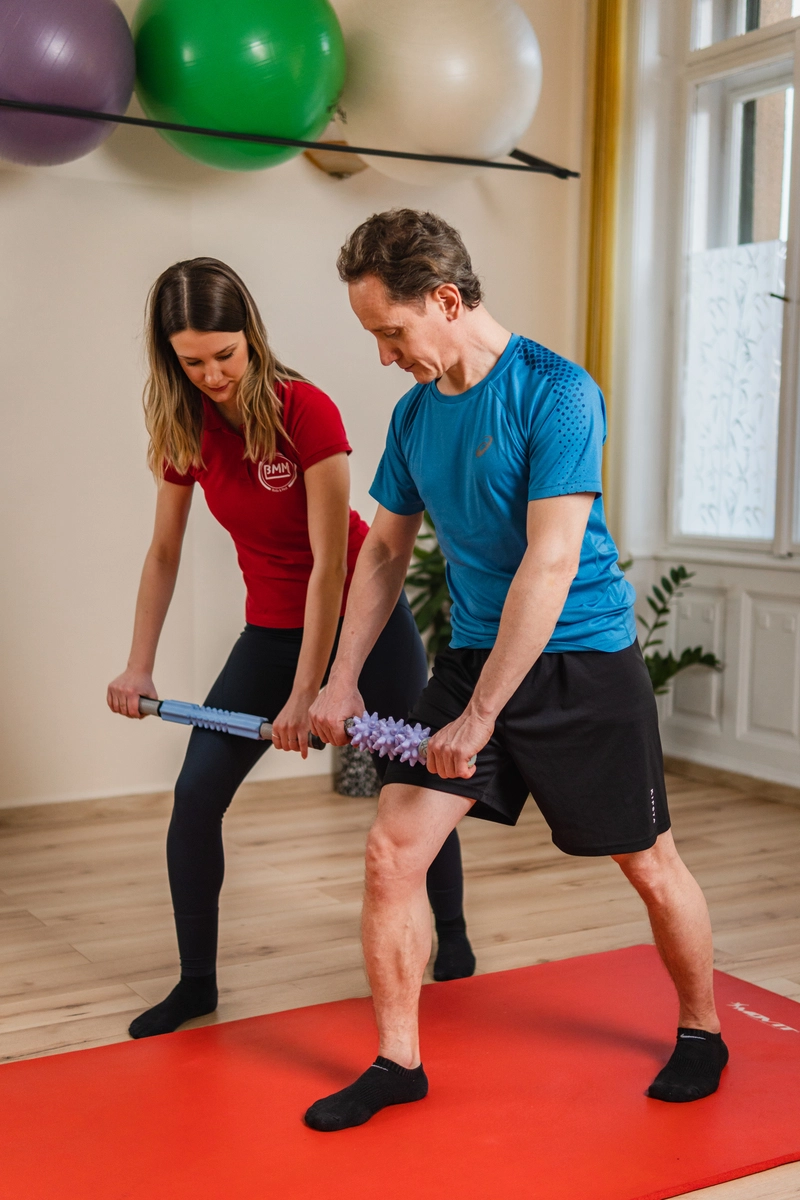
After surgery for a femoral neck fracture, physiotherapy plays a key role in recovery. The aim of physiotherapy is initially to restore range of motion and strengthen the hip muscles. Physiotherapy starts in the hospital and continues in the patient’s home.
It is important that a qualified physiotherapist sets up the exercise sequence, taking into account the doctor’s instructions (whether the limb can be fully or partially loaded or whether no weight can be placed on it), and the individual characteristics of the patient and the injury.
In the later stages of physiotherapy, the physiotherapist will teach exercises to help you perform the tasks you need to do in everyday life (e.g. sitting on a chair, sitting on the floor, standing up, lifting, getting on and off the bus, picking up shoes, etc.).
Femoral neck fracture – How long does it take to heal?
After glued prostheses are implanted, the patient can put his or her full weight on the limb after practically 1 day. Patients are given some kind of aid only to increase their stability and sense of security. After 6 weeks after hip prosthesis implantation, the patient can move without an assistive device and use the limb with full function.
After the implantation of glueless hip prostheses, patients have previously been subjected to partial weight-bearing. Nowadays, however, with advances in technology and implants and the use of so-called collar prosthesis stems, it is possible to apply a full body weight to these prostheses after surgery.
If the femoral neck fracture was treated with a screw-synthesis surgical technique, the limb must be completely unloaded after the intervention. The patient can touch the sole of the foot to the ground, but cannot put the weight of the body on it – doctors usually ask the patient to do this for up to 6 weeks with this surgical option.
Prevention of femoral neck fracture
To prevent femoral neck fractures, it is important to exercise regularly according to your ability and physical condition, and to eat a nutrient-rich diet, paying particular attention to calcium and vitamin D intake.
Women are recommended to have a bone density test after the menopause, and men over 70, to detect osteoporosis in its early stages. This can prevent deterioration through medication and lifestyle changes.
Part of preventing a femoral neck fracture is to minimise the chance of falls. This can be done by using movements that also improve your sense of balance. In addition, for older people or those who find it difficult to move, it is recommended to install handrails in the home and use anti-slip mats.
Our hip replacement doctors:

Dr. Zoltán Bejek PhD
Orthopedic Associate Professor, Robotic Surgeon

Dr. Szabolcs Gáspár
Orthopedic-traumatologist, head physician, robotic surgeon

Dr. Péter Molnár
Orthopedic-Traumatologist, Chief Operating Surgeon, Robotic Surgeon

Dr. Gergely Holnapy, PhD
Chief Orthopedic-Traumatology Physician, University Adjunct, Robotic Surgeon
Dr. Péter Doszkocs
Orthopedic-Traumatologist Chief Physician, Hip and Knee Surgeon, Lower Limb Specialist, Robotic Surgeon