Flossing technique
What is flossing technique?
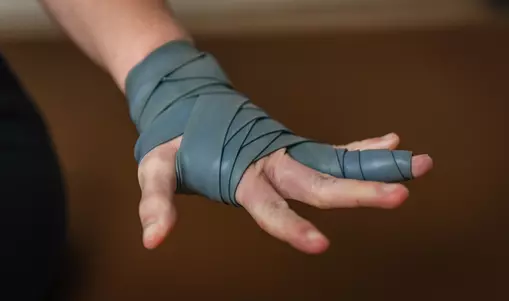
During the treatment, elastic rubber bands are wrapped around the injured, problematic area for a maximum of 2 minutes, and during this time, the affected region is moved. This is repeated a maximum of three times. With this technique, we affect the muscles, joints, and muscle fascia. The bands are available in different lengths and widths, and their color may vary depending on the manufacturer.
The band can be reused multiple times, washed with a neutral detergent in warm water, and has a long lifespan.
Effects of flossing therapy
- Pain relief
- Increased joint range of motion
- Reduction of swelling
- Release of muscle fascia adhesions
- Loosening of scars
- Faster regeneration
Extremely effective in rehabilitation following surgeries and injuries, as well as in the treatment of tennis elbow and heel spurs.

How does flossing therapy work?
1. Relieves pain
The band is applied with slight tension, meaning pressure is exerted on the tissues, thereby stimulating pressure-sensing receptors that can block pain-sensing receptors. This reduces the patient’s pain sensation during treatment, which is extremely important in cases of significant painful movement restriction following accidents!
2. Reduces swelling
A reduction in swelling can be noticeable after the treatment, but this is only temporary; a permanent edema-free state can only be achieved with continuous bandaging!
3. Sponge effect
The band is applied relatively quickly, allowing accumulated waste products to be removed rapidly. The band is then unwrapped quickly, allowing nutrient-rich fluid to flow in rapidly, thereby improving tissue nutrient supply.
4. Releasing adhesions
Movement performed during flossing treatment effectively helps to separate adhered tissues, thus releasing adhesions.
Our physiotherapists

Tímea Szentpétery
Physiotherapist

Krisztina Tatai
Physiotherapist

Sándor Dorottya Lilla
Physiotherapist

Rita Major
Physiotherapist

Book an appointment by phone

Online Appointment Booking