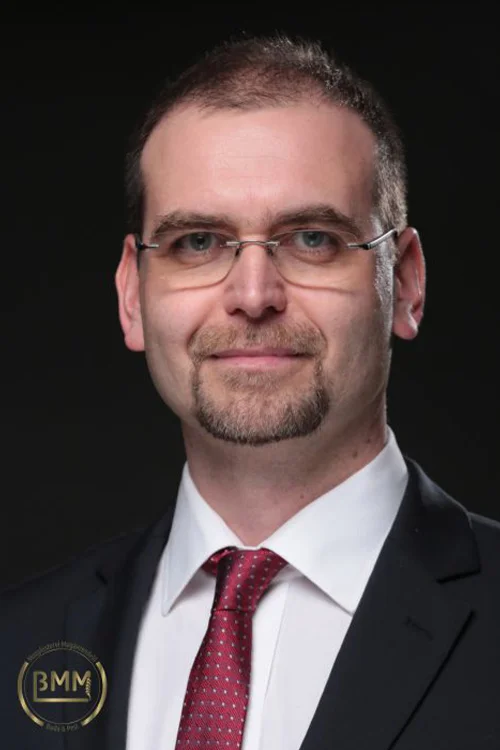
Dr. Bence Balázs Moravcsik
Orthopaedic-traumatology specialist
Dr. Bence Balázs Moravcsik
Orthopaedic-traumatology specialist
Speciality
Spine medicine specialist
Qualifications
Orthopedics-traumatology specialist
Budapest Private Orthopedic Clinic – Buda
Address 1111 BudapestBudafoki út 15.
tel +36 (1) 44 33 433
email bejelentkezes@bmm.hu
Ordering days
Thursday
Basic examination fee
55 000 Ft
The control fee
is HUF 45 000 for 3 months after the initial examination for the same complaint.
Telemedicine – Weekends only
20 000 Ft

Online appointment booking for Budafoki út clinic:
Please choose the service that suits you
The control fee is valid for 3 months after the initial examination, for the same complaint.
- 1. Select the service you want from the drop-down box.
- 2. Use the calendar to choose a date that suits you!
- 3. Enter your details to register or login with your previous registration.
- 4. If you would like to book on behalf of someone else (e.g. your child), please let us know at the place indicated.
- 5. Briefly describe your complaints!
- 6. Choose the type of consultation: initial examination, control examination or prescription.
- 7. Click on the button to book your appointment. Thank you for choosing BMM!
If you are unable to attend your scheduled appointment, please notify us of your cancellation at least 24 hours in advance.
This allows other patients the opportunity to receive timely medical care. Thank you for your cooperation and understanding!
Cancellation: +36 1 44 33 433
If you cannot find an available appointment for your selected week, please call our call center at +36 1 44 33 433 for further assistance! Our staff will be happy to help you schedule an appointment with your chosen physician or another specialist according to your complaint.
Patient Testimonials
About
I was particularly impressed by the amount of time that can be spent on patients and their recovery, a significant proportion of which can be spent on informing our patients.
A first-generation doctor who, even as a high school student, was committed to caring for people, to alleviating and eliminating their physical suffering. After graduating from high school, he began his medical studies at Semmelweis University, choosing a specialty at the age of six.
He has been in private orthopedics practice since 2009. His professionalism is reflected in the trust his patients place in him. His dynamism is reflected in his work and team building. He is the father of four children. He enjoys long-distance running, especially marathons, which require endurance. In addition to running alone, he occasionally plays basketball in his scarce free time as a team player.
AVAILABLE VOCATION
“In my last year at university, I realised that manual medicine was the best way to help patients heal. So I committed myself to surgery and a special branch of surgery, trauma surgery. The eight years I spent at the Accident Surgery Department of the Honvéd Hospital, during which I was able to dip my toes into all the trauma surgery underworld, are proof that I made the right decision.”
NOT BE A BARRIER TO MOVEMENT
“I was already attracted to orthopedics during my years in trauma surgery. The majority of accidents involve injuries to the bones, joints and cartilage of the hands, feet and spine, but we don’t have to be traumatised to have these parts of our bodies restricted by congenital anomalies, misuse or simply age. I was fascinated by the remedies for this, which is how I ended up specialising in orthopedics, which is concerned with preventing musculoskeletal disorders, treating existing problems and reducing the pain that almost always accompanies them, and in which I qualified in 2007.”
ABOUT THE CRAFT
“I am particularly interested in relieving spinal pain without surgery. I have acquired the necessary knowledge for the prevention and non-surgical treatment of spinal degenerative diseases and other degenerative diseases affecting the spine in a manual therapy course accredited by Semmelweis University, focusing on the non-surgical solution of spinal problems.”
SHIFT: FROM PUBLIC TO PRIVATE
“As I was sorely lacking the conditions to gain the trust of patients and the cooperation they needed to heal, I moved into the private sector. In 2008, I worked as an orthopedics specialist at Telki Hospital, and a year later I opened my own practice. This was the first time I was confronted with how much higher the expectations in private practice, both from myself and from patients, were than in the early 2000s.”
QUALITY DOCTOR-PATIENT RELATIONSHIP – THE IMPORTANCE OF TIME
“I was particularly impressed by the amount of time we can spend on patients and their recovery, a significant proportion of which is spent on informing our patients. We also have the opportunity to get to know them and, by talking to them, to explore the deeper, sometimes historical, causes of their problems. And what was once a dream has now become a reality: we can communicate with them and share information about their illness, tailored to their needs and individual expectations.”
FROM TOP TO BOTTOM, INSIDE AND OUT
“Everything in the human body is connected. And the psyche is not to be left out of the list. In other words, we take a complex approach to the patient’s problems in order to heal. This is what I call my own ars poetics, but it is also the OBJECTIVE of our practice. We take a holistic approach, which means that we look at illness in a causal context. Practice shows that not all symptoms are caused by musculoskeletal disorders, but may also have a psychological background, and treatment should be directed towards this. And if we do not find that Western medicine is sufficient to cure the patient, we do not hesitate to turn to other disciplines or to suggest alternative interventions. Our patient follow-up also fits into the overall picture. For the benefit of our patients and in order to broaden our own experience, we are always informed about the effectiveness of the treatment we use. If it doesn’t work, we decide on an alternative treatment after finding out the reason.”
PATIENCE AND EMPATHY
“The holistic approach mentioned above requires us to be patient and empathetic towards the patient. Since patients come to us primarily not for prevention but already in pain, they need both. Although one of the key tasks of the doctor is to reduce pain, the cause of pain is not always clear and known. Sometimes it can be immediately relieved by injections, sometimes it can be improved by adjusting the drug therapy, but in the case of syndromes with fixed pain, it is only after the causes have been identified that a curative treatment can be determined, which is not time-consuming but can be perceived as such. Identifying the problems and their causes, explaining the chances of recovery, and accepting the treatments that lead to results can only be done in cooperation with the patient, with a lot of patience and empathy. This is most often needed for patients with diseases that require a change of lifestyle in addition to therapy, for whom we also need to help with the transition. It is their own pain that encourages them to accept cooperation in their recovery. “
SUCCESS STATEMENT
“To achieve our goals, we need a sense of achievement. Our patients – together with us – provide that. Sometimes we even consider a quick and effective intervention a success, for example, when a businessman in severe pain can get on a plane the next day to attend a business meeting without pain, thanks to us. On other occasions, the pain in the patient’s leg due to spinal problems is a success for us, if not a quick, but lasting relief, and the patient’s satisfaction. In all cases, the patient’s best interests and recovery are paramount. But success is never achieved alone, only in partnership with the patient.”
INNOVATION
“We are a dynamic, young team building a community of practice, where it is very important to keep our dynamism and to continuously develop individual members and our collective knowledge in order to treat patients as effectively as possible. Our doctors, myself included, are at their most active professionally, with considerable professional experience behind them, and this includes an appetite for innovation, new methods and new tools. I could mention, for example, our in-office shock therapy treatments with a Swiss-developed device, or the use of the latest surgical techniques.”
TEAMWORK
“As we provide complex care for our patients, it is not enough for our doctors and nurses to excel individually, but teamwork within the practice is also important. We keep in close contact with the heads of therapy sessions, give each other feedback, hold joint meetings to share experiences and work closely with several co-specialists (rheumatology, neurosurgery, etc.).