Knee pain


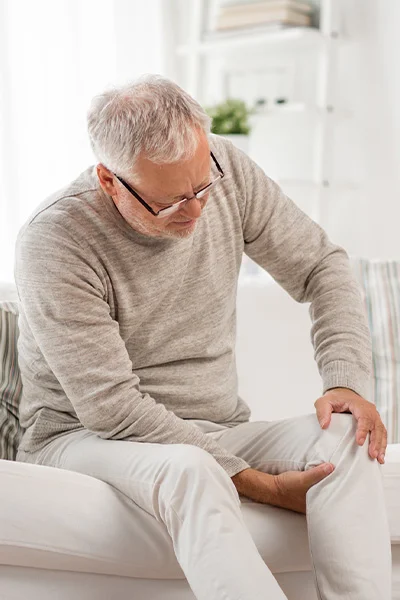
Causes of Knee Pain
In many cases, knee joint disease—joint inflammation affecting the knee—may be suspected. It is advisable to have these symptoms evaluated by a specialist as soon as possible. After performing a physical examination and any necessary diagnostics, the orthopedics specialist will develop an appropriate treatment plan.
It's important to take knee pain seriously and seek professional help instead of relying on home remedies.
It's a good idea to consult a specialist if:
- Someone is experiencing swelling, stiffness, or a stabbing pain in their knee
- He has difficulty bending and stretching his knees
- In the morning, after getting up, her knee hurts more
- Moving the knee produces a crunching sound
- Running, squatting, going up and down stairs, and even walking are difficult
- Knee pain makes it difficult to rest at night
In severe cases, the knee may even become immobile.
Causes of Knee Pain
There are many possible causes of knee pain, so an examinationby a specialist in orthopedics is essential for an accurate diagnosis and effective treatment. The most common cause of knee pain is joint inflammation of the knee joint. This joint inflammation, also known as osteoarthritis, usually develops as a result of repetitive strain, though other musculoskeletal conditions may also be the underlying cause. The painful symptoms may be caused by autoimmune rheumatoid arthritis, but gout, bursitis (inflammation of the bursa), or a previous injury may also be the underlying cause. In some cases, inflammation of the tendons may be the underlying cause of knee pain; in such cases, the muscles at the back of the thigh—which attach to the bones of the knee joint—become inflamed, causing swelling and pain in the knee area.

Dr. Péter Doszkocs
Orthopedic-Traumatologist Chief Physician, Hip and Knee Surgeon, Lower Limb Specialist, Robotic Surgeon
Online appointment booking:
Budafoki Road Clinic: Thursday
Bokor Street Clinic: Other days of the week
Please choose the service that suits you
The fee for a follow-up consultation is 25,000 Ft, valid for 3 months after the initial examination for the same complaint.
- 1. Select the service you want from the drop-down box.
- 2. Use the calendar to choose a date that suits you!
- 3. Enter your details to register or login with your previous registration.
- 4. If you would like to book on behalf of someone else (e.g. your child), please let us know at the place indicated.
- 5. Briefly describe your complaints!
- 6. Choose the type of consultation: initial examination, control examination or prescription.
- 7. Click on the button to book your appointment. Thank you for choosing BMM!
If you are not able to come to the appointment you have already booked, please let us know at least 24 hours in advance. This gives other patients the opportunity to get the medical care they need in time. Thank you for your cooperation and understanding!
Resignation: +36 1 44 33 433
If you can't find an appointment for the week of your choice , please call our call-centre on+36 1 44 33 433 for further assistance. Our staff will be happy to help you make an appointment with the doctor of your choice or another specialist according to your complaint.

Lifestyle Factors Underlying Knee Pain
Knee joint inflammation is a fairly common condition, but there is a lot we can do to prevent it. We can influence certain risk factors ourselves through our lifestyle choices.
The most common lifestyle factors that contribute to the development of knee pain:
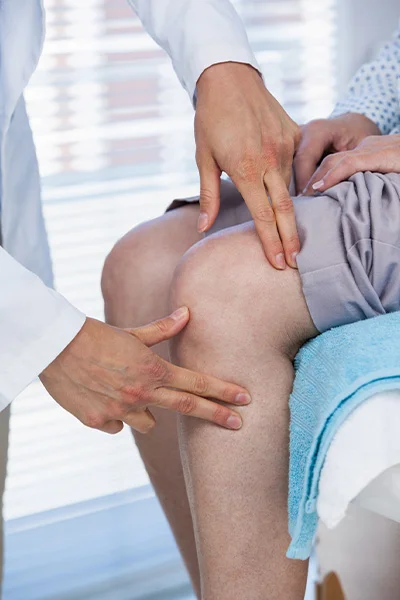
Obesity
Excess body weight places a significant strain on the joints, including the knees. According to some studies, even a 10 percent weight loss can alleviate the symptoms of joint inflammation.
Increased load
Certain forms of physical activity can put excessive strain on the knee joints. This is also true for certain types of physical work (such as jobs that involve kneeling) and for training in certain sports that is not performed properly. The latter includes any sport that involves jumping, running, or lifting heavy weights.
Muscle weakness
Just as excessive activity can worsen symptoms, so can a lack of exercise. Muscle weakness around the joints can worsen osteoarthritis pain, so engaging in low-intensity, muscle-strengthening exercises is particularly important for those affected (e.g., cycling, physiotherapy).
Insufficient fluid intake
Joint cartilage is mostly made up of water, so proper hydration is essential for the proper functioning of joints and muscles; therefore, it is important to pay close attention to your fluid intake.
Smoking
According to some studies, the joint inflammation that causes knee pain is associated with greater cartilage loss and more severe pain in people who smoke. One theory suggests that smoking inhibits the division of cells that make up cartilage tissue. Another possible explanation is that smoking increases the concentration of carbon monoxide in the blood flowing through the arteries, which impairs the oxygen supply to the cartilage and thereby hinders the repair of damaged cartilage.
Aging
As we age, our joints gradually wear out. Regular, appropriate exercise can slow down this process.
No
Women are generally affected by joint inflammation at a higher rate than men.
Family predisposition
If a parent has osteoarthritis, there is a greater chance that their child will also develop the condition.
Previous injuries
People who have had a knee injury in the past are at a higher risk of developing joint inflammation later on. For this reason alone, it is important to follow a proper, professional training regimen, including warm-ups and stretching.
Rheumatoid arthritis
In addition to osteoarthritis, another cause of knee pain can be rheumatoid arthritis, which is caused by inflammation resulting from a malfunction of the immune system. This is the second most common cause of knee pain. As the disease progresses, the immune system produces enzymes that break down the joint capsule, cartilage, soft tissues, and bones. The disease usually appears in adulthood and is more common in women.
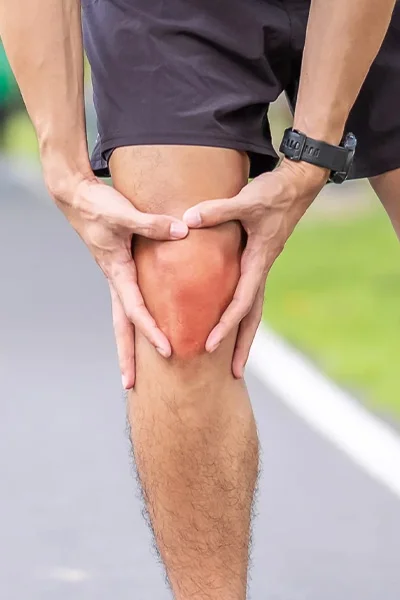
Inflammation of the knee joint's synovial membrane
Inflammation of the bursa in the knee joint—known medically as bursitis—can also be the cause of knee pain. Bursae—or fluid-filled sacs—cover bony prominences, cushioning and protecting them. When a bursa experiences inflammation, it fills with excess fluid. The inflammation can develop as a result of repeated minor trauma or even a single injury. A characteristic symptom is sudden knee pain that occurs in the joint and intensifies with movement.
Sports injuries
A common cause is knee pain resulting from various sports injuries, such as meniscus tears or runner’s knee. A meniscus tear usually occurs when the knee suddenly twists, rotates, or dislocates. The pain is localized to one or both sides of the knee and is severe. A meniscus injury is an acute injury characterized by a distinctive clicking sound and is often accompanied by ruptures in the cruciate and collateral ligaments.
Runner's knee is caused by improper and prolonged stress on the joint, leading to joint inflammation and cartilage degeneration in the knee joint. This degenerative condition is accompanied by inflammation and, therefore, swelling. The pain primarily occurs during physical activity and may later become chronic.
Psychological Causes of Knee Pain
Knee pain can have not only physical but also psychological causes. If knee pain cannot be diagnosed even after a specialist examination or imaging tests, it is worth considering whether a psychological factor might be underlying the pain. In such cases, it’s recommended to ask yourself a few questions about your self-awareness: Am I too stubborn? Do I cling too strongly to my point of view? Am I perhaps arrogant? Do I have a rigid, inflexible outlook on life?
The condition of the knee can indicate certain negative factors; by addressing these, you can achieve a significant improvement in your quality of life and even eliminate pain. One such factor is stiffness, which is typically indicated by difficulty bending the knee. Underestimating oneself can also cause knee pain and knee disorders. It’s worth reflecting on why this situation may have arisen: Do I have recurring conflicts? Am I afraid to do or take on something? Do I underestimate myself?
Physical symptoms caused by emotional problems should be taken very seriously. If physical examinations reveal no cause for the symptoms, it’s worth considering what changes might be needed in our lifestyle or our attitude toward life. In some cases, it may be helpful to seek professional assistance (from a psychologist or lifestyle counselor) to facilitate these changes.
The location of knee pain indicates the cause of the problem
If Your Knee Hurts on the Side – ITB Syndrome
A strong connective-tissue band (tractus iliotibialis) runs along the outer side of the thigh, into which the gluteus maximus muscle also inserts. The band extends along the thigh, then crosses the knee joint and attaches to the outer side of the tibia near the knee. As a result, with every knee flexion, the iliotibial band rubs against the slightly protruding bony prominence on the outer side of the femur (lateral epicondyle), which causes irritation and damage to the band. The problem is characterized by pain on the outer side of the knee, which often becomes more acute with movement and may occasionally be accompanied by swelling of the knee. Among the contributing factors, ligament shortening, an imbalance in the thigh muscles, muscle stiffness, and poor running technique are particularly significant.
If the Front of Your Knee Hurts – Patellofemoral Syndrome
The term refers to a problem with the joint between the patella and the thighbone (femur). In fact, the knee is not only where the tibia and femur connect, but there is also a true joint between the patella and the groove on the femur. If the patella is not in the correct position, it is subjected to much greater stress, which can lead to damage to the cartilage. Several factors can cause the patella to shift, but the most common cause is an imbalance in the muscles surrounding the knee. Due to the knee’s anatomical structure, several factors pull the patella toward the outer side, and the only force counteracting this is exerted by the lower, oblique fibers of the quadriceps femoris muscle, which, however, are prone to weakening. Consequently, a slight outward displacement of the patella (patellar lateralization) is very common, which significantly increases the risk of patellar injury.
The main symptom of this condition is pain in the front of the knee, behind the patella, which occurs mainly when the knee is bent forcefully: when walking down stairs , squatting, walking on uneven ground, and running.
A characteristic symptom is when prolonged sitting causes knee pain (“car-movie sign”); this is because the patella is forced deeply into the joint groove when the knee is bent, which can trigger the pain.
Risk factors therefore include an abnormal position of the patella (too far to the side, higher than normal, etc.), axial deformities affecting the knee (bowlegs), orthopedic abnormalities of the foot (e.g., flat foot), and excessive training.
If the lower part of the knee hurts – Inflammation of the patellar tendon
The quadriceps femoris muscle (musculus quadriceps femoris) passes over the patella and attaches to the tibia via the patellar tendon. When this extremely strong muscle contracts, the tension is transferred to the patellar tendon as well, and strenuous muscle activity can cause damage to the tendon.
In this case, the pain is felt on the front of the knee, below the patella, and can be triggered not only by running but also by jumping, squatting, and climbing stairs. Typical symptoms include tenderness in the tendon and a feeling of weakness in the thigh muscles at times during movement.
Factors that contribute to this condition include thigh extensor and flexor muscles that are too tight or too weak, insufficient warm-up, foot deformities (e.g., flat feet), lack of core stability, and excessive training.
If you notice any of the above symptoms, you should consult a specialist in orthopedics, who may order imaging tests (CT, X-ray, MRI, ultrasound), and following diagnostics of the symptoms, may recommend conservative treatment—such as physiotherapy or pain-relieving treatments like ultrasound therapy or soft laser therapy—or may suggest a surgical intervention. Until you see a specialist, it is advisable to relieve the pain with nonsteroidal anti-inflammatory creams and, in some cases, to take pain relievers.
Our Orthopedic Specialists

Dr. Zoltán Bejek PhD
Orthopedic Associate Professor, Robotic Surgeon

Dr. Szabolcs Gáspár
Orthopedic-traumatologist, head physician, robotic surgeon

Dr. Gergely Holnapy, PhD
Chief Orthopedic-Traumatology Physician, University Adjunct, Robotic Surgeon

Dr. Péter Molnár
Orthopedic-Traumatologist, Chief Operating Surgeon, Robotic Surgeon

Dr. János Bartha
Chief Orthopedic-Traumatologist, Robotic Surgeon
Dr. Péter Doszkocs
Orthopedic-Traumatologist Chief Physician, Hip and Knee Surgeon, Lower Limb Specialist, Robotic Surgeon

Dr. Dániel Kincses
Orthopedic-Traumatologist Specialist, Robotic Surgeon

Dr. Maysam Moghaddam Amin
Orthopedic-Traumatologist Specialist, Robotic Surgeon

Dr. Balázs Török
Assistant Professor of Orthopedics and Traumatology

Dr. Ferenc Tompai
Chief Orthopedic and Trauma Surgeon

Prof. Dr. Zsombor Lacza PhD
Chief Orthopedic-Traumatologist