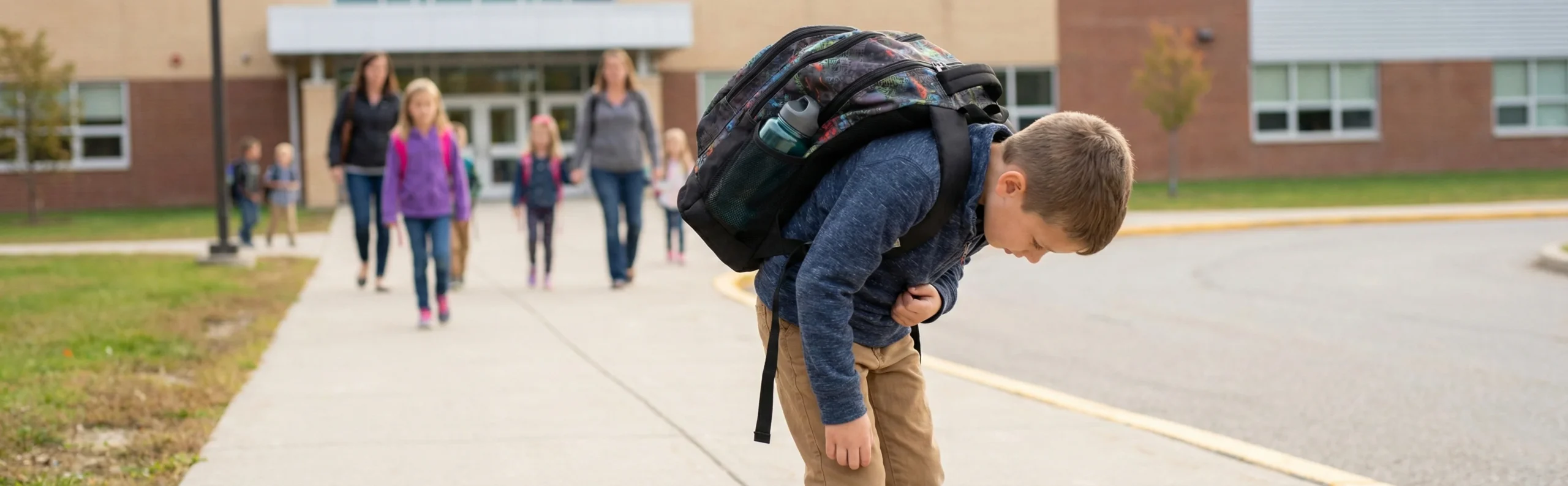
Back Problems Caused by School Bags in Childhood
Back Problems Caused by School Bags in Childhood
Author: Dr. Ákos Morvai | January 27, 2026


What Every Parent Should Know from a Pediatric Orthopedics Perspective
School backpacks are a daily part of children’s lives, so it’s no surprise that many parents worry that a backpack that’s too heavy or carried improperly could cause back pain, poor posture, or even childhood scoliosis. This topic often comes up during appointments in pediatric orthopedics, especially when a child complains of back pain or when an abnormality is detected during a school health screening.
In recent years, numerous large-scale international studies have examined the relationship between the weight of school backpacks, back pain, and scoliosis in children. The following summary provides an accessible, practical overview of these scientific findings from the perspective of pediatric orthopedics.
How common is it for school backpacks to be too heavy?
Studies show that a significant proportion of elementary school children carry school backpacks that are too heavy relative to their body weight. Numerous surveys have shown that in many cases, the weight of the backpack exceeds 10–15 percent of the child’s body weight, especially among smaller children.
This means that excessive backpack weight is not an isolated problem, but a common, systemic phenomenon. This is important in pediatric orthopedics because the developing musculoskeletal system may be more sensitive to prolonged, disproportionate strain, even if this does not in itself cause permanent structural changes.

Dr. Ákos Morvai
Chief Pediatric and Neuro-Orthopedic Physician
Online appointment booking for Budafoki út clinic:
Please choose the service that suits you
For pediatric orthopedic examinations, please register the appointment with the child’s name and details.
The control fee is valid for 3 months after the initial examination, for the same complaint.
- 1. Select the service you want from the drop-down box.
- 2. Use the calendar to choose a date that suits you!
- 3. Enter your details to register or login with your previous registration.
- 4. If you would like to book on behalf of someone else (e.g. your child), please let us know at the place indicated.
- 5. Briefly describe your complaints!
- 6. Choose the type of consultation: initial examination, control examination or prescription.
- 7. Click on the button to book your appointment. Thank you for choosing BMM!
If you are not able to come to the appointment you have already booked, please let us know at least 24 hours in advance. This gives other patients the opportunity to get the medical care they need in time. Thank you for your cooperation and understanding!
Resignation: +36 1 44 33 433
If you can’t find an appointment for the week of your choice , please call our call-centre on+36 1 44 33 433 for further assistance. Our staff will be happy to help you make an appointment with the doctor of your choice or another specialist according to your complaint.
Can a school backpack cause scoliosis in children?
Based on current scientific evidence, there is no proof that the weight, type, or manner of carrying a school bag directly causes childhood scoliosis, that is, idiopathic scoliosis. The development of childhood scoliosis is a complex process primarily driven by genetic and growth-related factors.
From a pediatric orthopedics perspective, it is important to emphasize that scoliosis is not “caused by a backpack.” At the same time, children with pre-existing scoliosis may be more susceptible to asymmetrical weight distribution. For them, it is particularly important to use a symmetrical backpack carried on both shoulders and to avoid excessive weight.
Is there a link between the weight of a school backpack and back pain?
Based on large-scale systematic reviews involving thousands of children, it has not been conclusively proven that a school backpack weighing more than 10 percent of a child’s body weight, on its own, causes more frequent lower back pain. At the same time, the back, neck, and shoulder pain reported by children is a genuine complaint that must be taken seriously in pediatric orthopedics.
Based on clinical experience and research, these symptoms often result from the combined effects of multiple factors. These may include prolonged carrying of heavy loads, lack of physical activity, weak core muscles, prolonged sitting and screen time, as well as improper bag-carrying habits. Together, these factors can increase the risk of musculoskeletal strain.
What can parents do to prevent this?
According to recommendations from pediatric orthopedics, the ideal weight of a school backpack should not exceed approximately 10 percent of the child’s body weight , if possible . For short periods and in exceptional circumstances, a load of 12–15 percent may still be considered acceptable; however, carrying a heavier load on a long-term basis is not recommended.
The correct way to carry a bag is also of paramount importance. It’s best to always carry the bag on both shoulders using properly padded shoulder straps, and it’s important that the bag doesn’t hang too low, as this can increase forward leaning and the strain on the spine. Packing habits also make a big difference: it’s best to carry only the gear you need for that day and to regularly review the contents of your bag.
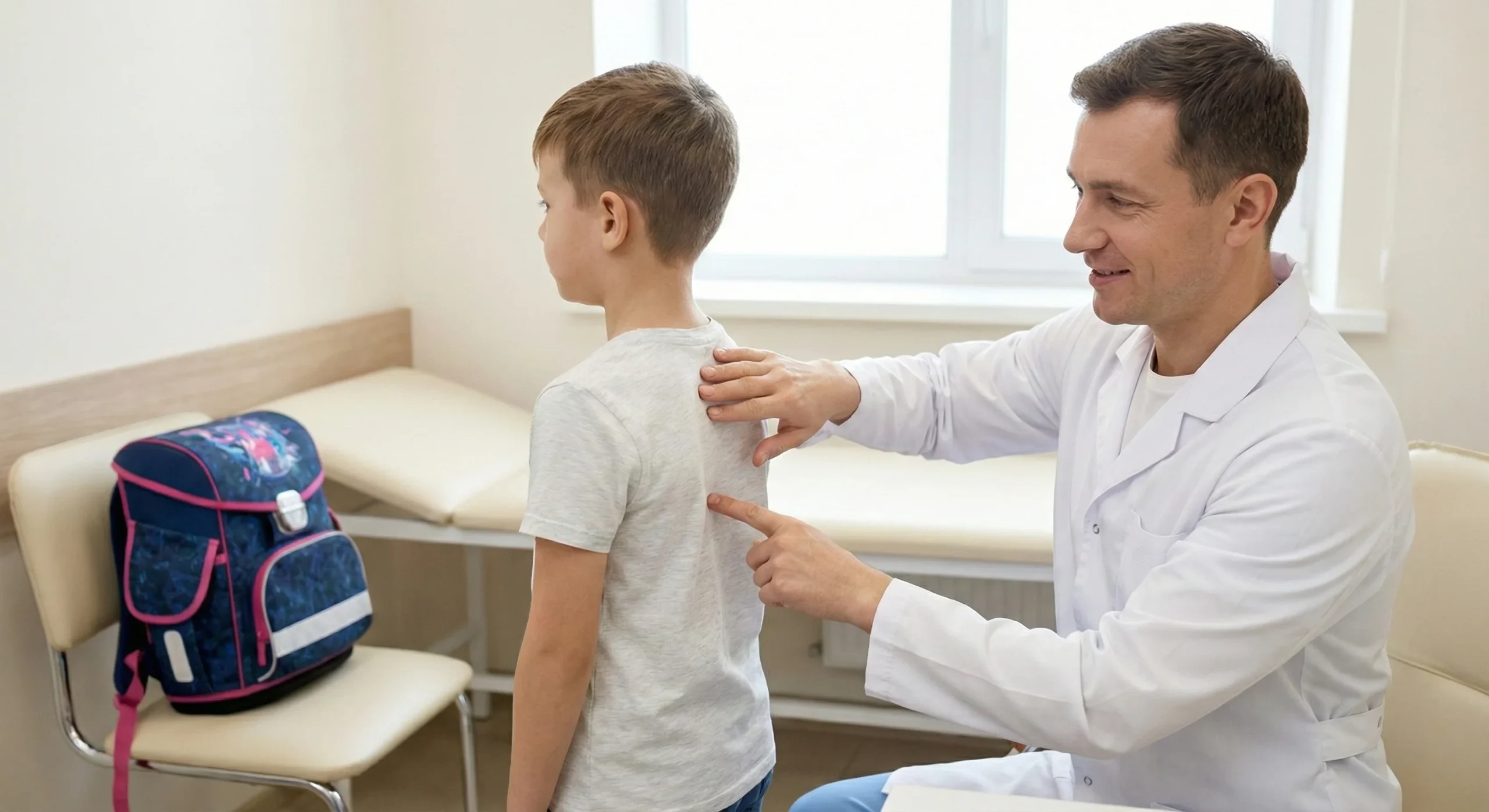
When is a pediatric orthopedic examination warranted?
The pediatric orthopedics evaluation is recommended if a child regularly complains of back, neck, or shoulder pain; if the child leans noticeably forward under the weight of a backpack; or if there is persistent asymmetry in posture, such as one shoulder consistently being lower than the other.
It is also advisable to consult a specialist if the child tires easily, avoids being carried, or if a spinal deformity is detected during a school screening. In such cases, the role of pediatric orthopedics is not only to rule out or confirm childhood scoliosis, but also to conduct a comprehensive evaluation of the child’s symptoms.
The goal is not to achieve perfect posture, but to ensure balanced, symmetrical weight distribution, encourage regular physical activity, and take the child’s complaints seriously. With proper attention and, if necessary, a pediatric orthopedics examination, problems can usually be detected and treated in a timely manner.
This information sheet is based on the findings of several international studies and systematic reviews. References: 1. Górna S, Pazdro-Zastawny K, Basiak-Rasała A, Krajewska J, Kolator M, Łesiuk-Krajewska A, Kozłowska-Panek K, Cichy I, Rokita A, Zatoński T. Assessment of the weight of elementary school students’ backpacks in urban environments in Poland: A cross-sectional study conducted as part of the “Lightweight Schoolbag” and “Let’s Get the Kids Moving” projects. Work. 2022;73(1):121–129. doi: 10.3233/WOR-210788. PMID: 35912770. 2. Ghanem I, Rizkallah M. Adolescent idiopathic scoliosis for the primary care physician: frequently asked questions. Curr Opin Pediatr. 2019 Feb;31(1):48-53. doi: 10.1097/MOP.0000000000000705. PMID: 30461512. 3. Calvo-Muñoz I, Kovacs FM, Roqué M, Seco-Calvo J. The association between the weight of schoolbags and low back pain among schoolchildren: A systematic review, meta-analysis, and individual patient data meta-analysis. Eur J Pain. Jan 2020;24(1):91-109. doi: 10.1002/ejp.1471. Epub 2019 Sep 9. PMID: 31421006. 4. Dockrell S, Simms C, Blake C. Schoolbag carriage