Tennis Elbow


Sometimes patients are surprised when, during an orthopedic examination, the doctor determines that their excruciating joint pain is caused by tennis elbow. Contrary to popular belief, tennis elbow can develop not only as a result of playing sports.
The orthopedic specialists at the Budapest Musculoskeletal Private Outpatient Clinic use their extensive experience and the most advanced therapeutic methods to help patients who wish to find relief from joint pain.
What is tennis elbow?
Tennis elbow is a form of tendonitis caused by excessive physical strain, as well as an associated, slowly developing inflammation of the periosteum affecting the outer surface of the elbow. It is a very common overuse injury among tennis players, but it is not limited to athletes. Tennis elbow typically causes sharp pain on the outer part of the elbow when the fingers and hand are extended backward. The pain worsens with activity, and over time, pain may also occur even at rest.
Examination: orthopedics specialist
Therapy: orthopedics specialist, physiotherapist-physiotherapist
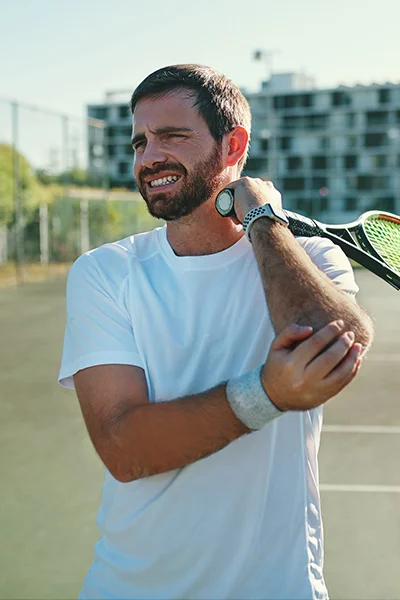
How does tennis elbow develop?
This condition often develops in tennis players, but it is not limited to them. Other sports (such as fencing and rock climbing), heavy housework, gardening, or regular violin playing can also lead to tennis elbow. In fact, spending many hours a day on the computer can also increase the risk of developing it. Using a keyboard and mouse requires keeping the wrist in a backward-bent position. If this continues for a long time, it strains the muscles, and over time, even severe, very painful symptoms may develop. Stiffness in the forearm muscles can also contribute to the development of tennis elbow.
What is the difference between tennis elbow and golfer’s elbow?
Both conditions develop as a result of intense strain on specific muscle groups and a multitude of repetitive microtraumas. The key difference is that tennis elbow causes changes on the outer surface of the elbow. It primarily affects the extensor muscles of the forearm, which originate from the area of the lateral epicondyle.
Golfer’s elbow, on the other hand, causes a condition on the inner surface of the elbow. It is caused by overexertion of the flexor muscles originating from the area of the medial epicondyle. It can also cause weakness in the forearm. It is triggered by the frequent repetition of throwing and flexing motions, so it is common among golfers, handball players, and gymnasts; however, similar to tennis elbow, golfer’s elbow is not limited to athletes.
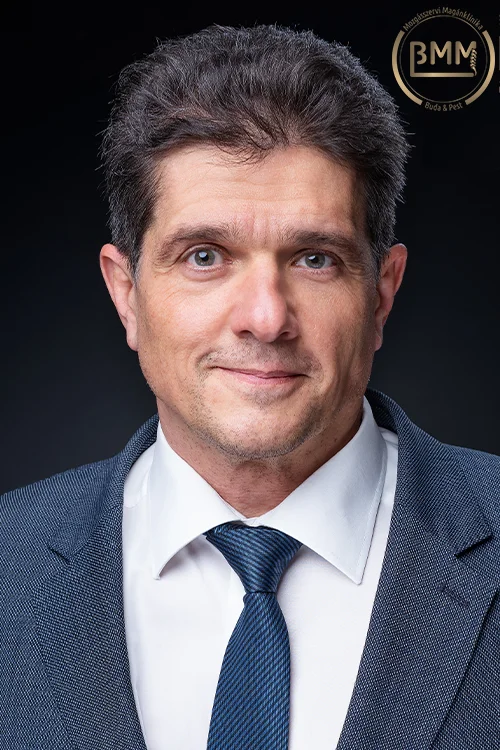
Dr. György Kocsis PhD
Orthopedic-Traumatologist, Chief Hand Surgeon, University Assistant Professor, Wrist, Elbow, and Shoulder Surgeon, Upper Extremity Specialist
Online appointment booking for Bokor Street:
Please choose the service that suits you
Control fee: 32 000 HUF, for 3 months after the initial examination, for the same complaint.
- 1. Select the service you want from the drop-down box.
- 2. Use the calendar to choose a date that suits you!
- 3. Enter your details to register or login with your previous registration.
- 4. If you would like to book on behalf of someone else (e.g. your child), please let us know at the place indicated.
- 5. Briefly describe your complaints!
- 6. Choose the type of consultation: initial examination, control examination or prescription.
- 7. Click on the button to book your appointment. Thank you for choosing BMM!
If you are not able to come to the appointment you have already booked, please let us know at least 24 hours in advance.
This gives other patients the opportunity to get the medical care they need in time. Thank you for your cooperation and understanding!
Resignation: +36 1 44 33 433
If you can’t find an appointment for the week of your choice , please call our call-centre on+36 1 44 33 433 for further assistance. Our staff will be happy to help you make an appointment with the doctor of your choice or another specialist according to your complaint.
Symptoms of tennis elbow
A characteristic symptom of tennis elbow is a sharp, intense pain on the outside of the elbow when the wrist is extended backward, which often occurs, for example, when shaking hands, making gripping motions, or opening doors. In more severe cases, the pain may occur even at rest and at night. Patients may also experience more intense symptoms upon waking in the morning. The pain may also radiate into the shoulders.
The pain associated with tennis elbow develops gradually and becomes more severe over time. The pain may be accompanied by muscle weakness, making it difficult for the patient to grip objects, or causing them to slip out of their hands. If periosteitis has also developed, the elbow bone becomes very painful when pressed. Numbness in the hand and arm may also be among the symptoms.
It is important to know that elbow pain can have several different underlying causes, so if it does not go away within a few days, it is important to see an orthopedics specialist as soon as possible.
How is tennis elbow diagnosed?
If you recognize the symptoms of tennis elbow, consult an orthopedic specialist who can diagnose the condition. The diagnosis can be easily made based on the patient’s symptoms and a physical examination. The specialist will first ask the patient in detail about their symptoms, then ask questions regarding their lifestyle, work, other medical conditions, and any medications they may be taking. At our clinic, we always set aside sufficient time to take a medical history, as this greatly aids in diagnostic procedures.
During the physical examination, the specialist palpates the elbow joint and checks its range of motion. If necessary, the doctor may order imaging tests to rule out other elbow conditions.
After the examination is complete, the doctor informs the patient about the details of the condition and recommends a personalized treatment plan. This may involve conservative therapy or, in rarer cases, surgical treatment. In the latter case, the doctor will also discuss the type of surgery, the tests required for the intervention, the anesthesia options, and the recovery process.
At the Budapest Private Orthopedic Outpatient Clinic, we have strived to bring together the best and most dedicated orthopedic specialists in the field so that we can offer effective and personalized solutions to the patients who come to us.
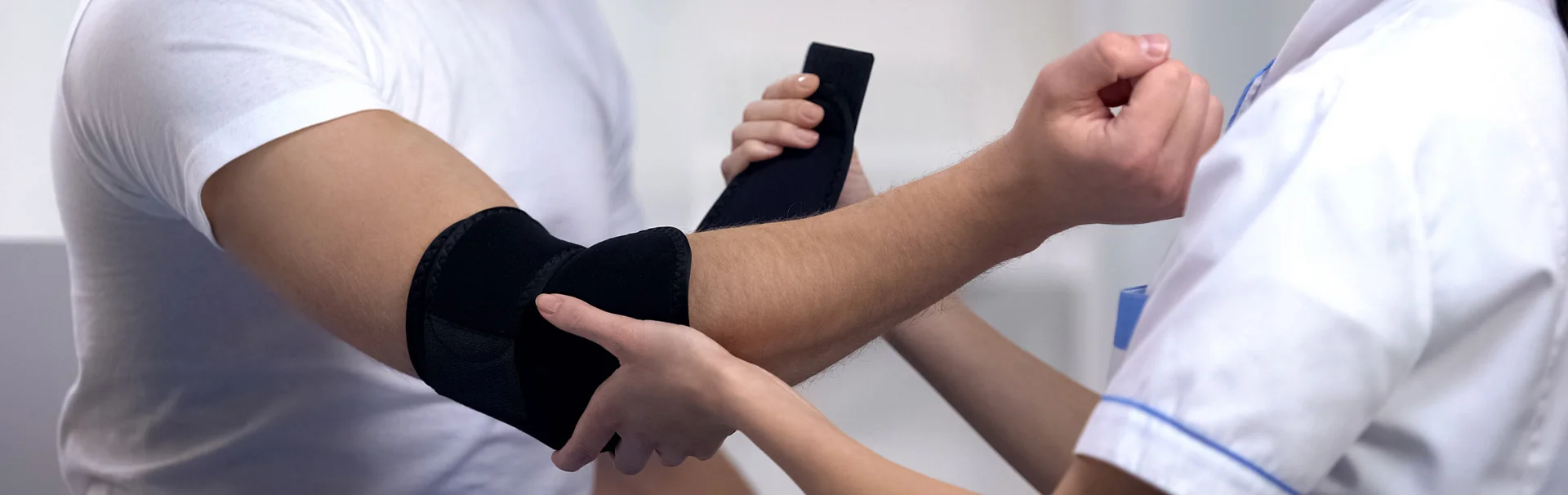
Treatment of Tennis Elbow
In more severe cases of tennis elbow, surgery may be an option, but fortunately, this is relatively rare. If the condition is so advanced or severe that conservative treatment no longer provides significant relief, surgery is performed, usually under general anesthesia. During the intervention, the scarred, contracted portions of the tendons are removed from the bone, thereby eliminating the painful, tight sensation. After tennis elbow surgery physiotherapy is recommended, and the expected recovery time is 3–4 weeks.
The thought of surgery can be a source of anxiety for many people, but we can help alleviate that anxiety by explaining in detail to our patients what will happen to them during the procedure, what kind of rehabilitation they can expect, and what surgical outcomes they can anticipate. We strive to answer all of our patients’ questions in detail.
Fortunately, tennis elbow often responds well to conservative treatment. This includes, among other things, rest, icing the affected area, and the use of pain relievers and anti-inflammatory ointments. For more severe pain, steroid injections may also be considered. It is important for patients to avoid movements that trigger the pain.
At the Budapest Private Outpatient Musculoskeletal Clinic, we also use highly effective shock wave therapy to help our patients suffering from tennis elbow recover. Repeating the 15-minute shockwave treatment results in lasting improvement within 2–4 weeks in 80% of cases! Just one treatment per week may be enough to achieve excellent results.
Shockwave therapy is an electrotherapy treatment method in which energy is delivered to the body in the form of waves. As a result, local blood circulation becomes more efficient, which triggers healing processes, and the pain associated with tennis elbow is dramatically and permanently reduced. Shockwave therapy is also ideal for treating long-standing, intense pain.
Comprehensive physical therapy can significantly reduce the risk of tennis elbow recurring and can also alleviate existing symptoms. Physiotherapy helps stretch the muscles around the elbow, relieve muscle stiffness, and alleviate pain. The therapy also includes strengthening the muscles of the upper arm and shoulder, which can help reduce stress on the elbow joint.
Have you experienced symptoms of tennis elbow? Do you have any other joint problems? Is it harder for you to move than it used to be?
Call +36 (1) 44-33-433 now to schedule an appointment for a specialist examination at the Budapest Musculoskeletal Private Outpatient Clinic!
Our Hand Surgery Specialists
Dr. György Kocsis PhD
Orthopedic-Traumatologist, Chief Hand Surgeon, University Assistant Professor, Wrist, Elbow, and Shoulder Surgeon, Upper Extremity Specialist