Pediatric Orthopedics Disorders
Pediatric Orthopedics Disorders
Author: Marketing BMM | June 2, 2022


A distinctive feature of pediatric orthopedics is that, when detected early, conditions can be treated much more effectively than in adulthood, since the skeleton, joints, and muscles are still developing. In addition to the evaluation and treatment of symptoms, pediatric orthopedic screenings are also of paramount importance. At the Budapest Private Outpatient Orthopedic Clinic, our physicians—who possess outstanding expertise and decades of experience—utilize the most modern therapies. There are no waiting times at our clinic; you can choose when and where you’d like to come in for an examination.
Congenital Developmental Disorders
According to WHO data, one in 33 newborns is affected by some form of congenital developmental disorder, which refers to inherited conditions that develop during the period from conception to birth, acquired, or caused by various environmental hazards. Some of these fall under the category of field of pediatric orthopedics .
Hip Dislocation
Hip dislocation is the most common congenital developmental disorder affecting the musculoskeletal system, with a prevalence of approximately 1%. It is 5 to 10 times more common in girls than in boys. The hip joint develops abnormally in utero, typically resulting in dislocation of the hip joint during or after birth. Hip dislocation is more common in babies in the breech position; however, according to pediatric orthopedics specialists, genetic factors may also underlie the development of this condition.
Symptoms
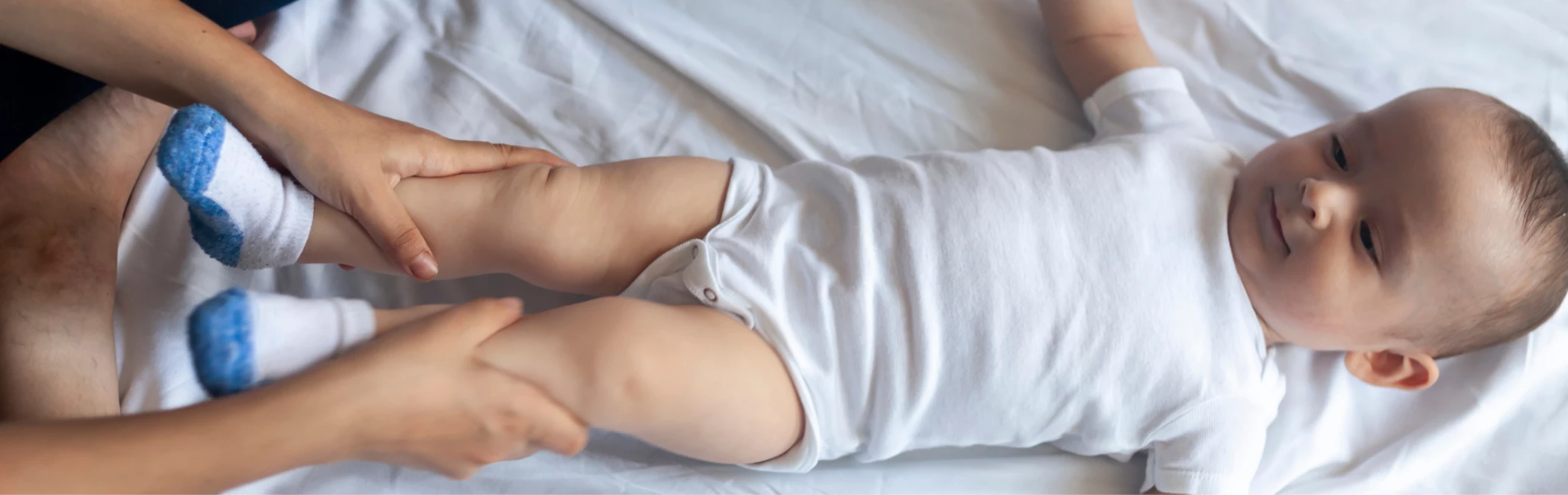
In infancy, the symptoms of hip dislocation are often not noticeable, which is why it is of the utmost importance to conduct a hip screening. Asymmetrical skin folds on the baby’s thighs or the baby holding their legs in different positions while sleeping may indicate hip dislocation. In children who are already walking, limping is a common symptom. Hip dislocation is diagnosed at the pediatric orthopedics specialist outpatient clinic .
Treatment
Hip dislocation in infants can be treated by keeping the baby’s legs in a constantly abducted position. This can be achieved, for example, with an abduction diaper or a special device. This long-term correction of the joint’s position helps the hip joint develop properly. If treatments during infancy do not produce satisfactory results or are not performed, hip dislocation can be corrected through surgery.
Clubfoot deformity
Clubfoot is a developmental disorder caused by multiple genes, which occurs twice as often in boys as in girls. Environmental factors and intrauterine pressure may also contribute to its development. It is a relatively common condition in pediatric orthopedics.
Symptoms
Clubfoot is easily diagnosed by examining the foot. The feet are turned inward and held in a fixed position. The foot is smaller than average and turned inward. Children walk on the outer edge of their feet and are unable to walk with their entire sole in contact with the ground.
Treatment
Treatment for clubfoot can begin when the baby is just a few days old using plaster casts to correct the position of the foot.
Perthes disease
In Perthes disease, the blood supply to the femoral head is impaired, preventing it from ossifying properly and causing it to flatten over time.
As a result, the femoral head is prone to injury, and hip dislocations occur more frequently. Perthes disease is commonly seen in pediatric orthopedics clinics and typically occurs in children aged 3 to 13. It is three times more common in boys than in girls.
Symptoms
Symptoms of Perthes disease include pain in the hip area, the knees, or the groin. The pain is usually dull, and as a result, children tend to put less weight on the affected leg. The symptoms improve with rest. In most cases, only one leg is affected, but in about 10% of cases, both legs are affected. Other characteristic features include thin muscles, possibly a shortened leg, and limited mobility. If you suspect your child has this condition, it is recommended that you visit a pediatric orthopedics specialist outpatient clinic.
Treatment
Perthes disease cannot be cured; while the duration, intensity, and frequency of painful episodes can be reduced, the condition itself cannot be cured.
Spinal Deformities
Spinal deformities in childhood are a common condition seen in clinics of pediatric orthopedics. While the cause of some of these conditions is unknown, rapid growth, spending many hours sitting in one place at school, and a lack of physical activity may also contribute to their development. As a result of poor posture, the spine’s natural curves may deviate from the optimal alignment, and lateral curvatures may also develop.
Is your child afraid of a medical exam?
Watch the BMM orthopedic story together to help ease your child’s anxiety about the orthopedics exam and make the visit with the specialist feel like a familiar situation!

Scoliosis
Scoliosis (more commonly known as scoliosis) refers to an abnormal lateral curvature of the spine caused by the displacement and twisting of the vertebrae relative to one another. It usually appears around the age of 10–12. This pediatric orthopedic condition is twice as common in girls as in boys.
Symptoms
A characteristic symptom of scoliosis is that one shoulder is higher than the other. In addition, back pain, a limp, and a decrease in physical performance are also frequently observed. In more severe cases, cartilage degeneration may develop over time.
Treatment
Treatment for scoliosis usually consists of a few sessions of physiotherapy per week, which may be prescribed for young patients by doctors at a pediatric orthopedics specialist outpatient clinic. In addition, regular daily exercise is important. In addition to performing the prescribed exercises at home , swimming is a good complementary sport , as it provides a steady and balanced workout for the body’s muscles without placing excessive strain on the joints. In cases of more advanced scoliosis, wearing a custom-made brace may also be recommended. In the most severe forms of scoliosis, surgery may be the solution, during which the joints are fused to reduce the curvature.
Scheuermann’s disease
A condition of unknown cause that frequently brings young patients to the pediatric orthopedics clinic. The essence of Scheuermann’s disease is that circulatory disturbances develop in the ossification centers of the vertebral bodies. As a result, bone cells die off and are replaced by cartilage cells. Over time, these cartilage cells develop into bone cells, but until that happens, the vertebra is very fragile and can easily become deformed.
Symptoms
In milder cases, the disease may remain asymptomatic, but back pain, tenderness, difficulty moving, and fatigue may occur. Spinal deformities may also be visible in the affected section of the back. A standing X-ray can aid in the diagnosis of Scheuermann’s disease.
Treatment
The progression of this common pediatric orthopedic condition can be prevented through ongoing physiotherapy. The goal is to relieve pressure on the vertebral bodies until spinal growth is complete. Strengthening the muscles around the spine and stretching these muscles greatly aids in this process. In more advanced cases, an orthopedic specialist may also prescribe the use of a brace.
Transient inflammation of the hip joint (transitoricus coxitis)
Transient hip joint inflammation is more common in younger children. The condition typically develops following upper respiratory tract infections and illnesses accompanied by diarrhea.
Symptoms
A characteristic symptom is that, a few days after a respiratory infection, the child experiences very severe hip pain, which in many cases makes it impossible for them to stand. It can develop a few days after a respiratory or gastrointestinal infection, but it can also occur as late as 2–3 weeks afterward.
Treatment
An ultrasound examination of the hip joint is required to make a diagnosis; during this examination, fluid accumulation is visible on the affected side, while the joint structures remain intact.
Treatment of the condition requires rest, 2–3 days of bed rest, and anti-inflammatory medication for 3–5 days. If the limp recurs, a follow-up X-ray may be necessary to assess for a possible complication (Perthes disease).
Lower Limb Axial Deviations
In the case of normal alignment, the axes of the lower leg and the thigh bone are extensions of one another. In this case, the outer and inner sides of the joints bear an equal load. If the femur and tibia form an outward or inward angle, we refer to this as bowlegs or knock-knees, respectively.
Symptoms
Pediatricians specializing in orthopedics can diagnose lower limb axial deviations through a physical examination. More advanced cases of bowlegs or knock-knees can be recognized at a glance. However, to make a precise diagnosis, the doctor may order an X-ray, as the X-ray clearly shows the degree and cause of the misalignment. If the misalignment is significant, increased stress is placed on one side of the joints, which over time can lead to cartilage degeneration and, as a result, joint pain and difficulty moving.
Treatment
Minor misalignments are typically more of an aesthetic issue, and children usually outgrow them over time, so they do not require any special treatment. In cases of more significant misalignment, surgery is the solution.
Lower Limb Length Discrepancy
Leg length discrepancy is common in children who are still growing. A mild discrepancy does not cause any noticeable symptoms; however, if the difference in leg length is significant, joint pain may occur. In childhood, this is typically caused by a growth disorder affecting one side of the limbs. After growth is complete, lower limb length discrepancy most often results from improperly fused bones.
Symptoms
The most characteristic symptom is an abnormal gait, the nature and severity of which depend on the difference in length between the two limbs.
Treatment
A significant difference in lower limb length disrupts the balance of muscle tone. This can be corrected with physical therapy. The heel lift inserted into the shoe can help compensate for the difference in leg length. In some cases, an intervention may be necessary.
Specialist paediatric orthopedics outpatient clinic
At the Budapest Private Outpatient Orthopedic Clinic, we place great emphasis on the healthy motor development of our youngest patients, as the optimal development of bones, muscles, and joints during childhood has an impact on our entire lives. At our pediatric orthopedics specialist outpatient clinic, our dedicated and experienced doctors pay close attention to the early detection of conditions and the application of the most effective treatments.
If your child has musculoskeletal problems or you would like to take them for a motor development screening, please call the following number to schedule an appointment: +36 (1) 44-33-433