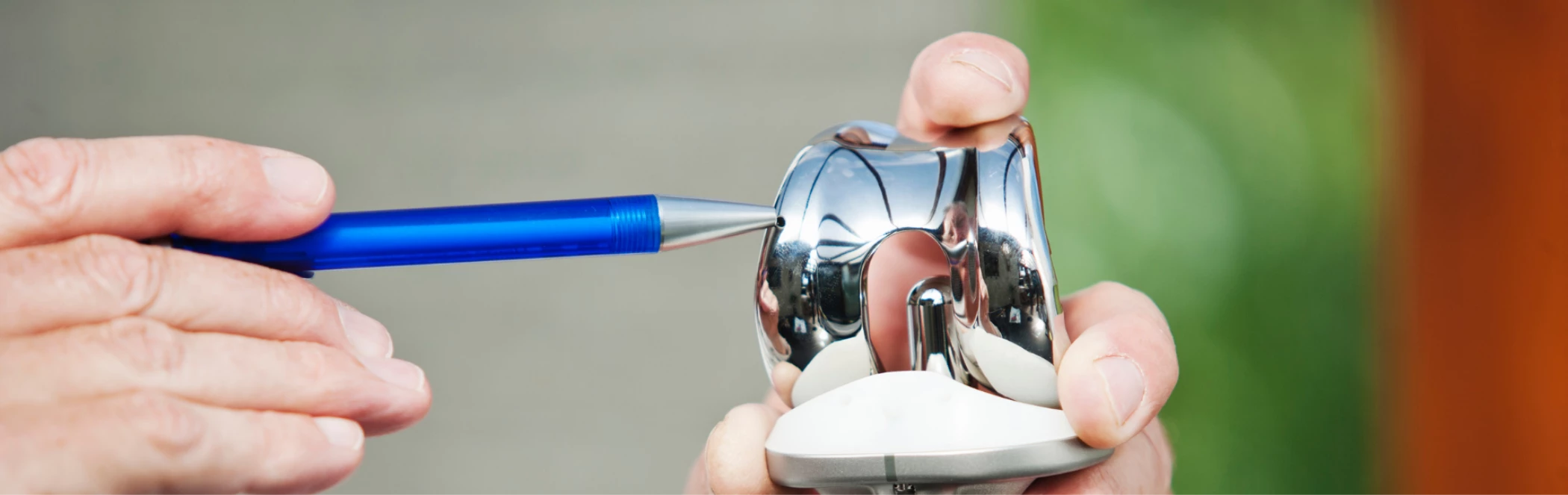
Knee prosthesis from a medical perspective
author Dr. Molnár Péter | 2021 .04.29.


Dr. Péter Molnár, the specialist orthopaedic traumatologist at the Budapest Musculoskeletal Private Outpatient Clinic, has been practicing since 1994 and has extensive experience in the implantation of knee prostheses and hip prostheses. When is knee prosthesis implantation necessary? Who is most affected by the problem? Why is rehabilitation after knee surgery important? In this article we summarise what the doctor shared in an interview about knee replacement surgery.
In which cases does the knee prosthesis help?
Wear and tear of the knee joint can reach a level where deformity, pain and reduced mobility cause the patient severe problems. Unable to bend and fully extend the leg, every step becomes painful. Non-surgical solutions, such as physiotherapy, are usually tried first to help the problem. If this is unsuccessful and causes severe pain on a daily basis, knee replacement surgery is considered .
In younger people, sports injuries can also lead to the need for a prosthesis. This is more common in middle-aged men, as they tend to play more intense sports such as football or martial arts, which are more likely to lead to injuries.
In older patients, knee joint wear is often caused by age itself. Among rheumatic diseases, rheumatoid arthritis, i.e. inflammation of the multiple joints, can cause severe wear of the knee joint. This disease means that the inner lining of the knee joint is permanently inflamed, which damages the cartilage surface and causes it to wear out prematurely. The ligamentous system of the knee joint is also often damaged, so these patients need a more specialised prosthesis to provide a little more stability. It is up to the orthopaedic surgeon to choose the right knee prosthesis.

Knee prosthesis types
Semi-prosthesis (sled prosthesis)
The knee joint is divided into three sectors. If only one of these sectors is worn out, if the patient is young, has no major axis deviation and the ligamentous system is intact, a semi-prosthesis, also known as a sled prosthesis, is implanted. To preserve bone, doctors try not to take away the intact cartilage surface of the knee. A professional protocol is used to decide whether this type of knee surgery is suitable for the patient.
Total knee prosthesis
If the entire surface of the knee joint is worn away, a total knee replacement is implanted. In this case, the entire knee surface is replaced during the knee replacement surgery. This type of knee replacement is more common in older people.
Rehabilitation after knee surgery
Post-operative physiotherapy after knee replacement surgery can greatly aid recovery. In the post-knee surgery period, it requires intensive attention from the patient. Of course, it is all worth it, as the rehabilitation is also there so that the patient can finally go to the follow-up examination saying:
Thank you, I'm fine now, my knee doesn't hurt.
It's important to send the patient to a physiotherapist for a consultation before the knee operation, where they can discuss what to do after the operation and what to look out for. Exercise is also started at this time. It is also important to have a good, direct relationship between the patient, the physiotherapist and the doctor. If this trio works well together, rehabilitation will work.
- we learn from Dr. Péter Molnár.
Can knee surgery be prevented?
There's no guarantee that you'll avoid knee surgery, but it's worth doing everything you can. For example, it's good to protect your knee health from a young age by choosing a sport that suits your physique. A young person with too loose ligaments should not play a rough ball game such as handball or basketball, as this can easily lead to injury and knee surgery.
However, if we don't push ourselves too hard, the effect of exercise on pain is very positive. If we don't move, the knee will hurt because the cartilage is softened. The cartilage works in the same way as the muscles: if you don't exert it, you don't need it, it slows down its metabolism, softens up and becomes uncomfortable. Good choices of exercise include cycling, swimming, jogging and walking.
Diabetes, other metabolic diseases and being overweight can also damage joints. It is important to lose excess weight slowly and gradually and to treat any metabolic diseases.
Successful knee replacement surgeries
In relation to knee prosthesis implants, Dr. Péter Molnár says that in recent years this type of knee surgery has become more and more popular. The success rate of knee replacement surgeries is now around 90%. This is due to the fact that surgical technology is becoming more advanced and very good implants are now being produced. As a result, there are many successful knee operations, with satisfied patients spreading the good news. And as a result, more and more people are taking the plunge for an intervention.
In case of knee pain, please contact the private outpatient clinic of Dr. Péter Molnár Péter, a specialist in orthopedics and traumatology at the Budapest Musculoskeletal Private Clinic!