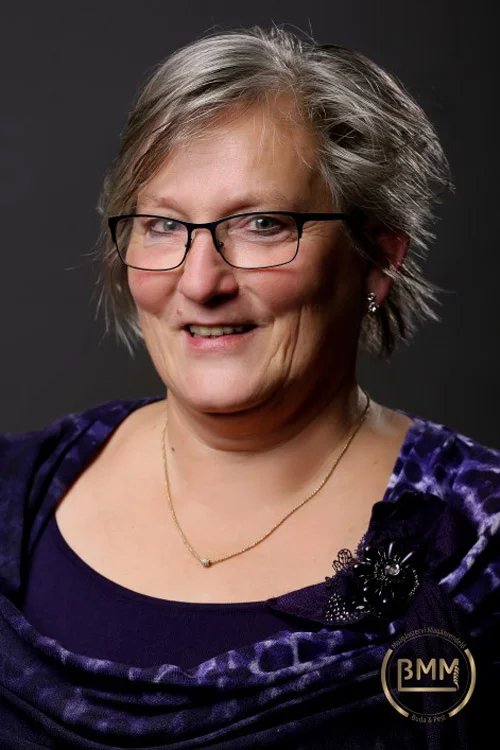
Hajnalka Mikonya
Speech Therapist
Hajnalka Mikonya
Speech Therapist
Budai Private Orthopedic Outpatient Clinic
Address: 1111 Budapest, Budafoki út 15.
Tel: +36 (1) 44 33 433
Email: bejelentkezes@bmm.hu

Dear Patients!
Appointments with Hajnalka Mikonya can only be made by phone!
About
She graduated from the College of Special Education Teacher Training with a degree in speech therapy, about which she knew at the time only that, after graduation, she would be able to work with children and help them recover.
She smiles a lot and finds joy in even the little things. She is empathetic and helpful, and has a knack for identifying the family members who, once her speech therapy work is complete, will become the patients’ support system—people whom the patient accepts.
Of his two grown children, his daughter lives in Turkey and his son lives in England.
THE FOUNDATION WAS GOOD
“The Gusztáv Bárczi College of Special Education was a small, independent institution at the time , with wonderful teachers and people from a variety of worldviews. They shared a common belief: that children with disabilities are people too. During the dual-track program, we focused on speech therapy and intellectual disabilities. We built a foundation in anatomy and psychology, which served as our gateway to speech-language pathology—a field that really resonated with me.”
SPEECH THERAPY PRESCHOOL
“I live in Tatabánya, where, in 1984, as a young professional, I was assigned to provide dyslexia therapy. Since it is easier to achieve results with children before they start school, I completed dyslexia prevention courses, which enabled me to identify children at potential risk and help them through individualized therapy. In 1995, I established a speech therapy preschool. Today, I serve as both the director and speech therapist of this affiliate institution, which operates within the Mészöly Gedeon Reformed Elementary School and Preschool.”
THEY ALSO FOUND COMMON GROUND ON HEALTH CARE
“Starting in 1987, I worked with stroke patients —specifically those with aphasia —in the internal medicine departments of St. Barbara Hospital in Tatabánya. Later, I started my own business. As part of this, I continue to this day to provide state-funded outpatient speech therapy services at the hospital’s neurology department—in addition to inpatient care and in conjunction with the stroke outpatient clinic.”
WE ALSO HAVE TIME FOR PRIVATE OUTPATIENT CLINICS
“At the Budapest Private Outpatient Musculoskeletal Clinic , I primarily treat patients with aphasia, but from time to time, young children with speech development delays also come to the clinic. I treat them through individualized therapy using a holistic approach that integrates movement, perception, and many other areas. By discussing my observations with the parents and ensuring that homework assignments are completed, I can achieve results more quickly than a speech therapist working in a preschool.”
FORENSIC EXPERT
“I became a forensic expert in 2008. In cases involving a petition for guardianship, I may be asked to provide an opinion on whether a patient—despite speech difficulties— is capable of making decisions regarding their own affairs. I can also advocate for the interests of people with dyslexia , for whom a language proficiency exam is not required for a degree if they have a documented reading disability, and from among whom I can identify those who are capable of passing the exam with modified test tasks.”
THE BEST IN ITS FIELD
“There are children with delayed speech, and there are those with dysphasia whose problematic language development has no medically identifiable cause. One of my primary areas of expertise is working with these children, including those on the autism spectrum who struggle with communication difficulties. In adult care, I specialize in aphasia, articulation disorders, and dysarthria .”
HELPING THEM TO HELP OTHERS
“I also support the development of speech-assistance devices based on information and communication technology, which is underway at the Department of Media Informatics (Telematics) at BME. With this program, which facilitates communication between patients and those around them, typed text can be converted to speech, while for people with aphasia who are unable to write, pre-categorized sentences can be loaded into the software. To perfect the tool, we need as much information as possible regarding patients’ needs; these are the missing links in the system.”