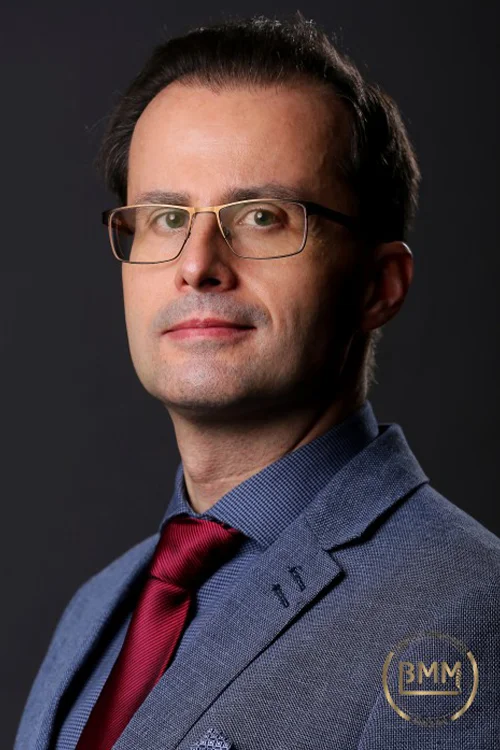
Dr Zsolt Sonnleitner
Assistant Professor of Orthopaedic Traumatology
Dr Zsolt Sonnleitner
Assistant Professor of Orthopaedic Traumatology
Speciality
Conservative and surgical treatment of musculoskeletal disorders; implantation of primary hip and knee joint endoprostheses,
Surgical correction of forefoot deformities (bunions, hammer toe)
Education
Orthopaedic-traumatologist specialist
Budapest Musculoskeletal Private Clinic - Pest
Address 1133 Budapest Pannónia u. 70.
tel +36 (1) 44 33 433
email bejelentkezes@bmm.hu
Ordering days
Monday
Basic audit fee
39 000 Ft
Fee for the control
31 000 HUF after the basic test 3 months, for the same complaint.


Online appointment booking for Pannónia Street:
Please select the appropriate service
Control fee: 31 000 HUF, for 3 months after the initial examination, for the same complaint.
- 1. Select the service you need from the drop-down box!
- 2. Use the calendar to choose a date that suits you!
- 3. Enter your details to register or login with your previous registration!
- 4. If you would like to make a reservation on behalf of someone else (e.g. your child), please let us know at the location provided.
- 5. Briefly describe your complaints!
- 6. Select the type of consultation: initial examination, control examination or prescription.
- 7. Click on the button to book your appointment. Thank you for choosing BMM!
If you are unable to make the appointment you have already booked, please, at least 24 hours before notify us of your intention to withdraw. This gives other patients the opportunity to get the medical care they need in time. Thank you for your cooperation and understanding!
Resignation: +36 1 44 33 433
If you cannot find an available appointment for your chosen week, please call our call center on +36 1 44 33 433 for assistance. Our staff will be happy to help you make an appointment with the doctor of your choice or another specialist according to your complaint.
Our patients' opinions
About
I think it is very important to be honest with patients and treat them as equals.
For as long as I can remember, I've always been fascinated by biology, the human organism and wanted to learn more about it. I wanted to be a doctor all my life, I couldn't imagine any other profession. So, from my primary school years onwards, I was consciously preparing for this career, for which I received all the necessary and possible support from my parents, despite being a first generation doctor.
It soon became apparent that I was a highly technical person. I was very keen to understand the workings of different machines and devices, so I used to take things apart and put them back together as a child. This continued later during my primary and secondary school years with the maintenance, repair and overhaul of my bicycles, and then during university with the maintenance, repair and overhaul of my cars, which were almost the same age as my own. To this day, when time allows, I still like to tinker and repair things.
It was a direct consequence of the above that during my university years I turned my attention to orthopaedics as a manual profession. From my fourth year onwards, I went to the operating theatre of the former MÁV Hospital orthopaedic department on a weekly basis. In my fifth year, I became involved in scientific work at the Orthopaedic Clinic of Semmelweis University, where I wrote my rector's thesis and won first prize.
After graduating in general medicine, I started training in orthopaedics and traumatology, which by then had been merged. I saw musculoskeletal surgery as the field where the most tangible results could be achieved the fastest, the most visible and therefore the most successful. I feel very fortunate to have been able to learn the profession from excellent master teachers in my first job at the Department of Trauma Surgery at the Károlyi Sándor Hospital, and to have enjoyed the variety of the profession from the very beginning.
Currently, I work at the General Traumatology Department of the Hungarian Defence Medical Centre, where I am involved in the surgical and conservative treatment of almost the entire spectrum of acute limb injuries, as well as orthopaedic interventions, mainly primary hip and knee joint replacements, and in the framework of same-day surgical care, mainly forefoot corrective surgery, and knee arthroscopies I end up. At my workplace, I also do my bit to educate medical students, residents and trainee doctors.
As a doctor at the Orthopaedic Specialist Clinic of the Hungarian Defence Forces Medical Centre, I mainly deal with chronic musculoskeletal diseases. In my opinion, in these cases the importance of conservative treatment methods, i.e. anti-inflammatory drugs, complex physiotherapy, physiotherapy, massage and manual therapy, followed by various injection treatments, cannot be overestimated. Only if these are unsuccessful should the patient be offered a surgical solution.
I think it is very important to be honest with patients and treat them as equals. We need to listen patiently to their complaints and ask guided questions to find out exactly what brought them to the clinic. This is followed by a thorough, careful, comprehensive physical examination, which in many cases helps to isolate the problem. If necessary, this is followed by appropriate imaging tests. Once the diagnosis has been made, it is essential to explain to the patient in a way that he or she can understand the exact nature of the condition, the cause of its development, its course, the treatment options and their mechanisms of action, and how to avoid recurrence or complications. I am convinced that with this knowledge, and by deciding on treatment together with the doctor, patients will recover more effectively and last longer. Nowadays, this can be achieved to the fullest extent in a private practice, which is why I am particularly pleased to work in the Budapest Musculoskeletal Private Practice.
My wife is also a professional, practising as a paediatric general practitioner. Our common profession is a special bond between us, as it gives us a much better understanding of each other's everyday problems, which may be meaningless to a „layman”. We have two little girls who enrich our lives.
As a doctor and a private citizen, I am a committed advocate of healthy living. I try to organise my life to make time for exercise every day, but at least five times a week. I have been mountain biking since childhood, and my family and I do a lot of walking and hiking. What little free time I have left is dedicated to my main passion, photography.
Professional curriculum vitae
Personal data
Name Dr Zsolt Sonnleitner
Name of workplace Hungarian Defence Forces Medical Centre General Traumatology Department
Jobs
- 2012 - Hungarian Defence Forces Medical Centre, General Traumatology Department
- 2006 - 2012 Main. Önk. Károlyi Sándor Hospital and Clinic, Department of Trauma Surgery
- 2004 - 2006 Semmelweis University, Central Trainee
Studies
- 2011 Orthopaedics and Traumatology - National Board of Examiners, with an „excellent pass”
- 2004 Diploma in General Medicine - Semmelweis University Faculty of General Medicine „cum laude”
- 1996 Graduation certificate - Móricz Zsigmond High School in Budapest
Language skills
- English intermediate level C state language examination, 1994
- German final university examination, 2004
COURSES, TRAINING
- 2007 43rd North Pest Doctors' Day
- 2007 44th North Pest Doctors' Day
- 2007 Celebration of Hungarian Science
- 2008 Surgical Technology Course, Budapest
- 2008 Pediatric Orthopaedics Course, Debrecen
- 2009 Basic research and interfaces in musculoskeletal sciences, Pécs
- 2009 Adult orthopaedics, Szeged
- 2009 Physiotherapy, Szeged
- 2010 Examination Preparation Course, Semmelweis University, Department of Traumatology
- 2012 Plastering and fixing techniques
- 2012 Errors, mistakes, overlooked cases in traumatology practice, reconstruction options
- 2013 What's new in the treatment of upper limb injuries and diseases
- 2013 AO Trauma Course - Principles in Operative Fracture Management
- 2013 Upper limb fracture treatment options
- 2013 Orthopaedic-traumatology interface
- 2014 Treatment techniques for injuries with severe soft tissue damage - Soft tissue management
- 2016 Traumatology Level Bearer Course, Debrecen
- 2016 Treatment of hip fractures
Organisational membership
- Hungarian Medical Chamber
Publications
- Ákos Zahár, Sándor Kiss, Zsolt Sonnleitner, György Szőke, Tibor Vízkelety: Resection of the proximal femoral end in young adults with cerebral palsy (Hungarian Traumatology, Orthopaedics, Hand Surgery and Plastic Surgery - 2004, Vol. 47, No. 3, pp. 209-215)