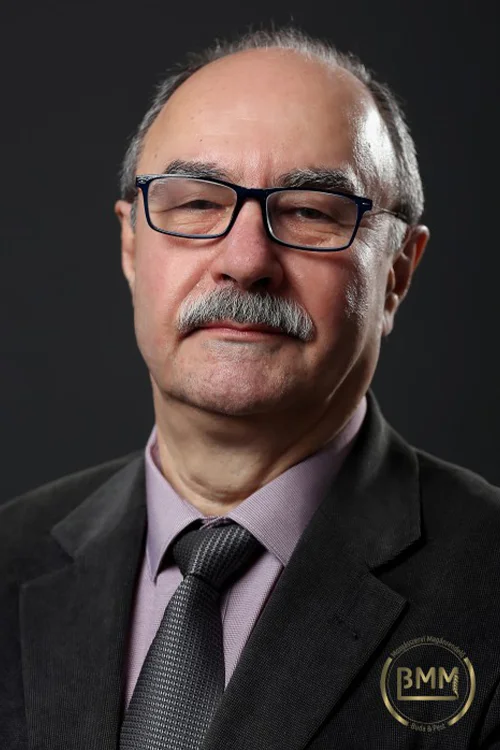
Dr. Sándor Horváth PhD
Specialist neurologist,
Candidate of Medicine,
Associate Professor
Dr. Sándor Horváth PhD
Neurologist, candidate of medicine, associate professor
Speciality
Migraine and headache specialist
Stroke prevention
Education
Neurologist, PhD
Budapest Musculoskeletal Private Clinic - Buda
Address 1111 Budapest Budafoki út 15.
tel +36 (1) 44 33 433
email bejelentkezes@bmm.hu
Ordering days
Wednesday
Basic audit fee
45 000 Ft
Fee for the control
HUF 35 000 after the basic test 3 months, for the same complaint.
Testing time
75 min


Online appointment booking for Budafoki út:
Please select the appropriate service
The follow-up consultation fee is valid for 3 months after the initial examination, for the same complaint.
- 1. Select the service you need from the drop-down box!
- 2. Use the calendar to choose a date that suits you!
- 3. Enter your details to register or login with your previous registration!
- 4. If you would like to make a reservation on behalf of someone else (e.g. your child), please let us know at the location provided.
- 5. Briefly describe your complaints!
- 6. Select the type of consultation: initial examination, control examination or prescription.
- 7. Click on the button to book your appointment. Thank you for choosing BMM!
If you are unable to make the appointment you have already booked, please, at least 24 hours before notify us of your intention to withdraw. This gives other patients the opportunity to get the medical care they need in time. Thank you for your cooperation and understanding!
Resignation: +36 1 44 33 433
If you cannot find an available appointment for your chosen week, please call our call center on +36 1 44 33 433 for assistance. Our staff will be happy to help you make an appointment with the doctor of your choice or another specialist according to your complaint.
Our patients' opinions
About
In my clinical work, I use the thinking I have learned from my scientific work in research.
In 1970, he graduated summa cum laude from Semmelweis Medical University with honours. He is a detailed, thorough man. He is passionate and tireless in his pursuit of unknown problems.
His hobby is his profession. He attends congresses, proofreads books, participates as a consultant in the monitoring of the literature in Hungary, and tries to make the readings available to the public through lectures. He is also involved in the management of programmes to promote the early hospitalisation of stroke patients.
Two grown-up sons have left the family home and are going their own way.
YOU NEED A DIRECTIONAL PERSONALITY
„In 1976, as a fresh graduate, my first job was at Neurology Clinic was. Professor Csanda, the pioneer of emergency neurology in Hungary, played a decisive role in the lives of the people who worked there. Neurology needed a change of approach and he was at the forefront of this. Emergency neurology was a crucial with stroke patients, and other neurological diseases requiring immediate intervention, such as severe muscle weakness and neuropathy, but the professor also worked with patients with a headache clinic and the only one in Budapest with Parkinson's disease detailed treatment and established the clinic's first sub-intensive class.”
AMERICAN RESEARCH- A NEW WAY OF THINKING
„Of the 13 years I spent at the Clinic, between 1986-1988, I spent two years in the laboratory of my university professor Dr. Miklós Palkovits in the United States, where I did neuroendocrinological and neuroanatomical studies. Based on my scientific work there and in my home country, I prepared and defended my PhD thesis. From my scientific work, I have used the knowledge I have acquired in my clinical work mindset I'll make it work for you. After my return home in 1991, I obtained my doctorate in medicine.”
FROM ESZTERGOM TO KISTARCSA
„For two years from 1993 Esztergom Hospital I was head of the neurology department and in 1995 I was appointed head of the MÁV Hospital to set up a stroke unit within the neurology department, which unfortunately could not be established for various, but mainly financial, reasons. Nevertheless, I stayed on as a neurologist in neurosurgery and at the end of 1998 I took over the Flór Ferenc Hospital of Pest County Head of the Department of Neurology. My role was not only to treat the actual patients, but to create conditions that would benefit all incoming patients, be it infrastructure, equipment or the right mindset of colleagues. In 2006 I was awarded the title of Specialist in Brain Disease and in 2010 the honorary title of Associate Professor. I retired from my department in 2013 and in 2015 I was awarded the title of vascular neurologist by licensing examination.”
HIS FAVOURITE SPECIALITY IS STROKE
„Just when I came back from the USA, the National Stroke Programme, and I became the Semmelweis University Department of Neurology one of the heads of the stroke department. That's when we started learning how to prevent this disease and how to treat patients already affected. Now, in addition to the immediate care of stroke patients, we are focusing on prevention - reducing existing risk factors through medication and lifestyle changes.”
SPECIALISING IN NEUROLOGY
„The clearer the complexity of a field becomes, the sooner specialisation in its sub-units will begin. So it is in neurology. It is therefore practically impossible for someone to excel in depth in all its specialities, but as head of the department, I had to have an overview of the whole of neurology, so that I can steer my department in the right direction, in the light of trends. To this end, I have called on the expertise of a diligent visitor to conferences and a constant reader of the latest literature I had to be, which is very useful for Private Musculoskeletal Clinic in Buda for almost six years now, in the care, treatment and cure of patients with a wide variety of complaints. The most common complaints of our patients are: headache, dizziness, visual disturbances, sleep disturbances, paralysis-weakness, neck and back pain, numbness, multiple sclerosis, Parkinson's disease and other neurological patients with movement disorders, walking disorders, treatment of symptoms of cerebral circulatory disorders, prevention of cerebral circulatory disorders.”
THERE IS TIME TO FIND OUT THE REAL SOURCE OF COMPLAINTS
„In the hospital and specialist clinics, we are always short of time, but in the surgery we can spend one and a quarter hours (75 minutes!) with a patient, so the patient can tell me their complaints in detail in a relaxed environment, I have time to review their previous medical history, previous CT and MRI scans, examine them thoroughly and order additional tests if necessary. Once the picture is complete, the pathology is established and there is time to discuss the proposed therapy in detail. Complexity is particularly important for people with chronic complaints who, despite their numerous findings, do not know or understand what is wrong with them. Explaining and understanding this is a crucial part of further doctor-patient collaboration.”
Professional curriculum vitae
Personal data
Name Dr. Sándor Horváth PhD
Name of workplaceBudapest Musculoskeletal Private Clinic
Jobs
- 1973 - 1976 Scientific Student Circle, I. Institute of Anatomy, Semmelweis Medical University, Budapest two national first prizes, one special prize
- 1976 - 1981 University Scholar, Semmelweis University of Medicine, Department of Neurology, Budapest
- 1981 - 1986 Assistant Professor, Semmelweis Medical University, Department of Neurology, Budapest
- 1986 - 1988 Fogarthy Research Fellowship, National Institutes of Health, Bethesda, Md., USA
- 1988 - 1994 Adjunct Professor, Head of the Stroke Department, Semmelweis University of Medicine, Department of Neurology, Budapest
- 1994 - 1995 Head of Department, Neurological Department, Vaszary Kolos Hospital, Esztergom
- 1996 - 1998 Head of the Stroke Department, MÁV Hospital, Budapest
- 1998 - 2013 Head of Department, Pest County Flór Ferenc Hospital, Neurological Department, Kistarcsa
- 2007 - 2025 Appointment of PTE Associate Professor
- 2013 - 2025 Volunteer, Flór Ferenc Hospital, Pest County, Neurology Department
EDUCATIONAL PRACTICE
- 1973 - 1976 Anatomy Practices, Deputy Head of Practice, Semmelweis University of Medical Sciences, Institute of Anatomy I
- 1977 - 1994 Neurological Practices, Head of Practice, Semmelweis Institute of Medicine, Neurology Clinic
- 1990 - 1994 Classroom lectures in Hungarian and English
- 1998 Member of the State Examination Board, Semmelweis University of Medicine
- 2004 Residency training (14 residents)
Studies
- 1970 Fazekas M. high school, Budapest, excellent school leaving examination
- 1976 Semmelweis Medical University, Faculty of General Medicine, Budapest, summa cum laude
- 1981 Excellent result in neurology
- 1986 - 1988 Research Fellowship, National Institutes of Health, Bethesda, Md., USA
- 1991 Doctor of Medicine
- 1995 - 1996 Health Care Manager Training, Project Hope, USA
Language skills
- English: intermediate
- Russian: basic stage
COMPANY MEMBERSHIPS
- Hungarian Society of Neurologists and Mental Health Practitioners, Member of the Board
- Hungarian Neurological Society, Secretary General
- Hungarian Stroke Society, treasurer
- Hungarian Stroke Society, Member of the Board
- Hungarian Parkinson Society, Hungarian Neuroimmunological Society, Hungarian Neuropathological Society, Hungarian Hypertension Society
CORPORATE ACTIVITIES
- Editor-in-chief of the official journal of the Hungarian Stroke Society, the journal „Brain Diseases” between 1993-2005
- Chairman of the Organising Committee of the III Hungarian Stroke Conference and the I Central and Eastern European Stroke Conference
- Treasurer of the Hungarian Stroke Society
- Secretary General of the Hungarian Society of Neurologists, then of the Hungarian Society of Neurologists
- Member of the College of Neurology (2011- )
LECTURES
- 10 presentations at international conference
- 8 training lectures at courses organised by the University of Pécs Medical School and later by the Neurological Clinic of the University of Pécs
- 4 classroom lectures at the Neurological Clinic of the University of Pécs
RCT TESTS
- 8 acute stroke
- 3 secunder stroke prevention