Robot-assisted orthopaedic surgery - what does it really mean for patients?


A robot-assisted orthopaedic surgery is one of the most advanced areas of orthopaedics in recent years. More and more patients are encountering the robotic surgery expression, especially when robot-assisted knee replacement or robot-assisted hip replacement surgery is considered.
However, it is important to clarify: robotic surgery does not mean futuristic, autonomous machines, but advanced medical technology systems that support and refine the work of the orthopaedic surgeon. In the case of orthopaedic prosthetic implants, even millimetre deviations can have long-term consequences. Slightly different axis alignment, sub-optimal implant positioning or inappropriate ligament tension can result in years of pain, instability or even the need for further surgery. A robot-assisted orthopaedic surgery technology is designed to reduce these risks.
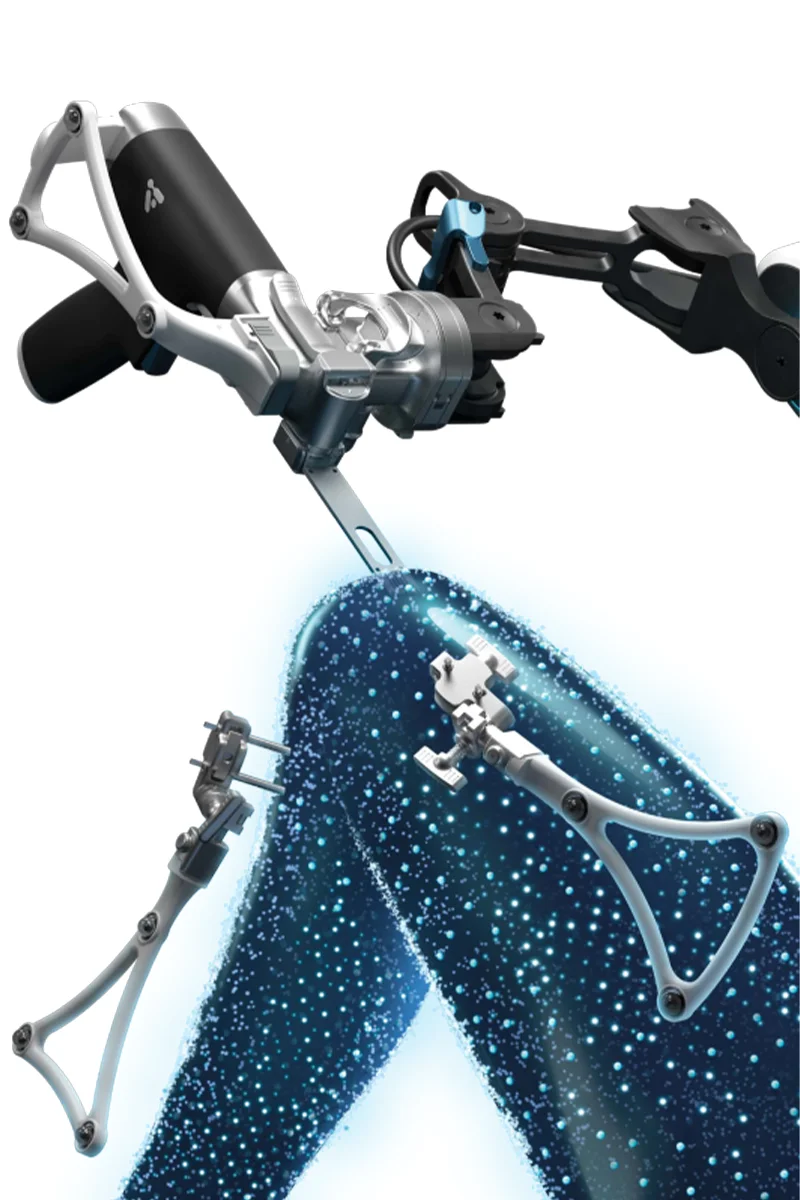
What does robot-assisted surgery mean in practice?
A robot-assisted orthopaedic surgery all decisions are still made by the orthopaedic surgeon. The robot does not operate autonomously, it does not „think” and it does not replace medical expertise. Instead, it acts as a highly precise, computer-controlled device that provides continuous feedback throughout the operation.
In orthopaedic robotic surgery, the system:
- maps the patient's individual anatomy in real time,
- helps you pinpoint the exact location and direction of bone cuts,
- warns if the surgeon deviates from the predefined optimal range.
This support is of particular importance robot-assisted knee and hip replacement in surgery, where the precise alignment of the implant is crucial to the quality of movement and the longevity of the prosthesis.
Why is robotic technology alone not enough in orthopaedics?
Although the robot-assisted orthopaedic surgery represents a significant technological advance, it does not automatically guarantee a better result. The key to success is always the experience and decision-making skills of the orthopaedic surgeon. Robotic technology can only offer a real advantage if it is used by a specialist with extensive experience in knee and hip replacement surgery and a thorough understanding of the anatomical context.
The robotic surgical system cannot judge, for example:
- the clinical significance of a complex axis misalignment,
- the current condition of the soft tissues,
- or the patient's individual movement patterns.
These remain purely medical decisions that require a high level of experience.
Advanced training for robot-assisted orthopaedic surgery
A robot-assisted orthopaedic surgery cannot be learned solely on the basis of traditional surgical practice. Surgeons must undergo rigorous, manufacturer-accredited training programmes before they can independently use these robotic surgical systems.
BMM orthopaedic surgeons not only perform the operations, but also teach the robot-assisted technique at an international level through the BMM Academy.
How does a robotic assisted knee or hip replacement surgery work?
Design
A robot assisted prosthesis surgery always starts with detailed planning during surgery. The surgeon digitally maps the patient's bone structures and joint conditions, then determines the ideal axes and range of motion.
Execution
A personalised surgical plan is then created, which can be performed with extreme precision using robotic surgery. Bone surface preparation is performed under controlled conditions, while the system provides continuous feedback.
Navigation and Fine Tuning
Robot-assisted hip replacement navigation plays a key role in accurately determining the angle and depth of the implant. Robot-assisted knee replacement and fine-tuning ligament tension helps to create a more natural knee movement.
The role of the CORI robot in robot-assisted orthopaedic surgery
A CORI robotic surgical system is one of the most advanced solutions for robot-assisted orthopaedic surgery. Its special feature is that it does not require prior CT or MRI scans, but produces a digital anatomical map in real time during the operation. The CORI robot allows the surgeon to continuously check and, if necessary, modify the surgical plan based on the current anatomical and functional data. This allows both robot-assisted knee replacement, mind robot-assisted hip replacement The system allows the procedure to be performed with less bone loss and in a tissue-sparing manner.
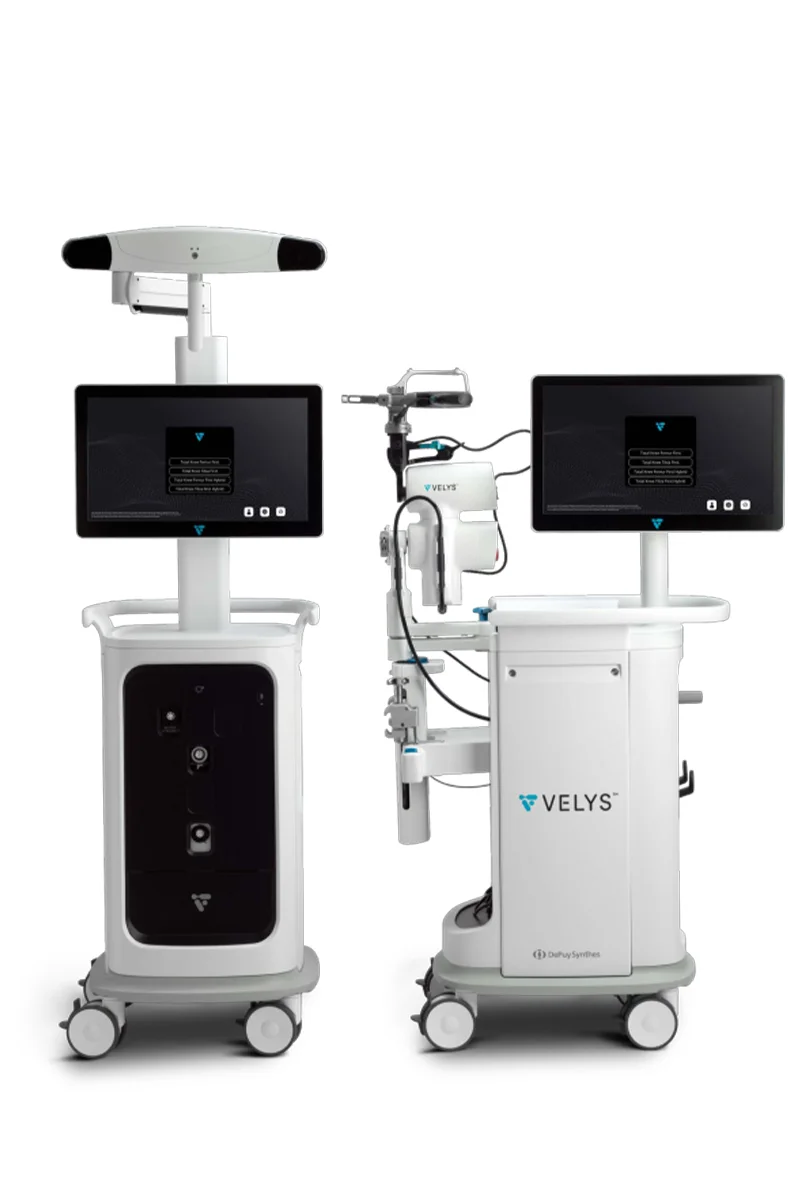
What does the VELYS™ robot assisted system offer?
A VELYS™ robot assisted system specifically robot-assisted knee replacement technology optimised for surgery, which also uses real-time data. With a strong emphasis on soft tissue protection and restoration of functional movement, VELYS provides continuous sensory feedback to help the surgeon to ensure that the implant fit is as close as possible to the patient's natural movement. This often results in faster rehabilitation and more stable knee function.
CORI or VELYS - what does the patient perceive?
For patients, the most important question is not which robotic technology is „better”, but which system provides the optimal solution in a given clinical situation. The versatility of CORI makes it ideal for robot-assisted hip and knee replacement surgery, while VELYS offers outstanding support for functional knee reconstruction. The decision is always made by the orthopaedic surgeon, taking into account the patient's condition, lifestyle and anatomical features.
| Featured on | CORI | VELYS |
|---|---|---|
| Type of surgery | Hip & Knee | Knee specialist |
| Imaging | Real-time map (without CT) | Sensorless real-time data |
| Main focus | Tissue care & Precision | Functional Movement & Stability |
What does this mean for patients in the long term?
A robot-assisted orthopaedic surgery The biggest benefit is that they allow for more predictable and personalised results. More precise implant placement, more natural movement and reduced tissue stress combine to help you recover faster and return to daily life.
However, it is important to stress that robotic technology is a tool. The key to real success remains the experienced, highly skilled orthopaedic surgeon, in whose hands the robot is a highly precise assistant.