Rotator cuff syndrome


What should you know about rotator cuff tears? How can I recognise a rotator cuff problem? When does surgical treatment become necessary? With the help of our shoulder specialist, we have gathered the most important information on the subject.


What is a rotator cloak?
Tendonous attachment of the rotator cuff 4 muscles arising from the scapula on the humerus.
The four muscles that stabilise the shoulder joint and help rotate and lift the arm:
- Supraspinatus
- Infraspinatus
- Teres minor
- Subscapularis
What is the function of a rotator cuff?
This well-structured and coordinated group of muscles has 2 main functions:
Centralisation
The muscles of the rotator cuff form a counterforce, partly against each other and partly against the deltoid muscle, and hold the humeral head in the articular socket. If this function is significantly impaired, the shoulder's lifting function becomes difficult or is completely lost.
Move to
rotator cuff muscles contribute to the rotational and lateral lifting movements of the arm. The supraspinatus muscle basically supports the lateral lifting of the arm, the infraspinatus and teres minor the outward rotation of the arm, while the subscapularis muscle supports the inward rotation.
Damage to the rotator cuff can restrict arm movement and cause pain, which can significantly affect the affected patient's daily activities and quality of life.
What are the most common diseases and injuries of the rotator cuff?
Problems with the rotator cuff can be many and varied. Due to its complexity, many diseases and injuries can make it difficult to move. These require specialist help to investigate and diagnose.
Although the mantle can indicate many different conditions, the following are the most common:
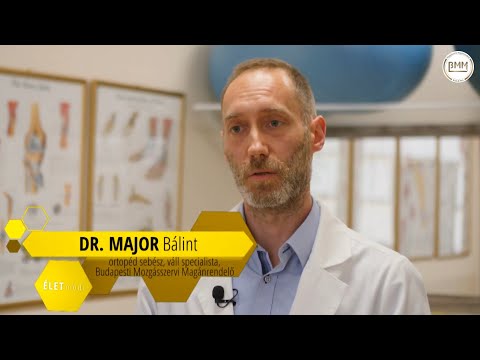
Rotator cuff tear
In the case of a rotator cuff injury, the rotator cuff stabilising the shoulder joint may be partial or complete rupture. A rotator cuff tear can lead to shoulder pain, weakness, lifting difficulties in more severe cases, and rarely - when more than one tendon is involved - to shoulder dislocation can cause.
This injury most commonly affects the supraspinatus muscle.
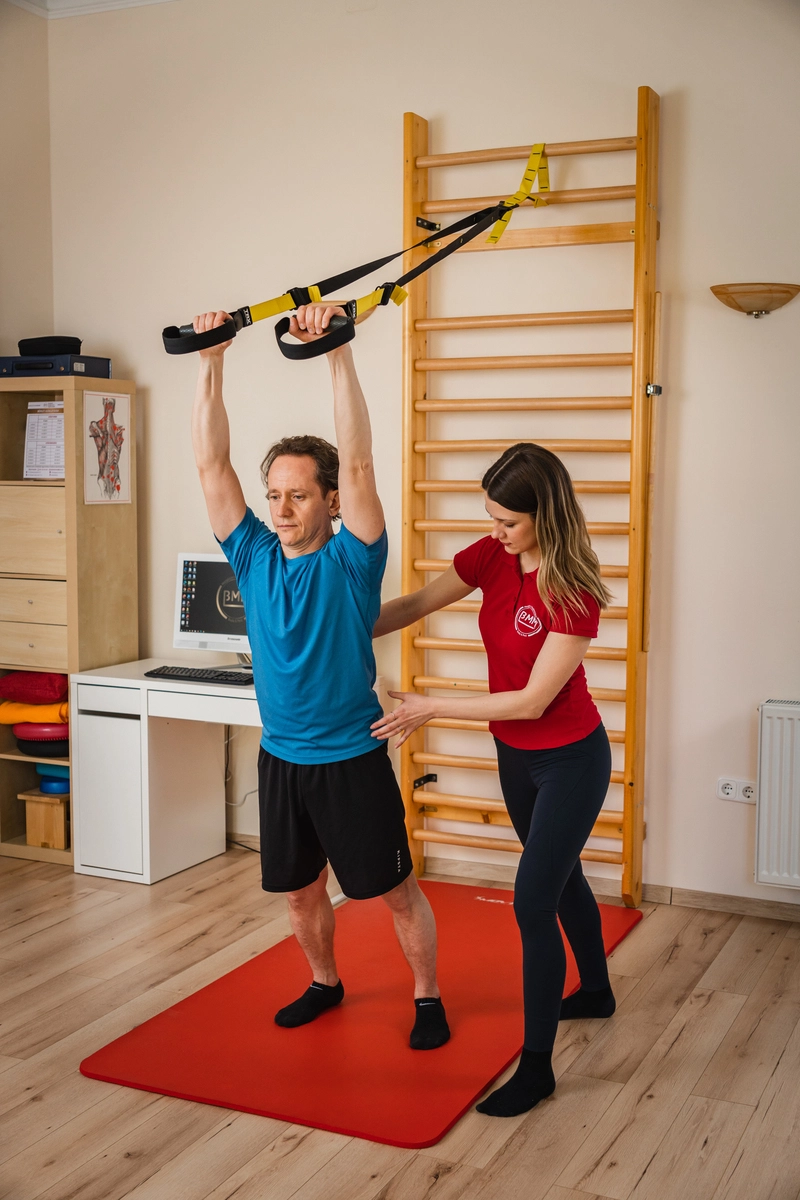
The causes of injury can vary:
- Overloading - It occurs particularly with repetitive movements, such as various sports activities, throwing or lifting overhead, as a result of work.
- Age-related degeneration - Tendons and muscles weaken and wear out with age.
- Trauma or injury - due to a fall, sport or other accident
The most common symptoms of injury:
- Shoulder pain: it occurs during daytime activities and is often worse at night or when moving (lifting, rotating) the shoulder.
- Weakness of the arm.
- Restricted active movement of the shoulder.
The doctor will consider a number of factors to determine a personalised treatment. Most important is the severity of the injury and the patient's overall health.
- Surgical intervention – The most ideal result is the reattachment of the torn tendon, which the surgeon performs arthroscopically. If a rotator cuff tear is still treated conservatively (see below), surgical intervention (biceps long head separation, upper case reconstruction) may also be considered if unsuccessful. In severe cases (inability to lift the shoulder), the implantation of a shoulder prosthesis may be considered as a possible treatment.
- Conservative therapy - Sometimes a torn tendon (e.g. due to an old tear, atrophied or fatty muscle) cannot be reattached or (e.g. due to poor tendon quality, old age, etc.) is not worth reattaching. Rest, physiotherapy, anti-inflammatory drugs and steroid injections can help.
Rotator cuff calcification
Rotator cuff calcification, also known as calcific tendonitis, is a condition where the calcareous deposits (calcium salts) form in the tendons that form the rotator cuff. This disease is often chronic for shoulder pain and lead to reduced mobility.
Possible causes of its development:
- Repetitive (micro)injuries.
- Overload caused by repetitive movements.
The causes listed can be common, but the exact cause and mechanism are not really known. It is important to know that rotator cuff calcification is often associated with chronic inflammation, which can exacerbate the symptoms.
The most common symptoms of calcification are:
- Chronic pain: The shoulder “aches”, but on certain movements the pain increases, it gets worse and makes it difficult to rest at night.
- Acute pain: Sudden onset, devastating pain (one of the most painful shoulder complaints) that subsides in about a week.
- Chronic and acute painful periods alternate at certain intervals.
- Disability
Treatment:
Treatment depends on the severity and duration of the symptoms.
- Conservative treatment - For milder, chronic pain, rest, anti-inflammatory drugs, physiotherapy (soft laser, shockwave therapy), injections (steroids) can help. For acute pain, diclofenac preparations, icing, rest, even bandaging the shoulder for a few days can help.
- Surgery - Prolonged complaints, recurrent acute symptoms. Minimally invasive, arthroscopic surgery (evacuation and removal of the calcific deposit) can provide a cure.

Before surgery
- Recognition of a rotator cuff tear, surgical plan after setting up our surgeon will discuss in detail with the patient the steps of the surgery, rehabilitation, expected time of return to work and sports.
- An anaesthetic examination is carried out within one month before the operation having the necessary findings (laboratory tests, ECG, chest X-ray).
- You may also need to change your medication (e.g. stop taking anticoagulants) before surgery.
UH performed by a doctor
Imaging tests are needed to make an accurate diagnosis and to choose the right treatment. In our office it is possible to take X-rays, but in the office of Dr. Bálint Major shoulder specialist the examination also includes an UH examination of the shoulder joint, which in many cases can already confirm the rotator cuff injury. If the possibility or need for a suture arises, we recommend an MR examination.
We would like to point out here that we do not consider it ideal for the patient to decide where to have an MRI scan, for the same price, with a wide variety of scans of unfortunately often useless quality. In our practice we will be happy to help you choose the right quality MR laboratory! The UH scan is part of the orthopaedic consultation, there is no extra charge.
What is rotator cuff surgery?
Rotator cuff tear surgery is usually arthroscopic method, which is a minimally invasive procedure.
- The procedure is most often performed under general anaesthesia, often with the use of a supplementary cervical anaesthetic.
- The doctor inserts a tiny camera and instruments into the shoulder through small incisions.
- The surgeon will sink anchor screws into the bone at the tendon attachment area and then use the threads to suture the detached tendon to the bone.
- After reattaching the torn tendon, the skin is closed with a suture.
- The operation usually takes 1.5-2 hours.
- After the procedure, the limb is secured in a shoulder brace.
After surgery - How to recover?
- For most rotator cuff operations, you can leave the hospital the same day, or the next day if necessary.
- From the day after the operation, rehabilitation can start with the passive movements (without forcing the shoulder) that you have learned previously, and should be continued in the weeks after the operation under the supervision of a physiotherapist.
- During the 2 weeks after the operation, care must be taken to ensure that the wound is not exposed to water. This is crucial to avoid infections and other complications.
- At the 6-week check-up, the brace is removed and active movements begin (use of the shoulder in everyday life under the supervision of a physiotherapist).
Recovery after rotator cuff surgery The process can take up to 4-6 months. The aim is to enable the patient to live a full life again, if possible.
Possible complications of rotator cuff surgery
It should not be overlooked that rotator cuff tear surgery, like all surgical procedures, can rarely have unintended consequences:
- Recurrence of rotor sheath rupture
- Poor shoulder function
- Nerve damage
- Risk of infection
- Bleeding
- Persistence of a certain level of pain
The most common complaints treated by our gynaecologists:
Our patients' opinions
Our specialist doctors
Dr. Bálint Major
Senior Specialist Orthopaedic-traumatologist
Dr. Balázs Gloviczki PhD
Orthopaedic-traumatologist, shoulder specialist
Dr. György Kocsis PhD
Orthopaedic traumatologist, hand surgeon, assistant professor, wrist, elbow and shoulder surgeon, upper limb specialist

Dr. Ferenc Tompai
Orthopaedic and trauma surgeon general
Dr. János Bartha
Orthopaedic-traumatologist, robotic surgeon