Schroth - Therapy at BMM
Schroth therapy
The Schroth method is currently the most effective physiotherapy method for treating scoliosis and Scheuermann's disease. It is important to stress that is justified for structural scoliosis.
What is structural scoliosis?
Scoliosis can be divided into 2 broad groups:
Group 1 is a group of so-called functional scoliosis:
a the lateral deviation of the spine is not accompanied by bony formations, rib, vertebral deformity. Usually caused by poor posture or differences in limb length. In this case, symmetrical trunk muscle strengthening exercises are performed.
Group 2 is the group of structural scoliosis:
a lateral deviation of the spine is also accompanied by deformity of the bony formations, rib humps, lumbar humps, rib valleys, lumbar valleys are formed. In this case there is a justification for Schroth therapy.
The method offers the possibility to correct the spine in 3D.
The essence of Schroth therapy
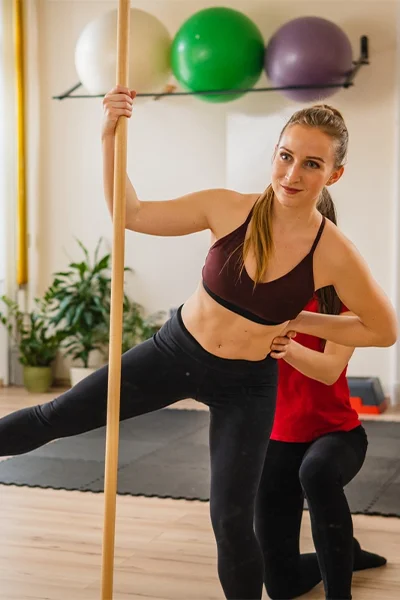
Maximum active stretching of the spine, maximum correction of trunk asymmetries, and muscle strengthening and stretching in a corrected position. Schroth therapy is not just a set of physical exercises, but an approach that also provides the patient with practical advice on posture.
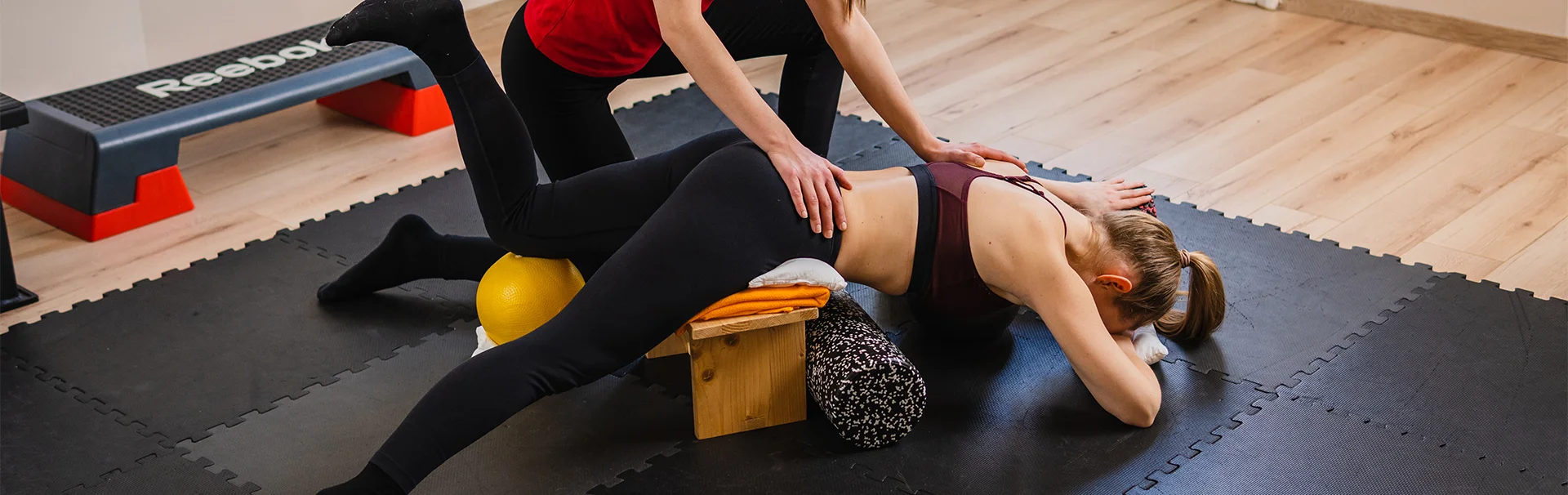
We are helped by external tools: cushions, balls, rollers, mirrors.
Practical advice for people coming to Schroth therapy
- In all cases it is necessary to from full spine, in upright position (AP, lateral) X-rays Action! Without this, therapy cannot be started!!!
- The first time we evaluate the X-ray image taken, we measure the degree value of the given curves.
- A detailed musculoskeletal examination is carried out: analysis of posture, mapping the position of bony formations, examination of the condition of muscles, etc.
- It is advisable to accompany a minor child, or the active participation of the parent in the therapy, because if the parent does not see the treatment at home, there will be no help, which is very important in the initial phase.
- Then the essence of the method and the theoretical background will be discussed. We aim to think logically, understand why we are doing what we are doing.
- Gradually learn the specific exercises, posture correction movements.
How does the Schroth method work?
In all cases, long-term therapy is needed. At home on a daily basis and you should do the exercises at least once a week under the guidance of a physiotherapist to achieve beautiful and long-lasting results. During the exercise, the sensorimotor posture correction using proprioceptive and exteroceptive stimuli to help the patient recognise incorrect posture.
During the therapy, in Schroth-specific positional adjustments, with the spine corrected in three dimensions, we achieve a relative increase in muscle activity and awareness and reflexive taking up of the corrected situation. In this three-dimensionally corrected position, special rotational breathing is used, which is important in achieving derotation and reducing rib hump.
What is the effectiveness of the Schroth method?
The Schroth method is one of the most effective therapies for scoliosis for the treatment of grip dysfunction, functional and structural scoliosis and Scheuermann's disease with excellent results. However, due to its complexity, it should not be used under the age of 10 years.
In the early 20th century, Katharina Schroth developed the Three-Dimensional Scoliosis Therapy. The method not only treats the lateral curvature but also corrects the rib hump caused by the twisting of the vertebrae, which is why it is called three-dimensional. The method is based on dividing the trunk into three blocks based on the anatomical properties of the vertebral column, which are deformed in a twisted position offset from each other when the spine is twisted. The bony deformity can result in the vertebrae becoming wedge-shaped, limiting the mobility of the ribs and subsequently reducing the respiratory volume.
Indications for Schroth therapy:
- Scoliosis (scoliosis)
- Scheuermann's disease (a disorder of snail growth in youth)
- Pre-operational mobilisation
- Post-operative rehabilitation
- Other vertebral deformities and postural problems
Basic elements of Schroth therapy:
- Teaching individual corrections
- Maintenance control
- Respiratory therapy
- Body awareness development
- Teaching self-correction, self-control
- Teaching the progression-preventing direction of everyday activities
- Corset management - habituation, weaning
Our physiotherapists
Tímea Szentpétery
Physiotherapist
Dorottya Lilla Sándor
Physiotherapist
Major Rita
Physiotherapist
Krisztina Tatai
Physiotherapist

Call us

Online booking