Physiotherapy for children
The physiotherapy for children is a specialised area of physiotherapy in which therapy is tailored to the age, abilities and intellectual abilities of the child. We welcome our patients from 0-18 years of age at the Budapest Musculoskeletal Private Clinic, so we work with children from newborn to teenagers.
How does physiotherapy for children work?
The therapy is first carried out in a with health check than for adult treatments. It starts with the recording of the child's medical history: i.e. planning, pregnancy, birth, analysis of infant and toddler movement patterns and questioning of movement development. To ensure the most accurate history taking, please bring your child's medical records with you. The assessment is done in a playful way, by testing different movement sequences, reflex tests and elementary movement patterns. For newborn babies for the examination and subsequent treatments, preferably bring a cloth nappy, a change of clothes (socks, T-shirt, trousers) for older children.
Why start physiotherapy in childhood?
From birth to the age of 10-12, movement is the main means of interaction with the outside world, through movement, organs and organ systems are developed, and experience and stimuli are acquired. Movement is the main stimulus for bone growth and muscular development, but if this process is not inhibited, development may slow down or even stop altogether, and later in life deformities and postural defects may develop. In addition to the relationship between bone and muscle, the development of the nervous system is closely linked. The developing nervous system is able to control increasingly complex movements, and the practice of these movements feeds back into the refinement of the nervous system, which can be used to learn new movements. It thus plays an irreplaceable role in the functional development of the nervous system.
Movement development in childhood
Each child's development is unique, reflects the maturity of the nervous system and is closely related to the development of other skills. The most important thing is that the stages of movement development - turning, crawling, climbing, standing up - are performed in the correct order, that no movement is missed, and that the movements are performed regularly and for the right length of time.
The most common problems are a lack of head elevation in the prone position around three months of age, and if the baby has difficulty lying on his or her stomach, does not rest on the forearms or lift the chest. Another common problem around the age of six months is a failure to turn from the baby's back to the tummy or from the tummy to the back.
In addition, postural asymmetry can occur at any age and is most often caused by a one-sided head posture. Often it can develop in foetal life, in which case the asymmetry is evident in the newborn's posture and the shape of its skull.
What symptoms should you see a paediatric physiotherapist for?
- Soft and weak or tight, rigid muscles
- Asymmetric head and neck posture, positioning of limbs
- Does not like to lie on its stomach, does not lift its head
- Different use of limbs
- Frequent back of head and trunk strain
- Slow development of movement

What complaints can you make to us?
- Babies and young children with developmental delay
- Crooked neck or torso, asymmetrical postures
- Muscular tone distribution disorders
- Movement coordination or balance disorders
- Central nervous system injuries: genetic disorders, cerebral palsy, slower development due to early neurological immaturity
- Orthopaedic conditions: sloppy posture, scoliosis, flat feet or other static foot deformities, hip problems, X-foot, O-foot
- Traumatology cases: rehabilitation after an accident or surgery
- Other childhood musculoskeletal problems
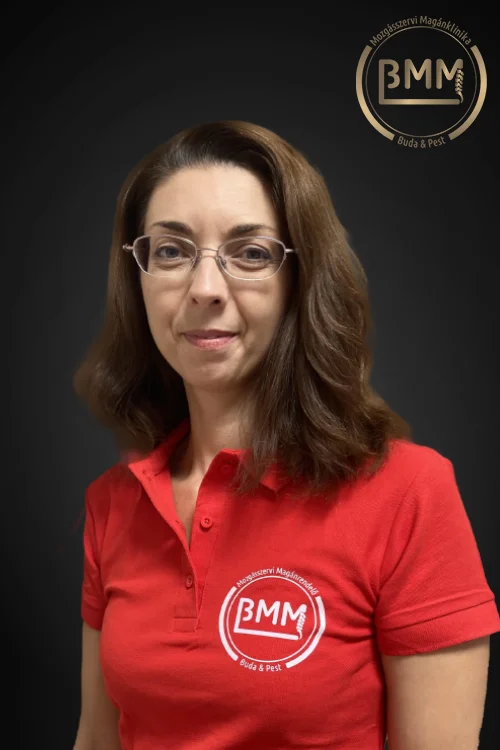
Tímea Szentpétery
Physiotherapist
Poor posture
Neglect is an increasingly common problem among older children, young learners and adolescents. Sloppy posture can be actively corrected and usually does not cause pain, but without treatment it can lead to a variety of musculoskeletal problems and pain later in life. It is not a disease in itself, but most spinal disorders develop from it. Improper posture may be caused by sudden rapid growth that the child's muscles cannot follow or by incorrect sitting, psychological factors, lack of willpower or a disruption of the muscular balance of the trunk. We distinguish four types of postural inactivity:
- Flat back, when the physiological curves are straightened, i.e. the curvature of the dorsal spine and the homogeneity of the lumbar (waist) spine are reduced. The trunk is straightened in side view and the back is flat.
- Kypholordotic back, when the physiological curves are more pronounced, i.e. the dorsal and lumbar curves are more pronounced.
- Saddle on back if the degree of dorsal hunch is normal but the lumbar hunch is increased
- Convex back the back is more convex than normal, extending over part of the lumbar spine, the trunk is convex in lateral view and the back is humped.
Flat feet
Another common problem in childhood, which is a widespread disease, is lúdtalp, and other static deformities of the foot. Foot deformities start to develop around the age of 3 and can last up to 10-12 years. The foot arch typical of adulthood does not start to appear until the age of 5-6 years at the earliest. During flat feet, the longitudinal arch of the foot descends. This is due to the weakening and elongation of the muscles and ligaments that maintain this arch.
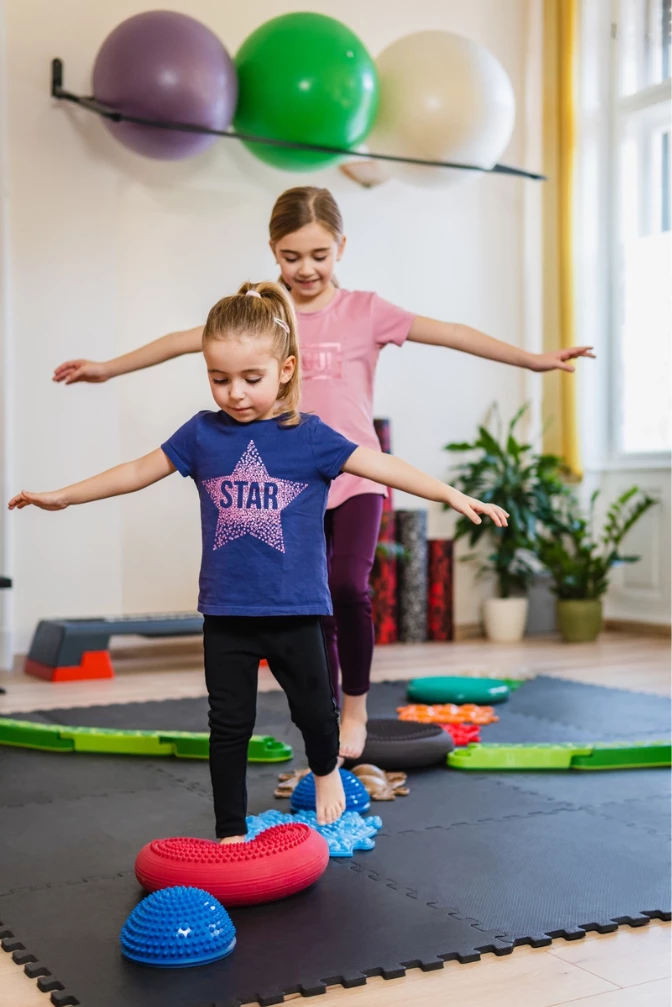
This is often associated with a sinking of the transverse arch, when the transverse arch between the toes of the first and fifth metatarsal heads sinks. To help the arch develop and to correct the flat feet that have already developed, it is worthwhile to perform foot exercises. For children, the equipment can be used to make the exercises more colourful and varied, making them more enjoyable and more enduring.
Our physiotherapy treatments for children
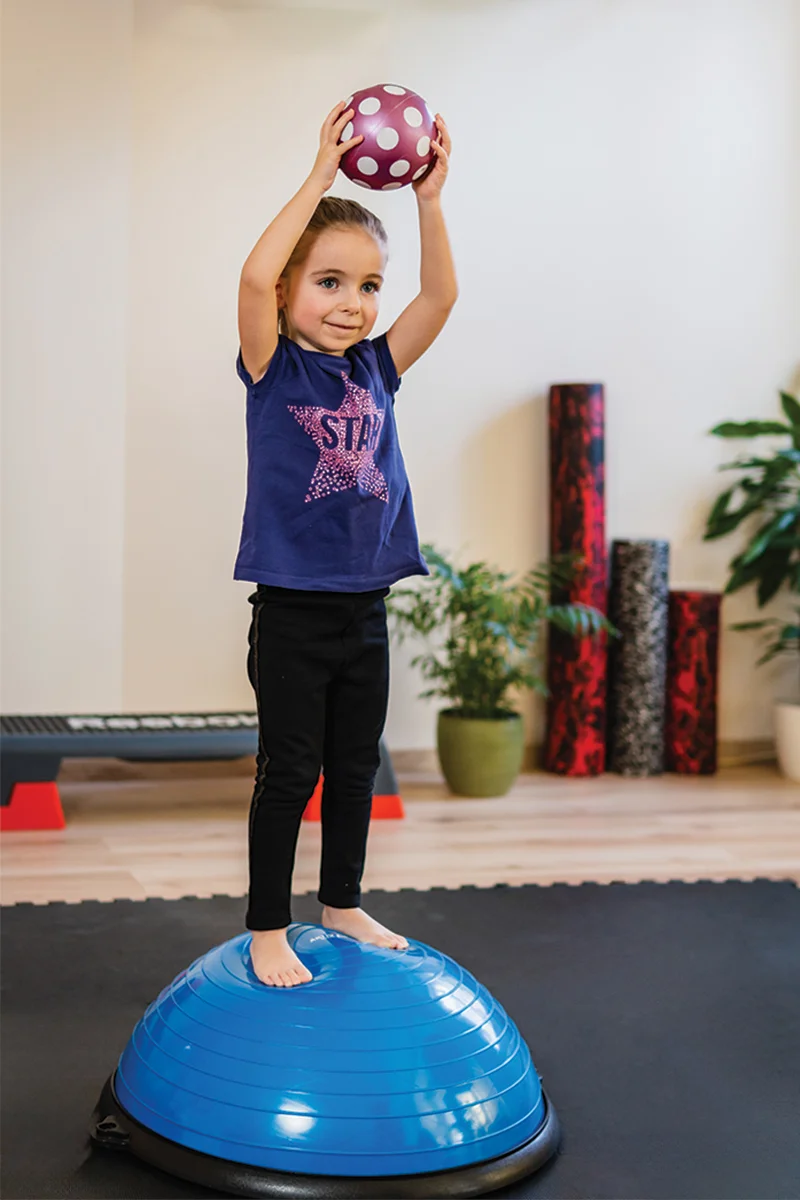
- Active physiotherapy: strengthening muscles, activating, practising and learning new functions through playful, varied exercises. Restoring muscular balance, stretching tight muscles that tend to contract and strengthening weaker muscles that tend to stretch.
- Early development: correction and activation of age-appropriate movement functions, normalisation of abnormal muscle tone, mobilisation of joints, reduction of abnormal reflexes, strengthening of muscles, initiation and facilitation of movement development, development of coordination and balance, and the elicitation of certain responses
- Postural gymnastics, spinal gymnastics
- Treatment of scoliosis Schroth 3D scoliosis therapy
- Manual techniques
Working together with a parent
We try to make the sessions colourful, with different exercises and a variety of tools. Communication with parents, setting common goals and working together is very important. We also give parents tasks to do at home. With early treatment and professional development, disadvantages can be corrected and eliminated.
Prevention is crucial, but established conditions can be well treated, often conservatively. It is also advisable for children who are active to learn a personalised, easy-to-follow physiotherapy routine to avoid pain and deformity and to improve sports performance.
Continuous improvement
Physiotherapists are constantly undergoing special training to provide the most appropriate therapy and development for children. As an example, the qualification of Specialist Paediatric Rehabilitation Therapist and the Specialised Manual Technique of the Eddy are in progress.

Call us

Online booking