Specific scar treatment
As science advances, the range of options for scar therapy continues to grow. It is very important to know that it is never too late to start scar treatment!
Functional improvement is possible at any time post-injury. We can effectively treat scars from various injuries, surgeries, plastic surgeries, whether it is a scar from a traumatic injury, a scar from a caesarean section, a scar from abdominal surgery or even a scar from a breast augmentation.
What exactly is a scar?
A scar is a collagen-rich replacement tissue created to replace dead tissue. It forms as a result of injury or surgery when the original tissue is no longer able to reproduce itself. The scar tissue that forms at the site of an injury loses its original functions, has no skin pigment, so it will not tan, has no sweat or sebaceous glands, and does not grow hair or nails. There are not only skin scars, injuries to muscles, tendons, joint capsules and organs are also healed by scarring.

During wound healing, a significant amount of collagen is produced to stabilise the damaged area. The scar is an unstable tissue that constantly searches for a fixed point and pulls it towards itself when it finds it. This can lead to tissue adhesions, which can cause musculoskeletal or even internal organ problems.
Musculoskeletal scars can narrow the range of joint movement and disrupt muscle balance. Scarring affecting internal organs can cause many complaints, you might not think, but a bowel scar following the removal of a particular section of bowel can cause abdominal pain, bloating, constipation and even painful flexion of the hip joint.
According to statistics, in 60-70% cases, a complaint develops within a year and a half after the scar has formed!
The so-called skin scar on the surface of the skin is just the “tip of the iceberg”. So a well-healed scar can be bumpy and problematic under the surface, while a badly scarred scar with a defect can be problem-free.
For scar management, it is important to be aware of the tensile strength of the scar, which is 3% at 1 week, 30% at 3 weeks and 80% at 12 weeks.
Scar treatment is based on the scar defect
A scarring defect, i.e. abnormal scar formation, occurs when the scarring process is locally or systemically damaged. Local causes are circulatory disorders, infection. Systemic causes: internal diseases, individual genetic predisposition to the development of the defect, dietary habits. There are four known scarring defects, the recognition of which is the key to a basis for scar treatment is.
1. Hypertrophic scar
It is characterised by a nodular scarring, red, heavily vascularised, itching, protruding from the skin level, but not crossing the scar line. It often develops after burns and scalds. There is an imbalance between collagen formation and breakdown. Its spontaneous tendency to degenerate is 36 months!!!.
2. Keloid scar
A thickened benign mass of tissue that rises above the level of the skin, extending beyond the original lesion site, spreading beyond it, and encroaching on the surrounding intact tissue. Itching, painful, no spontaneous tendency to degenerate. In young, dark-haired women, it develops in the chest, back, shoulders.
3. Contracture scar
It is characterised by a funnel-shaped indentation. It develops after secondary wound healing processes, e.g. when the surgical site has had to be reopened due to infection. Most common after abdominal surgery at drains, sutures, burns, acne, piercings.
4. Atrophic scar
Too little collagen is produced at the site of the injury. A depression is visible on the skin. A common presentation is the site of BCG injection, acne.
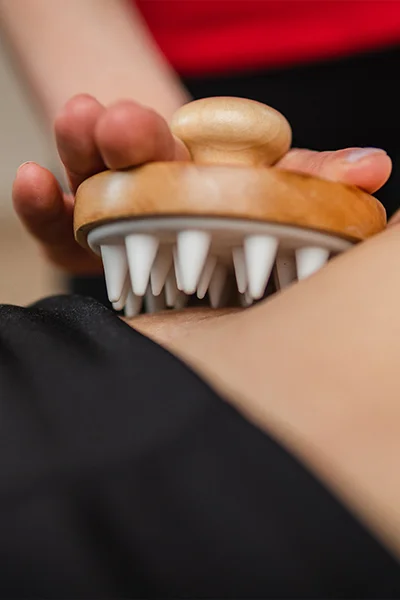
Forms of heat treatment
The two forms of scar treatment There are two types of therapy: manual and non-manual. In each case, the form of treatment is determined by the scar specialist after a thorough examination and tailored to the individual. A combination of both manual and non-manual forms of treatment can be used to achieve the individually effective scar treatment.
Manual forms of scar treatment
It is a highly effective treatment that targets the root cause of the complaints, i.e. the release of tissue adhesions. It is important to the results of scar treatment must be maintained by regular self-treatment by the patient, mobilisation training should be done: e.g. fascia training, yoga. Among the soft tissue manual therapies, FDM technique can achieve good results.
Non-manual scar treatment options
Non-manual scar treatment involves the use of some kind of assistive device to release the adhesions. Such a scar treatment method is flossing, a spitting, the SMR use of tools, the kinesio tape, the cross tape, the brush massage, the Penczel stick, and the dermaroller. The techniques recommended by the scar specialist are learnt and practised by the patient during the treatments, so that they can be used in the future as part of self-treatment.
How is scar treatment done at BMM?
We see patients by appointment, without waiting scar treatment for consultation and therapy. The first step is a thorough assessment and examination by our qualified therapist. The first step is a review of the medical documents relating to the injury or surgery that led to the scar. Please be sure to bring any related medical documents and final reports with you to your first consultation!
After taking the medical history, a detailed examination is performed: the scar is mapped manually and visually, its appearance, its mobility and any possible functional disturbances are detected. After the examination, our therapist will explain any abnormalities found and draw up a personalised treatment plan.
Scar treatment requires several suitable therapies, which uses specific methods to achieve individualised scar healing. It is important that the self-treatment techniques taught by the scar therapist are applied regularly in the patient's home between two guided sessions.
Duration of scar treatment always depends on the scar: the depth of the scar, the type of scarring defect, the severity of the abnormalities and scarring are largely determined. However, with proper scar treatment, the problems causing the complaint can be solved!

Scar treatment methods available in our private practice
- Fascia treatment: a therapeutic method for lesions of the connective tissue that envelops muscles and organs, i.e. fascia
- FDM therapy: special therapeutic holds to treat lesions of the muscular bladder
- Scar massage: manual scar treatment using a special massage technique
- Spitting: with this technique, the adhesive layers of the muscle bladder can be separated
- Flossing therapy: stimulation of muscles, joints, subcutaneous tissues by elastic rubber bands. Effective in helping the movement of adherent tissues, thus releasing adhesions
- SMR therapies: the SMR is a special therapeutic tool for self-massage, to release muscles and contractions. It can be used with exercises taught by the therapist to obtain quickly noticeable results
- Soft laser treatment: through biostimulation, the laser beam triggers and stimulates healing and cell regeneration, increasing blood and lymph circulation in the treated area. A scar treatment method that can be used to relieve pain, itching and inflammation. Does not treat adhesions alone
- Ultrasound therapeutic scar treatment
- Kinesio or cross tape Put up by
- Chopping stick application
Other non-manual scar treatment options
A scarring defect, i.e. abnormal scar formation, occurs when the scarring process is locally or systemically damaged. Local causes are circulatory disorders, infection. Systemic causes: internal diseases, individual genetic predisposition to the development of the defect, dietary habits. There are four known scarring defects, the recognition of which is the key to a basis for scar treatment is.
1. Corticosteroid injection
A local injection scar treatment that chemically dissolves tissue adhesions. It achieves a reduction in the height of the treated scar.
2. Criotherapy
Also known as cold therapy treatment, after which the scar becomes flatter and softer, but it cannot dissolve the tissue deposits.
3. X-ray irradiation
For keloid scar defects, its use should be considered after corrective surgery. Therapy to be performed only on the advice of a specialist.
4. Scrotal release operations
In many cases it can provide a solution, but corrective surgery also heals with scarring. Scar management is also required after corrective surgery.
5. Creams
In many cases, external treatment of the scar with a cream containing allantoin, uric acid or heparin is recommended. These can fade the scar and reduce itching, but they do not work on the subsurface deposits.
6. Aromatherapy
High in vitamin E, elasticising oils can be used externally, e.g. wheat germ oil, shea butter, calendula oil. Regenerating oils: macadamia nut, argan oil. Tissue regenerating oils: lichen seed oil, wild rose oil. These should be applied to wet skin or sprayed over the affected area with aromatic water.
Our physiotherapists
Tímea Szentpétery
Physiotherapist

Dorottya Sándor
Physiotherapist

Krisztina Tatai
Physiotherapist
Major Rita
Physiotherapist

Call us

Online booking