The Conductive Pedagogy
What is conductive pedagogy?
The system of conductive pedagogy, also known as conductive education, is a true Hungarian heritage, the creator of which is András Pető.
Conductive pedagogy has a holistic view of the human being, seeing the human being as a multifaceted entity, the whole of body-mind-spirit. It is a method for the development of people with damage to or disease of the central nervous system. It can achieve very good results in the complex development of people with disabilities.
Conductive pedagogy aims to promote the development of gross and fine motor, cognitive and social skills. The synergistic application of educational, psychological and rehabilitation techniques will enable patients to achieve a better quality of life and to develop the most active and self-sufficient constructive lifestyle possible, according to the individual's abilities.

When is conductive education recommended and for whom is it most helpful?
Conductive pedagogy can be used for both adults and children. It can be effective at any age, but children often have greater developmental potential because of the greater flexibility of the brain.
Conductive education for children
For children in continuous development, the method of conductive pedagogy can be part of a careful education. This can improve the life chances of young children and give them the opportunity to reach a fuller adulthood.
We welcome children for conductive education in the following cases:
- Children not born at term
- Nervous system involvement
- Severe and mild motor developmental delay
- Foot and spine deformity
- Sensory hypersensitivity
- Sensory, intellectual or speech disability
- Disabled person with an altered state of mobility
- Cerebral palsy in children
For children of preschool age (3-6 years), our aim is to provide adaptive development based on individual abilities and needs, according to age-specific needs, in a playful way. This is done in a complex way, through the development of movement, reason, speech and communication, manipulation, play, perception, self-care, balance, eye-hand and eye-foot coordination, and social skills. The sessions are delivered in groups or through differentiated individual development.
Of course, significant results can be achieved not only with pre-school children, but also with older children.
If you feel that your child may need conductive education, but the symptoms/illnesses listed above do not fully match, please feel free to contact BMM. Our Conductor, Darai Lili help.
Conductive pedagogy for adults
Conductive pedagogy is not just for children, it can also be used to develop adults. In older age, it is recommended to start therapy in the following cases:
- Cerebral paretic
- Traumatic brain injury
- Foot and spine deformity
- Various post stroke conditions (haemiparesis, aphasia)
- Parkinson's disease
- multiple sclerosis
In the case of adults, our primary goal is the rehabilitation and social integration of people with disabilities, helping them to achieve as much independence as possible.
We pay particular attention to:
- learning to change individual situations
- developing large and fine motor skills
- symmetrical body positioning
- reduction of abnormal co-movements
- developing eye-hand coordination
- awareness of directions
- improving grip-release
- developing logical thinking and attention
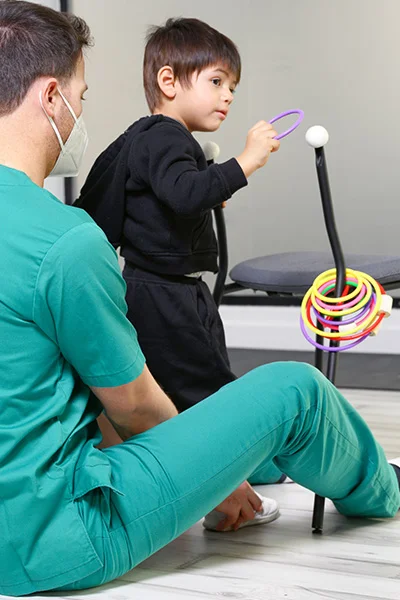
Conductive pedagogy is available in individual and small group formats
When our patients enter the world of conductive pedagogy, they are invited to individual and small group adventures. The development journey starts with the first assessment, where we set personalised, achievable short and long-term goals.
After creating an atmosphere of trust and security, the we not only teach our patients, we inspire them to improve. We will start on a common path that involves learning the so-called “orthomotor solutions”. In addition to focusing on the development of individual abilities and skills, we naturally take age-specific factors into account in conductive education.
Our primary goal is to eliminate unwanted movement patterns, develop the nervous system and promote daily activity. Key to this process is the gradualism, a regularity and the consistency compliance with. Practicing what you learn in therapy sessions at home will reinforce what you have learned and help you achieve the best results.
It is worth noting that conductive pedagogy does not only focus on physical development. It is a holistic approach that balances physical, intellectual and emotional development. For this reason therapy sessions often include playful elements and creative techniques, to help you enjoy the learning process. All of these contribute to the development of the whole person and promote independent living.
Conductor therapist

Darai Lili
Conductor

Call us

Online booking