Shoulder dislocation


-
The shoulder joint is one of the most complex joints in the human body. The joint between the head of the humerus and the shoulder blade is the joint with the widest range of motion. The whole joint is surrounded by the joint capsule and a wide cartilage (labrum glenoidale) is placed on the surface of the scapula to increase the surface area of the articular groove. In addition to the above, the complex ligamentous system of the joint and the presence of active stabilising muscles, the rotator cuff is.
The shoulder instability one of the main causes is loose and overstretched ligaments that do not stabilize the stumps properly, which can lead to partial shoulder dislocation (subluxation) or complete dislocation of the joint.

Dr. Bálint Major
Company Specialist
Orthopedic-traumatologist general practitioner
ONLINE APPOINTMENT BOOKING – BOKOR STREET CLINIC
Please select the appropriate service
Control fee: HUF 35 000, for 3 months after the initial examination, for the same complaint.
- 1. Select the service you need from the drop-down box!
- 2. Use the calendar to choose a date that suits you!
- 3. Enter your details to register or login with your previous registration!
- 4. If you would like to make a reservation on behalf of someone else (e.g. your child), please let us know at the location provided.
- 5. Briefly describe your complaints!
- 6. Select the type of consultation: initial examination, control examination or prescription.
- 7. Click on the button to book your appointment. Thank you for choosing BMM!
If you are unable to make the appointment you have already booked, please, at least 24 hours before notify us of your intention to withdraw. This gives other patients the opportunity to get the medical care they need in time. Thank you for your cooperation and understanding!
Resignation: +36 1 44 33 433
If you cannot find an available appointment for your chosen week, please call our call center on +36 1 44 33 433 for assistance. Our staff will be happy to help you make an appointment with the doctor of your choice or another specialist according to your complaint.
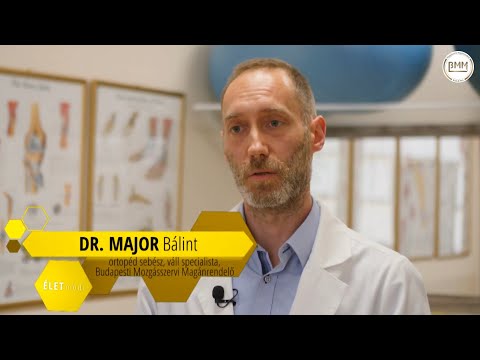
In the case of a shoulder dislocation, the rotator cuff may also be damaged.
Dr. Bálint Major talked about rotator cuff syndrome in the magazine "Lifestyle".
Development of shoulder pain
There are basically 2 well-defined causes of shoulder disfigurement:
- Most often, some kind of trauma leads to shoulder dislocation. This trauma is the result of some external influence. Usually a fall, other accident, or sports injury is due to.
This is the case, for example, if someone's shoulder is dislocated or they fall on their outstretched arm or elbow and hit their shoulder indirectly. This causes the joint capsule, the labrum (cartilage ring that supports the articular cartilage) and ligaments to be severely stretched or damaged.This event results in the shoulder losing the function of its stability elements, or in simple terms, dislocating. - The other case is when the shoulder fucking behind the shoulder joint instability or a traumatic dislocation contributes to later instability. In the vast majority of cases, forearm laxity is a congenital disorder. In this type, the shoulder can be completely or partially dislocated in any direction without any particular trauma, even as a result of a wrong movement.
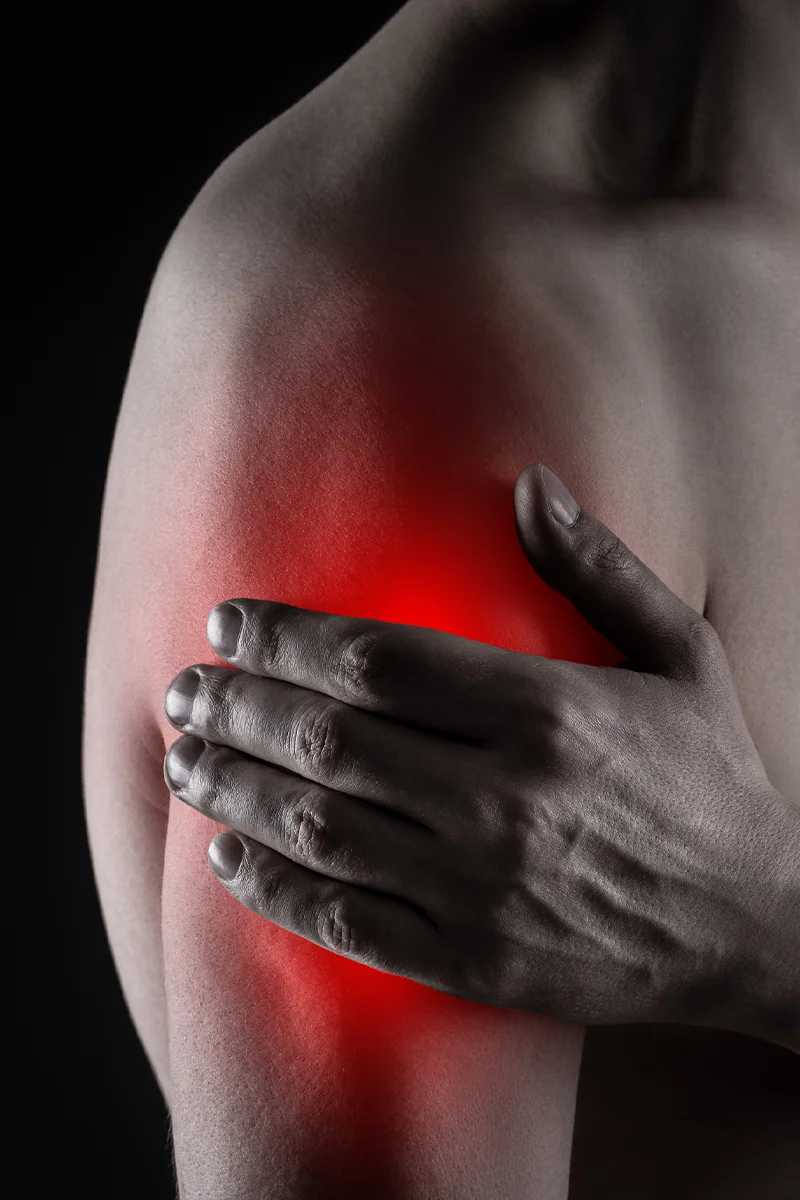
Causes of shoulder disorder can be
- Trauma (ligament, labrum tear, compression fracture of the joint head)
- Developmental abnormality, underdevelopment of the articular surface
- General joint laxity
- Disorder of muscle function
The shoulder fracture can also be classified by direction
- Front-bottom
It is the most common of the shoulder dislocations, and is most common in younger people and active athletes - Rear
The rear shoulder dislocation is typical for about 5% cases - Multidirectional
The shoulder joint is abnormally mobile in several directions, often due to genetic predisposition, connective tissue weakness or previous injury
Symptoms of shoulder dislocation
The symptoms of shoulder dislocation are fairly easy to recognise. The person suffering a shoulder dislocation clearly feels that the limb is out of place, experiences severe pain and is unable to move the limb properly. Signs of dislocation, i.e. a dislocated shoulder, are clearly visible to the eye. The main symptoms of shoulder dislocation may include:
- Intense and very sharp pain
- Instability, feeling of insecurity during the intention to move the arm
- Deformation of the injured shoulder depending on the direction and degree of displacement
- Swelling of the joints
- Typical posture - displacement of the upper limb can cause the patient to be forced to hold the posture, usually unable to straighten up completely
In some cases, the shoulder becomes so unstable that it often leaves the diaphragm regardless of activation. Recurrent dislocations often occur if the injury is not treated properly.
Replacing a dislocated shoulder
Shoulder dislocation can be treated conservatively (non-surgically) or surgically. The type of treatment depends on the extent and severity of the dislocation and other possible injuries to the shoulder.
It is important that the dislocated shoulder do not try to put it back in place at home. Anyway medical care is needed the right way to tackle the problem.
Treatment of shoulder pain
First and foremost, once the doctor has examined the limb, an X-ray examination is taken. The X-ray examination can determine whether a complex injury, such as a broken bone, has occurred.
- If nothing is torn or broken, the dislocated shoulder is followed by a manual reposition. So the doctor pulls the limb back into place. This is very it is important that the patient can relax, If this fails, the humerus is placed back into the socket under anaesthesia.
- If the dislocation was traumatic and severe, with a broken bone or a rotator cuff tear, then surgical intervention needed. Surgical repair of the shoulder dislocation usually done arthroscopically. However, there are cases where open surgery is warranted. This is mainly necessary in cases with severe bone fractures.
More about shoulder dislocation surgery:
https://bmm.hu/muteti-kezeles/vallficam-mutet/
Dr. Balázs Gloviczki PhD
Orthopaedic-traumatologist, shoulder specialist
Online appointment booking for Budafoki út:
Please select the appropriate service
Control fee: HUF 35 000, for 3 months after the initial examination, for the same complaint.
- 1. Select the service you need from the drop-down box!
- 2. Use the calendar to choose a date that suits you!
- 3. Enter your details to register or login with your previous registration!
- 4. If you would like to make a reservation on behalf of someone else (e.g. your child), please let us know at the location provided.
- 5. Briefly describe your complaints!
- 6. Select the type of consultation: initial examination, control examination or prescription.
- 7. Click on the button to book your appointment. Thank you for choosing BMM!
If you are unable to make the appointment you have already booked, please, at least 24 hours before notify us of your intention to withdraw. This gives other patients the opportunity to get the medical care they need in time. Thank you for your cooperation and understanding!
Resignation: +36 1 44 33 433
If you cannot find an available appointment for your chosen week, please call our call center on +36 1 44 33 433 for assistance. Our staff will be happy to help you make an appointment with the doctor of your choice or another specialist according to your complaint.
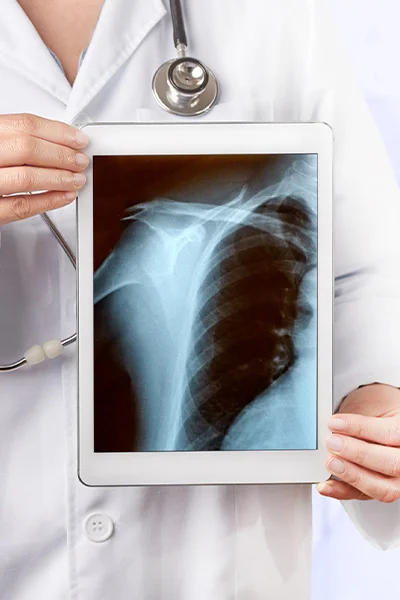
The role of shoulder X-rays
In the case of a varicose vein, the X-ray examination is the primary tool to help the doctor. Based on the X-rays, the doctor can decide which method to use to put the dislocated shoulder back in place.
After being manually or surgically the repositioning is done another X-ray is taken, which serves several purposes:
- Check
Repeated X-rays are necessary primarily to make sure that the doctor is satisfied that the shoulder joint has been properly repaired. - Exclusion of injuries
Shoulder dislocation can be associated with the injuries already mentioned (broken bones, cracks or other injuries around the shoulder joint). These injuries may be small or hidden and not visible on the first X-ray. Once the shoulder is repaired, these abnormalities are easier to detect. - Avoiding complications
If the reduction is inadequate, it can cause further injury or increase joint instability, which can lead to problems later on. Repeated X-rays will help to detect such potential problems early.
Shoulder ficam healing time
The healing time for a shoulder dislocation, post-injury rehabilitation and return to normal activity takes 4-6 months, depending on the extent and severity of the shoulder dislocation. The rehabilitation of a dislocated shoulder is particularly important physiotherapy, regardless of the type of injury and the treatment.
The best and most effective long-term treatment for dislocations due to looseness of the shoulder is to strengthen and maintain the shoulder muscles. In the case of loose shoulder joints, this is the best way to prevent further dislocations.
In case of complaints, please contact Dr. Bálint Major a shoulder surgeon with decades of experience helping people who want to heal!
The most common shoulder conditions treated by our specialists:
Our specialist doctors
Dr. Bálint Major
Specialist in orthopaedics and traumatology
Dr. Balázs Gloviczki PhD
Orthopaedic-traumatologist, shoulder specialist

Dr. György Kocsis PhD
Orthopaedic trauma surgeon and hand surgeon, assistant professor, specialist in wrist, elbow and shoulder surgery, upper limb specialist

Dr. Ferenc Tompai
Orthopaedic and trauma surgeon