Golf books


Five times more common tennis elbow Although golf elbow is rarely mentioned, it is a condition that makes life difficult for many people, often with severe pain and loss of grip. Golf elbow causes symptoms on the inner surface of the elbow. It is caused by an overuse of the flexor muscles and a series of recurrent microtraumas. You don't have to live with the pain, nor should you, but the symptoms of golf elbow can be effectively relieved or eliminated. The team of trained doctors at Budapest Musculoskeletal Private Clinic offers fast and accurate diagnosis and state-of-the-art therapeutic procedures to patients seeking recovery at several locations in Budapest.
Dr. György Kocsis PhD
Orthopaedic trauma surgeon and hand surgeon, assistant professor, specialist in wrist, elbow and shoulder surgery, upper limb specialist
How is golf elbow formed?
Golf elbow (Latin: medial epicondylitis) is caused by overuse of the flexor muscles of the elbow and the resulting microtrauma. It can cause severe pain and inflammation. Overuse can be caused by sports but also by other strenuous activities.
Common causes of golf elbow:
- Sports involving throwing, throwing motion, such as golf, baseball, handball, javelin throwing.
- In tennis, it can also be caused by a high-force serve and a tennis racket that is too heavy (incidentally, a more common tennis-related lesion is called tennis elbow, which causes a lesion on the outer surface of the elbow and affects the forearm's extensor muscles).
- For monotonous, strenuous hobbies involving prolonged movements. Examples include hoeing and gardening.
- Carrying heavy suitcases or other heavy objects for long periods of time on a regular basis.
- The frequent use of axes, chainsaws and other hand tools over long periods of time can also cause golf elbow, typically an occupational hazard.
What are the symptoms of golf elbow?
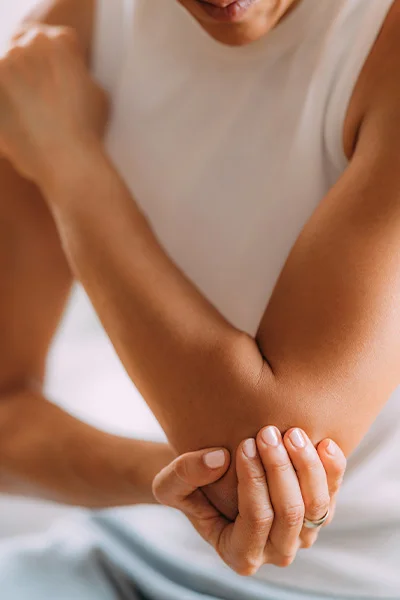
A typical symptom of golf elbow is pain on the outside of the forearm, on the little toe, which can extend from the elbow to the wrist. The pain is felt and increases when the wrist is bent towards the palm. In addition, the inner elbow bumps become sensitive to pressure and the elbow may swell. Grip may become weak and patients may find it difficult to grasp objects.
What are the varieties of golf elbow?
Golf elbow can be classified according to the severity and extent of the damage. Tendonitis caused by a recent golf elbow can also cause severe pain. If treatment is started in time, rest and conservative therapy can often quickly relieve symptoms.
Golf elbow is more advanced and usually heals more slowly if the inflammation has already affected the periosteum at the end of the humerus.
If the strain on the elbow is continuous (for example, in competitive athletes, people doing strenuous physical work), tendonitis can become prolonged and chronic. In this case, permanent damage to the tendon can also be expected, it can become scarred and shrunken. In such cases, conservative therapy is not always sufficient and surgical intervention may be necessary.
How is golf elbow diagnosed?
Do your elbows and forearms hurt? Do you feel pain on the inside of the forearm and especially when bending the wrist? Your symptoms may be caused by golf elbow, but they may also be similar to other health problems. So it is definitely recommended an orthopaedic specialist who will diagnose the lesion that is causing the painful symptoms.
The doctor will first ask you questions about your symptoms, which may include your lifestyle, work, any medications you may be taking, other past and present medical conditions, and surgery. This information will greatly help to make an accurate diagnosis, so the doctors in our private practice always take the time to take a medical history.
Then comes the physical examination. The orthopaedic doctor palpates the elbow joint, checks for tenderness in any area, and then examines the range of motion by moving the joint. An imaging scan is not usually necessary to diagnose golf elbow, but may be ordered to rule out other elbow conditions.
At the end of the examination, the specialist will tell you what disease he or she has diagnosed as the cause of your symptoms and give you all the relevant information. If you have any questions, feel free to ask them. The doctor will also suggest a personalised treatment plan, which is more often conservative therapy and less often surgery.
Managing the golf elbow
Gulf elbow responds well to conservative therapy in most cases, but surgery may be considered for more advanced conditions with more severe pain.
The aim of conservative treatment is to reduce pain and inflammation and to restore the original functions of the joint (optimal weight-bearing capacity and range of motion). Resting the arm is essential to reduce the symptoms of golf elbow. The sooner you start resting your arm after the onset of symptoms and the sooner you see a doctor, the faster and more complete your recovery will be. Sports and other activities that cause pain are recommended to be avoided at least until recovery. If the pain subsides, it is still advisable to exercise moderately. It is recommended that the forearm be immobilised with a splint or sling during the healing period.
To relieve severe pain and inflammation, it can be helpful to ice the painful area. To do this, wrap ice in a towel and place it on your elbow for up to 20 minutes, 3-4 times a day. It is easier if you use a cold-warm therapeutic pad for this purpose.
The doctor may also recommend anti-inflammatory and painkilling medicines and creams. You may also need steroid injections. A physiotherapy and physiotherapy treatments can also help restore the original functions of the arm. Physiotherapy helps to stretch the muscles around the elbow, relieving stiffness and helping to strengthen them.
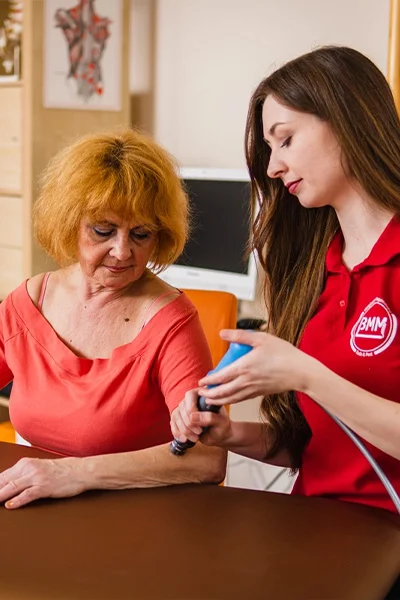
At the Budapest Musculoskeletal Private Clinic shock wave therapy we also help to heal the symptoms of golf elbow. It is a very effective electrotherapy method. Repeated 15 minute shockwave treatments can produce significant and lasting improvements in as little as 3-4 weeks in 80% cases! For good results, 1 short treatment per week may be enough. During the treatments, energy is delivered to the body in the form of waves, improving circulation locally and triggering the healing process. And the pain associated with golf elbow is quickly and permanently reduced.
Conservative therapy is usually sufficient for golf elbow. If this is not successful, or if the tendon is severely shortened and scarred, surgery may be required. The procedure is usually performed by our doctors as part of a day's surgical treatment. During the operation, the shortened, calcified parts of the tendon are removed from their attachment points, thus eliminating the tension and pain. Post-operative physiotherapy is a great aid to recovery.
Can golf elbow be prevented?
There is no 100% method to prevent golf elbow, but there is a lot you can do to prevent it.
- It's important to always warm up your muscles before exercising, and it's also a good idea to do gentle stretches. It is advisable to seek the help of a coach or trainer to learn the technique of the sport precisely. Incorrectly performed movements put extra strain on the tendon and can easily lead to tendonitis.
- If you feel pain during exercise, stop immediately and rest your arm a lot in the following days. If the pain does not go away, see a specialist as soon as possible.
- Do not do strenuous movements for a long time! For example, do gardening for shorter periods several times a week rather than once for half a day.
Are you suffering from golf elbow symptoms? Do you have other musculoskeletal complaints? Can't move as well as you used to? Make an appointment at the Budapest Musculoskeletal Private Clinic for a specialist examination by calling +36 (1) 44-33-433.
We employ the best and most dedicated orthopaedic specialists in the profession, who offer effective and personalised solutions to patients who come to us.