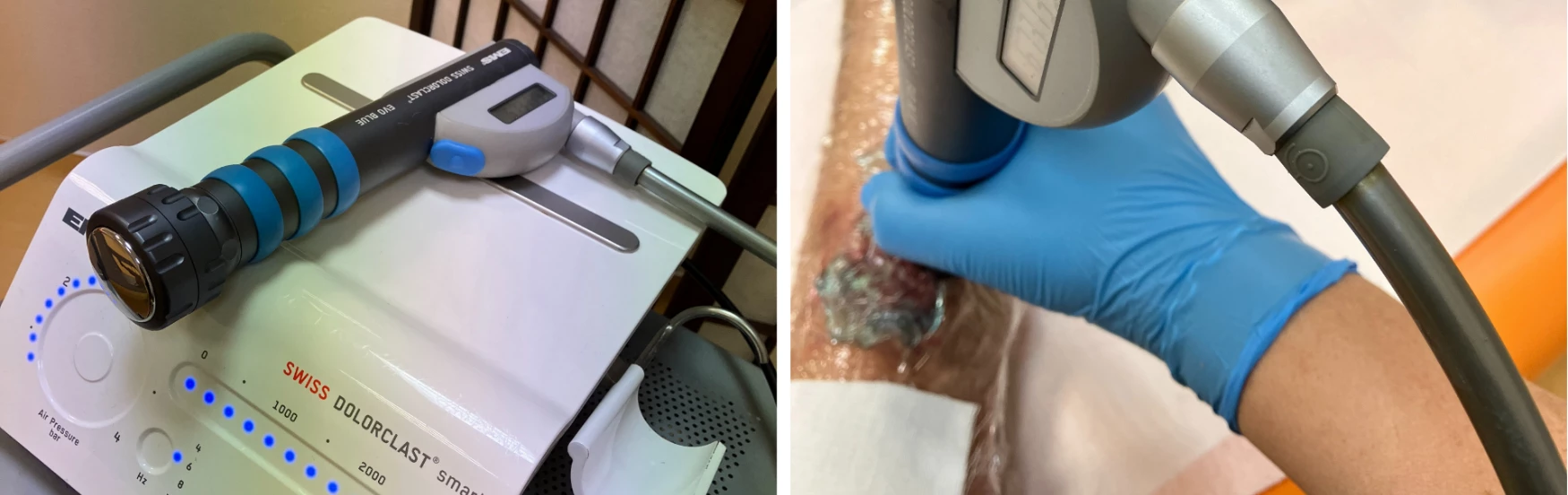
Wound treatment with shockwave therapy
Author Mónika Hegedűs | 2022.05.10.


Do you have a wound that is difficult to heal and causes you a lot of pain and difficulty in your daily life? The solution is the modern wound treatment of the 21st century, shockwave therapy, which increases wound healing to 90% efficiency. Wounds that have been a problem for a long time heal very nicely: they contract quickly, pain and inflammation are reduced - all without side effects. This method of wound treatment is only available in a few places in the country. In the Budapest Musculoskeletal Private Clinic, Mónika Hegedűs, wound therapist and shock wave specialist, is waiting for patients who want to heal.
Shock wave therapy in wound care
Shockwave therapy works with sound waves. It was originally developed to treat joints. Over time, it was recognised that it could also be used to treat wounds. In wound care, an improved form of shock wave therapy is used. This method is only used in a few places in Hungary because few specialists have the necessary knowledge. Shockwave therapy is an additional aid in wound management that significantly increases the effectiveness of wound healing.
How does shockwave therapy work?
Shockwave therapy uses a compressed air machine that uses sound waves to stimulate circulation deep within the tissues. It delivers oxygen-rich blood to wounds that are difficult to heal, speeding up the regeneration process and helping new cells to form faster. This means that the healing process can begin and wound care becomes much more effective.
It could be said that therapy can transform a slightly lifeless wound into a healthy, more vital wound. During the first treatment, the wound will start to bleed minimally, but that's a good sign! The deep strokes will deliver oxygenated blood to the wound, allowing it to heal nicely.
Which wounds does the method help to heal?
Shockwave therapy is a very effective way to help ulcerative wounds and the accident wounds recovery. It is not used to treat surgical scars as it is not a scar treatment. However, in the case of sex or difficult-to-heal surgical wounds you should take advantage of this method.
How many treatments are needed?
It is personalised, depending on the size and depth of the wound. Our wound care specialist will be able to tell you at the first appointment how many treatments you are likely to need, how often you should have them and how long it is likely to take for your wound to heal.
Typically 1 treatment per week is needed, and in most cases you can achieve good results in 5 weeks. The smaller the wound, the faster the healing. That's why it's a good idea to start treatment as soon as possible.
How is wound treatment with shockwave therapy carried out?
Shockwave therapy is an additional, very effective adjunct to wound care. The treatment is carried out according to the following schedule:
- Shockwave can only be used to treat wounds that have been cleaned by a specialist and are free of discharge. Therefore, the the first step is to clean the wound thoroughly and precisely. This prevents the bacteria that cause inflammation from spreading throughout the body.
- Then cover the wound with sterile foil, then apply a contact gel.
- Then comes the shock wave treatment. Our specialist “pushes” the wound with a lower bar pressure and a higher Hz frequency, always with a number of strokes between 1 and 3000, according to its size. Larger wounds should be treated with a higher number of strokes. Shockwave treatment is associated with minimal minor pain, and some patients feel no pain at all during wound treatment.
- Finally, the last step dressing the wound. To do this, our specialist uses the optimum bonding material for you.
Shockwave treatment time depends on the size of the wound, typically lasting about 10 minutes. The wound treatment itself can take longer than this due to cleaning and dressing:
A patient spends as much time with me as their wound needs. If 10-15 minutes is enough for optimal wound care, then 10-15 minutes. But if his wound needs 1.5 hours for thorough cleaning and dressing for the most effective wound healing, I will spend 1.5 hours with him. I always strive for 100% in my work, I see my profession not as a job but as a vocation. I am happy together with my healed patients, because it is very important to me that they leave the surgery satisfied, pain-free and healed.
Mónika Hegedűs
The BMM wound care and shockwave specialist
The first meeting typically takes longer because it is when our wound care and shock wave therapist will assess the wound and ask the patient about any complaints. He or she will then give you full details of the shockwave treatment, the proposed therapy and the expected outcome.
Contra-indications
There are also contraindications to the use of shockwave therapy for wound treatment. Examples include periostitis and very severe vasoconstriction. If you cannot be treated with shockwave, our specialist can still help you with other methods. With thorough wound cleansing and a professional wound management process, most wounds can be healed, even if more slowly than if the wound treatment is combined with shockwave therapy.
Is it difficult or impossible for your wound to heal? Is it causing you a lot of pain and making it harder to move? You can also contact our wound treatment and shock wave specialist, Mónika Hegedűs with confidence.
Mónika Hegedűs has been working in the health sector for 37 years and is a specialist in the treatment of leg ulcers and hard-to-heal wounds. She uses a very effective wound treatment method, including shock wave therapy. This allows wounds to heal better, faster and more beautifully.