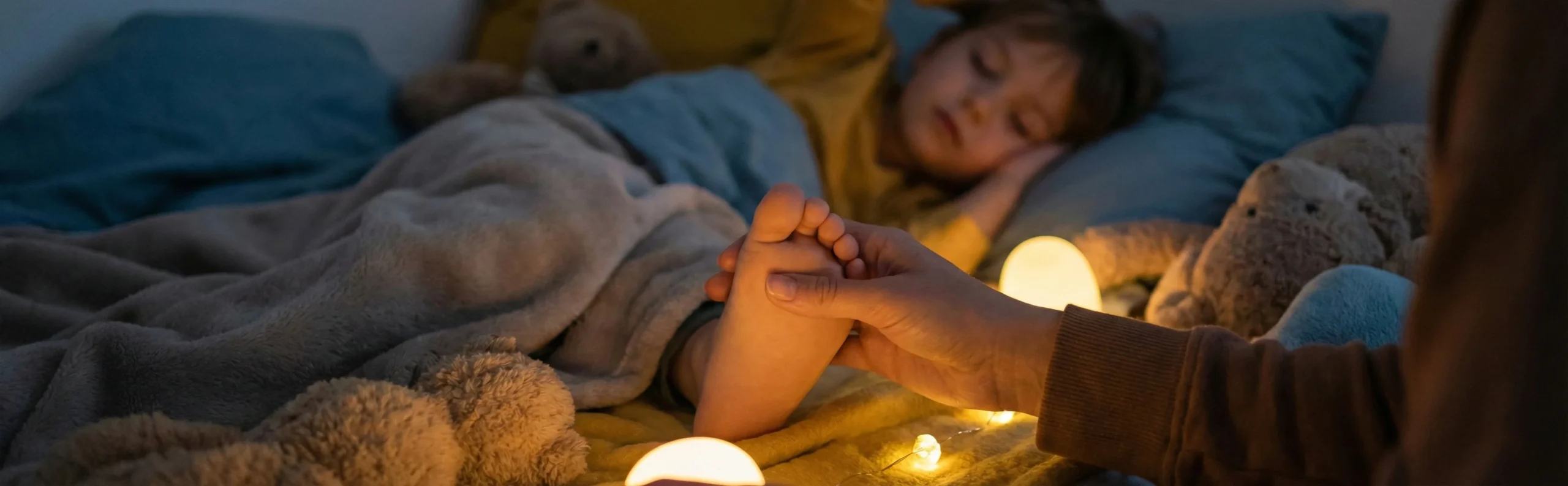
Childhood foot pain at night - what does „growing pains” really mean?
Author Dr. Ákos Morvai | 2026.02.13.


At the end of the day, many parents are familiar with the situation where a fully active, happy child wakes up at night or in the evening crying and with a sore foot. During the day, there is no sign of a problem, but in the evening the complaint appears. The expression is often heard: growing pains.
Although this name is widely used, it is not medically accurate. It is therefore important to understand what the condition is, why it develops, when it is considered harmless and when it is appropriate to seek medical advice again.
What is growing pains in childhood?
Growing pains are a common, benign childhood phenomenon that occurs mostly in preschool and school-age children. It is associated with recurrent, intermittent leg pain, mainly affecting the lower limbs.
Based on current medical knowledge not caused by bone growth, and does not show any correlation with rapid growth phases. The name is therefore misleading, but the term is still used in the literature to describe the phenomenon.
This is one of the most common reasons why parents request a paediatric orthopaedic examination for recurrent night-time leg pain.

Dr. Ákos Morvai
Paediatric Orthopaedic and Neuro-orthopaedic Surgeon
Online appointment booking for Budafoki út:
Please select the appropriate service
For paediatric orthopaedic examinations, please book the appointment in the child’s name and enter the child’s details.
The follow-up consultation fee is valid for 3 months after the initial examination, for the same complaint.
- 1. Select the service you need from the drop-down box!
- 2. Use the calendar to choose a date that suits you!
- 3. Enter your details to register or login with your previous registration!
- 4. If you would like to make a reservation on behalf of someone else (e.g. your child), please let us know at the location provided.
- 5. Briefly describe your complaints!
- 6. Select the type of consultation: initial examination, control examination or prescription.
- 7. Click on the button to book your appointment. Thank you for choosing BMM!
If you are unable to make the appointment you have already booked, please, at least 24 hours before notify us of your intention to withdraw. This gives other patients the opportunity to get the medical care they need in time. Thank you for your cooperation and understanding!
Resignation: +36 1 44 33 433
If you cannot find an available appointment for your chosen week, please call our call center on +36 1 44 33 433 for assistance. Our staff will be happy to help you make an appointment with the doctor of your choice or another specialist according to your complaint.
Typical symptoms of foot pain in children
The symptoms of growing pains are so characteristic that in many cases the pattern of complaints is enough to suggest a diagnosis.
The pain most often occurs in the shin area, is usually bilateral, occurs in the evening or at night, resolves completely in the morning and does not cause limping or permanent limitation of movement.
The child is active during the day, running, jumping, playing sports, and the pain does not affect his daily movements in any way. The symptoms return intermittently and may disappear for weeks or months. This fluctuating nature is a very important feature.
What causes night-time leg pain in children?
The exact cause is not known, but research has clearly shown that not inflammatory, not a bone or joint disease, and not a developmental disorder is behind it.
A more likely explanation is that the muscles become fatigued during daytime exercise, and by the evening the nervous system's perception of pain becomes more sensitive. Some children may have a lower pain threshold, which may explain why they are the ones who have the complaint.
This is why pain typically occurs in the evening and at night, rather than during exercise.
How is growing pain diagnosed?
Growing pain is called a diagnosis of exclusion. This means that the child's physical examination is completely normal, the pattern of complaints is typical and there are no symptoms that would lead to suspicion of other diseases.
Typically, no blood tests, X-rays or other imaging tests are needed. Diagnosis is based on the nature of the symptoms and the absence of abnormal findings on examination.
When is childhood foot pain not considered harmless?
Although growing pains are benign, if certain symptoms occur, a repeat medical examination is necessary.
Warning signs include pain that persists during the day, always occurs in the same spot and is pressure sensitive, swelling or redness of the joints, a limping child, fever, weight loss or general malaise.
These no longer fit the typical picture of growing pains.

What can a parent do if a child complains of leg pain?
The most important thing is to calm the child and relieve the pain. As the phenomenon is harmless and self-limiting, the aim of treatment is to improve comfort.
In many cases, gentle massage of the painful area, stretching the muscles, warm compresses and making the child feel safe will help. Painkillers can be given occasionally, if necessary, in age-appropriate doses.
Growing pains are therefore one of the most common causes of nocturnal childhood foot pain. It is benign, does not cause permanent damage, does not affect the child's development and gradually disappears over the years.
The most important thing for parents is to recognise the typical symptoms and to know when a follow-up medical check-up is warranted. If in doubt, seek a paediatric orthopaedic opinion from BMM specialists.
Literature:
Adolf, S., Braun, S. & Meurer, A. Growing pains. Orthopaedic 48, 461-468 (2019). https://doi.org/10.1007/s00132-019-03745-2
Lehman PJ, Carl RL. Growing Pains. sports Health. 2017 Mar-Apr;9(2):132-138. doi: 10.1177/1941738117692533. epub 2017 Feb 8. PMID: 28177851; PMCID: PMC5349398.
O'Keeffe M, Kamper SJ, Montgomery L, Williams A, Martiniuk A, Lucas B, Dario AB, Rathleff MS, Hestbaek L, Williams CM. Defining Growing Pains: a scoping review. pediatrics. 2022 Aug 1;150(2):e2021052578. doi: 10.1542/peds.2021-052578. PMID: 35864176.
Smith M, Pacey V, Davies LM, Coventry J, Ilhan E, Williams CM. Assessments, diagnostic criteria and outcome measures for growing pains and persistent pain in the presence of restless leg syndrome in children: a scoping review. BMJ Open. 2025 Dec 3;15(12):e101989. doi: 10.1136/bmjopen-2025-101989. PMID: 41338633; PMCID: PMC12684109.
Hestbæk L, Lücking A, Jensen ST. Growing pains in Danish preschool children: a descriptive study. Sci Rep. 2024 Feb 17;14(1):3956. doi: 10.1038/s41598-024-54570-3. PMID: 38368453; PMCID: PMC10874442.