What are the symptoms of scoliosis?
Author Dr. Bence Balázs Moravcsik | 2018.10.20.


The spinal column is the supporting pillar of our body, whose function is to ensure posture and coordinate large movements. It is made up of vertebrae, giving your torso a strong and flexible skeleton.
Scoliosis, or scoliosis, is one of the most common problems today, which affects not only children, but also adults. Scoliosis is the we mean the bending of the spine, which usually involves a vertebral twist. As a result, the mobility of the affected vertebrae is significantly reduced, to the extent that the active straightening of the vertebral column may no longer be possible. With the rotation of the vertebra back stretch called rib hump, muscle hump in the lumbar region can develop.
Over time, untreated scoliosis can cause serious complaints and even daily obstacles in the patient's life. Screening and diagnosis in childhood, and the use of correct treatment is therefore of paramount importance.
How can scoliosis be recognised?
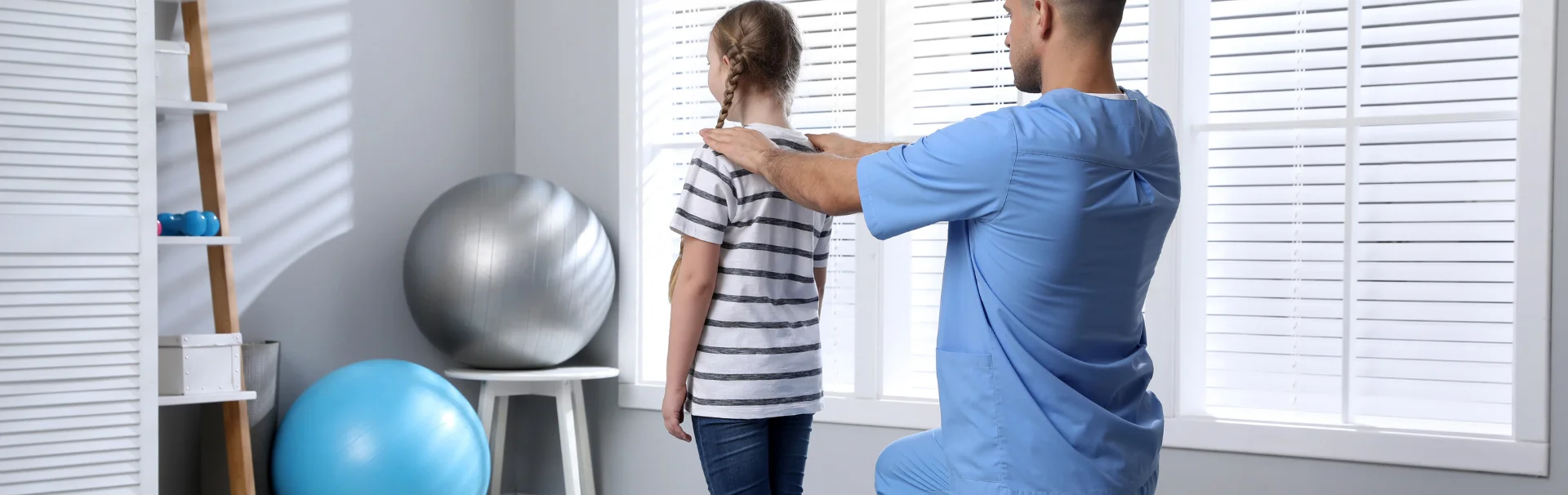
The most common symptom of scoliosis is that the one shoulder or hip is higher than the other. This is accompanied by a visibly bad posture, which the patient has difficulty or no ability to correct.
On negligence we are talking about when scoliosis has not yet developed, however, the poor posture is already becoming ingrained. Over time, this can develop into compulsive behaviour, which can be permanent, especially in children. Unfortunately, neglecting to address the issue of posture and downplaying its importance can lead to scoliosis, which can cause serious back and lower back pain as an adult.
It is usually a childhood problem, which, with appropriate exercise easy and quick to remedy - and thus prevent the development of scoliosis.
In such cases no deformities in the vertebrae, the problem is mainly related to weakness of the back, abdomen and pelvis muscles. The development of there could be several reasons, for example sudden growth, reduced muscle strength, incorrect sitting, but psychological factors may also play a role.
Four types of negligence are distinguished:
- A flat back is when the curve of the backbone and the lumbar (waist) curve are reduced, resulting in a flat back.
- A kypholordotic back is when the dorsal and lumbar curvature is more pronounced than normal.
- We speak of a saddle back when the degree of dorsal hunch is normal but the lumbar hunch is increased.
- In the case of a convex back, the dorsal curvature also extends to part of the lumbar spine.
In all cases, it is crucial to diagnose and treat the problem as soon as possible. With early therapy avoid a lot of pain and everyday inconvenience!
Please contact our experienced specialists and therapists, we will be happy to help you!