W-seats in children - What paediatric orthopaedics says scientifically
Author Dr. Ákos Morvai | 2026.01.14.


Many parents have heard the warning „Don't let your child sit in a W”. The fear most often relates to damage to the hips, knees or posture. But what does paediatric orthopaedics say about this, and what does scientific research support it?
In this article, we will take a detailed look at what is involved in the W-seat.
What is a W-seat?
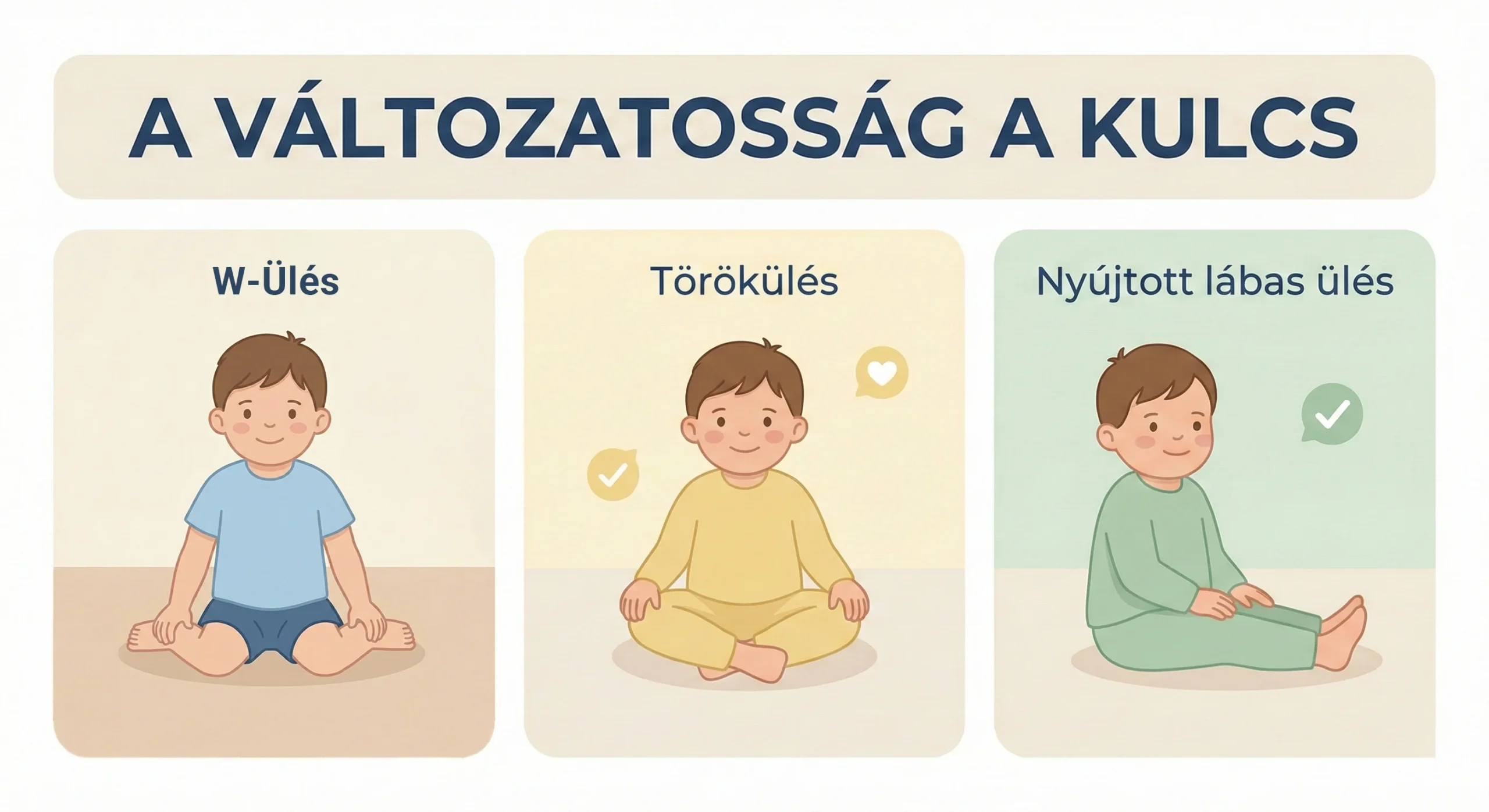
The W seat a typical sitting position in which the child sits on his bottom with his knees bent, his legs facing to the side and his feet forming the letter W when viewed from above. This sitting position is most common between the ages of 2 and 6 years and most children adopt it instinctively during play. A paediatric orthopaedics the W-sitting itself does not pose a health risk, but it is worth monitoring the frequency and alternation of positions.
Why are parents worried?
Concerns around W-sitting usually relate to the possibility of hip dysplasia, poor posture or muscle weakness. We often hear that the W-sit damages the hips, weakens the core muscles or causes long-term musculoskeletal problems. However, it is worth stressing that these claims have been made for a long time without scientific evidence spread among parents and teachers.

Dr. Ákos Morvai
Paediatric and neuro-orthopaedic surgeon
Online appointment booking for Budafoki út:
Please select the appropriate service
For paediatric orthopaedic examinations, please book your appointment with the child's name and with data be fixed.
The follow-up consultation fee is valid for 3 months after the initial examination, for the same complaint.
- 1. Select the service you need from the drop-down box!
- 2. Use the calendar to choose a date that suits you!
- 3. Enter your details to register or login with your previous registration!
- 4. If you would like to make a reservation on behalf of someone else (e.g. your child), please let us know at the location provided.
- 5. Briefly describe your complaints!
- 6. Select the type of consultation: initial examination, control examination or prescription.
- 7. Click on the button to book your appointment. Thank you for choosing BMM!
If you are unable to make the appointment you have already booked, please, at least 24 hours before notify us of your intention to withdraw. This gives other patients the opportunity to get the medical care they need in time. Thank you for your cooperation and understanding!
Resignation: +36 1 44 33 433
If you cannot find an available appointment for your chosen week, please call our call center on +36 1 44 33 433 for assistance. Our staff will be happy to help you make an appointment with the doctor of your choice or another specialist according to your complaint.
What does science show about the W-session?
Recent research has produced a systematic literature review on the W session. The researchers reviewed thousands of scientific papers, specifically looking for evidence of long-term adverse effects of W-birthing. The results were surprising: they found only seven studies that specifically looked at W-birth, and based on these paediatric orthopaedics experts say there is no evidence that the W-sitting alone is harmful.
Research has shown that there is no causal link between W-birth and hip dysplasia, musculoskeletal problems or muscle weakness. Separately, whether W-sitting can cause hip dysplasia or worsen an existing condition was investigated and no association was found. Another study looked at muscle function in different sitting positions and found that muscle activation was broadly the same regardless of how the child sat.
What does paediatric orthopaedics advise?
However, this does not mean that you can sit in any position for long periods of time. A paediatric orthopaedics stresses that the most important thing is to move and change positions. It is best for children to keep changing movement patterns during play: climbing, squatting, running and sitting in succession. In this context, W-sitting as a temporary, in-game position is perfectly normal, can be an element of natural movement.
In some cases, however, it is worth seeking professional help. A paediatric orthopaedic examination is recommended if:
- the child sits almost exclusively in W and does not change position,
- a known neurological disorder, muscle tone problem or orthopaedic disease.
In such cases, paediatric orthopaedics experts can give personalised advice on the right movement and sitting patterns.
What to know about the W-seat according to paediatric orthopaedics
The W-seat for children by itself not proven to be harmful, and the current view of paediatric orthopaedics is that it should not be banned. The key is regular exercise, frequent changes of posture and monitoring of the child's development. If there are any musculoskeletal or orthopaedic problems, the paediatric orthopaedics experts can give you the guidance you need to help your child develop safely and healthily.