Physiotherapy for children with disabilities
Author Marketing BMM | 2022.10.11.
Developmental disorders, accidents or other illnesses can lead to abnormal health conditions, in which case our main goal is to make a full recovery as soon as possible, to regain or come as close to a state of health as possible and to achieve the highest possible level of independence. Therapy should be chosen according to the extent of the disorder or impairment and the current functional, mental and mobility status, and short- and long-term goals should be set, just as we would for adults.
How can physiotherapy help children with disabilities?
The children with disabilities development can often deviate from the earliest age to the healthy development. It often stops at a level typical of an early stage of life, or develops only minimally. The child's automatic control of his or her body encounters problems and no or pathological development of adequate movements typical of infancy. Development is a very long, time-consuming and energy-intensive process for both the child and the environment. But to achieve the highest possible level of independence continuous improvement are in need. It is important that the child motivation at the highest level, as this will be a prerequisite for success. Constant motivation and the will to meet new goals will drive you forward. This requires age- and fitness-appropriate play activities and fun, as well as the constant setting of smaller, more achievable goals together.
Before starting home exercise, it is worth considering whether you can do it safely. After all, if we do not have sufficient knowledge and experience of the anatomical and pathophysiological background of the child's movement, we may even cause a minor or major accident. It is therefore worth asking a physiotherapist or other specialist for guidance on what to do and what not to do before starting a home exercise programme. Ask for advice and help on safe and optimal postures and the correct grip positions to move your child. It is also important to be constantly careful when performing movement tasks, as the child's current movement status may fluctuate and what we could easily perform today may not be possible at all the following day. Of course, the ideal solution would be for the therapy to be delivered by a professional and for the home programme to take place under their guidance. In such a case, the therapist shows and teaches home exercises, passive re-education, massage, body and posture changes for daily activities, and helps make caring tasks as easy as possible.
In the absence of development, motor and neurodevelopment may slow down or even stop.
This also increases the likelihood of secondary consequences, such as muscle contractures, deformities or abnormal compensations in the spinal segments, pelvic posture, head, neck and tongue movements.

What is the purpose of physiotherapy for children with disabilities?
The most important task is to improving quality of life, the basic task of which is to correct posture, thereby creating a safe resting position, and to find and create situations that will increase the joy of experiencing the world for our disabled child. As an example, lying on the back can often cause severe tension in the severely and multiply disabled child, known as opisthotonicity, whereas a stable side-lying position can help to inhibit abnormal reflexes. We then set goals during the exercises that can help facilitate daily living.
Many times the in infancy or injuries in the womb can result in sensorimotor dysfunction, i.e. in addition to damage to motor function, there are also sensory problems such as communication disorder, perception and cognition problems, experience problems. We can all influence the development of these during therapy. Through continuous somatic stimulation (touch, sight, hearing), the child discovers his body, his body's limits, and discovers and learns to connect with his environment. These are all prerequisites for the development of body schema and motor coordination.
What helps in physiotherapy sessions for children with disabilities?
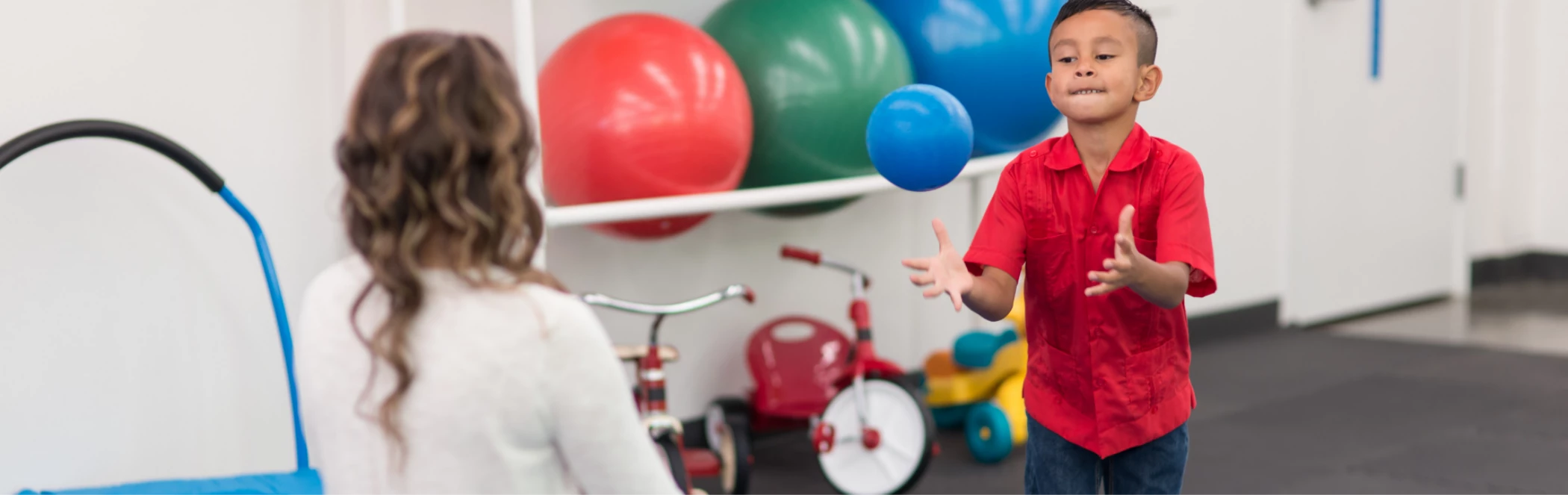
During the development sessions, different exciting play activities for children to develop their underdeveloped or malfunctioning nervous systems through their own active participation. We do not use a set training programme, but adapt it to each child's individual level of development and current mood. The different and diverse tools we try to create an environment for the child in which children who have difficulty coordinating their own body parts, have immature nerves and are used to failure for joyful movement we can encourage. Development also includes passive movement, massage, manual techniques on tight muscles, and active exercises that help to isolate arm and leg movements, opposing limb movements, strengthening or relaxing muscles, feeling and taking up correct postures, and improving coordination.
To sum up, our aim is to improve the quality of life, physical and mental well-being (habilitation, rehabilitation) of children with disabilities, to help their families and to promote their full social integration.

Call us

Online booking