Not all baby carriers are hip-friendly - what should you know about carrying as a parent?
Author Dr. Ákos Morvai | 2026.02.13.


Babywearing is a natural part of everyday life in many families. It is comfortable, practical and most parents feel that the closeness is good for the baby. But when the term „hip-friendly carrier” is mentioned, few people know exactly what it means in medical terms.
In recent years, studies have analysed in detail the effects of babywearing on the infant's hip development, muscle function, nervous system, and the stress on the parent's body and mental state. The following summary draws on these findings to help you understand the issues.
What does hip-friendly carry really mean?
The hip joint in babies is immature at birth. The relationship between the femoral head and the hip joint socket becomes more stable in the first few months, so the position in which the baby is held for long periods of time is crucial.
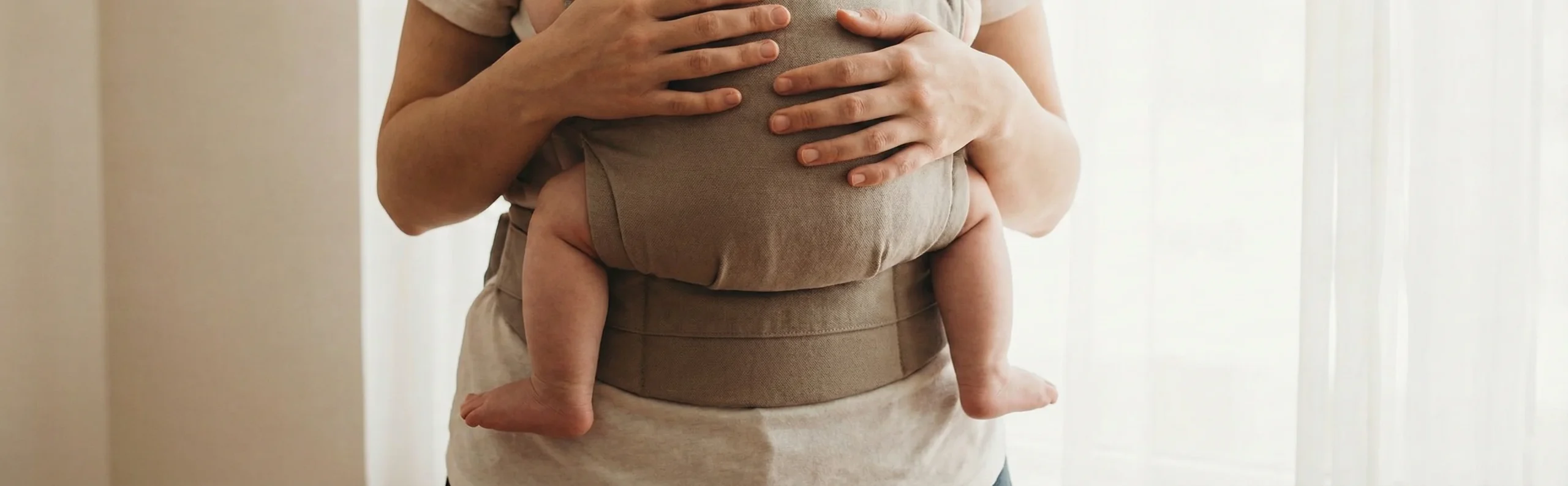
Tight swaddling, where the baby's legs are stretched out and locked together, has been shown to increase the risk of hip dysplasia (DDH). In contrast, so-called M-positioning, when the thighs are in a raised and extended position, supports the natural maturation of the hips. This is the basis of what the literature calls the hip-friendly posture.

Dr. Ákos Morvai
Paediatric and neuro-orthopaedic surgeon
Online appointment booking for Budafoki út:
Please select the appropriate service
For paediatric orthopaedic examinations, please book your appointment with the child's name and with data be fixed.
The follow-up consultation fee is valid for 3 months after the initial examination, for the same complaint.
- 1. Select the service you need from the drop-down box!
- 2. Use the calendar to choose a date that suits you!
- 3. Enter your details to register or login with your previous registration!
- 4. If you would like to make a reservation on behalf of someone else (e.g. your child), please let us know at the location provided.
- 5. Briefly describe your complaints!
- 6. Select the type of consultation: initial examination, control examination or prescription.
- 7. Click on the button to book your appointment. Thank you for choosing BMM!
If you are unable to make the appointment you have already booked, please, at least 24 hours before notify us of your intention to withdraw. This gives other patients the opportunity to get the medical care they need in time. Thank you for your cooperation and understanding!
Resignation: +36 1 44 33 433
If you cannot find an available appointment for your chosen week, please call our call center on +36 1 44 33 433 for assistance. Our staff will be happy to help you make an appointment with the doctor of your choice or another specialist according to your complaint.
Wide or narrow base substrate? There is a real difference
Tests have shown that not all carriers provide the same hip position. Wide-based carriers allow for a posture that is hip-friendly and similar to the position provided by devices used to treat hip deformities.
In contrast, narrow-based supports can result in a significantly more unfavourable hip position, which in the longer term does not optimally support joint maturation.
This is why, from a paediatric orthopaedic point of view, the design of the carrier really matters.
How does carrying affect your baby's spine and muscles?
The muscle development of babies is closely linked to the position in which they spend their time. Lying on their stomachs has been shown to activate the back muscles the most, while carrying a baby and holding hands also trigger significant neck muscle activity.
Conversely, long periods in a car seat or other passive device reduce muscle function. Carrying the baby in the correct position therefore provides more active muscle work than a prolonged immobile position.
The neurological effect of proximity
The closeness between baby and parent has not only an emotional but also a physiological impact. Studies have shown that the physiological functions of the baby and the parent, such as heart rhythm, are better coordinated during the carrying process.
This one-stroke regulation helps calm the baby's nerves, reduces the stress response and promotes a sense of security.
What does carrying mean for the mother's state of mind?
Research has also shown that during babywearing, mothers' negative thinking spirals can be reduced and their sense of mental well-being improved. It was not the frequency of the babywearing that had a positive effect, but the experience itself.
Babywearing can therefore be a simple, natural way to reduce the emotional burden on parents.
How does carrying put strain on the parent's body?
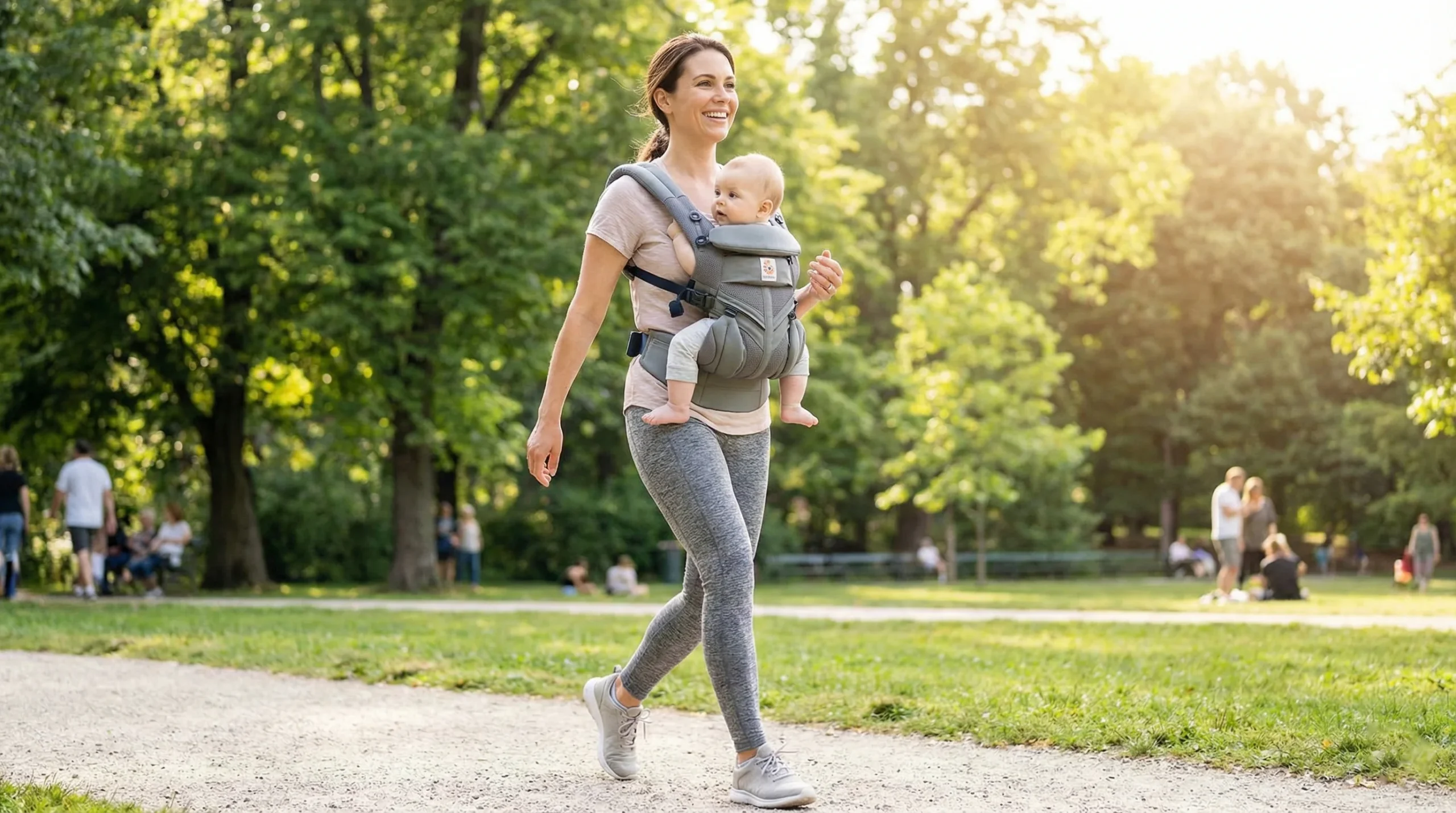
Biomechanical studies have shown that using a baby carrier puts less strain on the parent's joints than carrying the baby by hand for longer periods. Hand-carrying significantly increases the strain on knee and hip joints, especially over time.
No significant difference was found between the bandana and buckle carriers in terms of muscle strain on the parent, provided the fit is ergonomic and the weight distribution is appropriate.
What is worth remembering as a parent?
- Hip-friendliness is a concept of real orthopaedic importance, and the design of the carrier matters for the baby's hip development.
- Babywearing supports the baby's muscular function, helps to calm the nervous system, has a positive effect on the parent's state of mind and is gentler on the parent's body than carrying the baby in your arms.
- However, it is important to remember that weight-bearing is not a substitute for lying on the stomach and freedom of movement, but a valuable complement to them.
So babywearing is more than just a convenience. The correct body position and the design of the carrier are also important from a physiological and orthopaedic point of view.
By making a conscious choice, parents not only serve their own comfort, but also actively support their child's healthy development. For an infant hip screening or an annual paediatric orthopaedic check-up, contact the specialists at BMM!
Literature:
- Siddicky S, Eckels J, Rabenhorst B, Mannen E. Ultrasonographic evaluation of infant hips in the Pavlik harness compared to body-worn commercial baby carriers. J Orthop Res. 2023 Nov;41(11):2495-2500. doi: 10.1002/jor.25571. Epub 2023 May 3. PMID: 37080928; PMCID: PMC11060426.
- Taboada-Iglesias Y, Domínguez-Estévez A, Rodríguez-Gude C, Gutiérrez-Sánchez Á. Physical and Physiological Consequences of Babywearing on the Babywearer: A Systematic Review. Healthcare (Basel). 2025 Sep 2;13(17):2193. doi: 10.3390/healthcare13172193. PMID: 40941545; PMCID: PMC12428022.
- Vaidya S, Aroojis A, Mehta R. Developmental Dysplasia of Hip and Post-natal Positioning: Role of Swaddling and Baby-Wearing. Indian J Orthop. 2021 Sep 25;55(6):1410-1416. doi: 10.1007/s43465-021-00513-3. PMID: 35003533; PMCID: PMC8688658.
- Williams L, Standifird T, Madsen M. Effects of infant transportation on lower extremity joint moments: baby carrier versus carrying in-arms. Gait Posture. 2019 May;70:168-174. doi: 10.1016/j.gaitpost.2019.02.004. Epub 2019 Mar 8. PMID: 30877855.
- Wu CY, Huang HR, Wang MJ. Baby carriers: a comparison of traditional sling and front-worn, rear-facing harness carriers. Ergonomics. 2017 Jan;60(1):111-117. doi: 10.1080/00140139.2016.1168871. epub 2016 Apr 7. PMID: 27054475.
- Siddicky SF, Bumpass DB, Krishnan A, Tackett SA, McCarthy RE, Mannen EM. Positioning and baby devices impact infant spinal muscle activity. J Biomech. 2020 May 7;104:109741. doi: 10.1016/j.jbiomech.2020.109741. epub 2020 Mar 9. PMID: 32178849; PMCID: PMC7188598.
- Schoppmann J, Teismann T, Holleck-Weithmann VA, Hundertmark E, Jandewerth K, Obereiner P, Rudolph D, Seehagen S. Infant carrying is associated with reduced maternal repetitive negative thinking and increased maternal mental health. J Reprod Infant Psychol. 2023 Sep;41(4):456-469. doi: 10.1080/02646838.2021.2012647. Epub 2021 Dec 9. PMID: 34882494.
- Han JH, Rankin L, Lee H, Feng D, Grisham LM, Benfield R. Infant and parent heart rates during a babywearing procedure: evidence for autonomic coregulation. Infant Behav Dev. 2024 Dec;77:101996. doi: 10.1016/j.infbeh.2024.101996. epub 2024 Oct 5. PMID: 39369660.