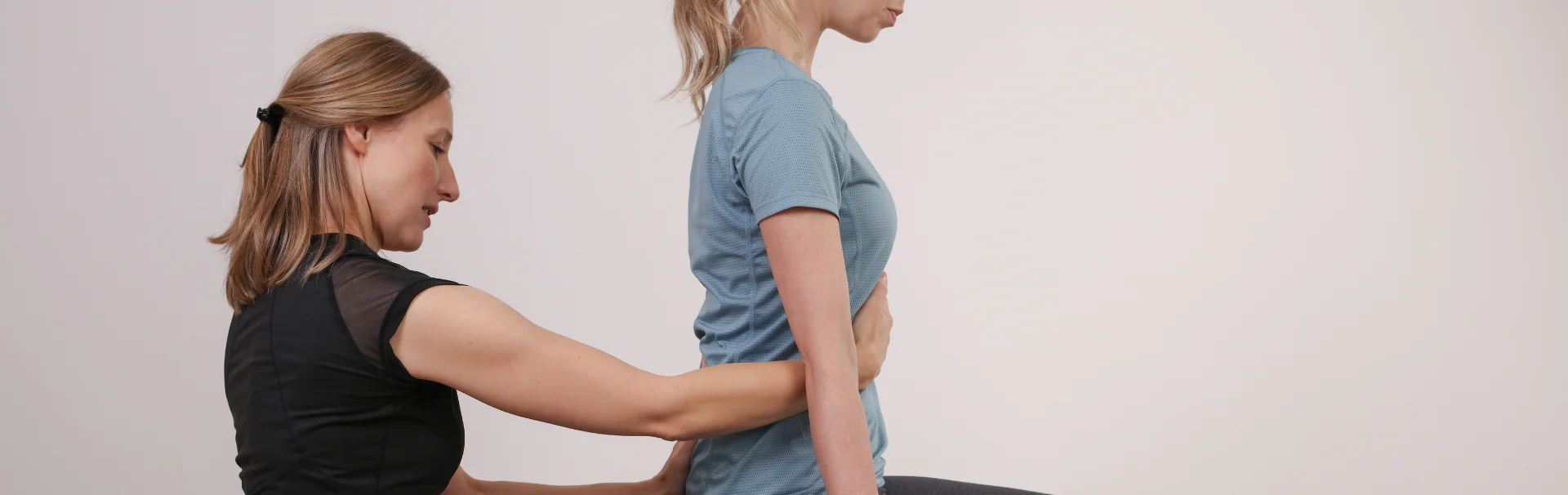
Physical therapist answers: what can I do to prevent scoliosis?
Author Loránd Szabó | 2018.10.20.


The healthy spine is straight in the frontal view, and laterally it forms a convex curve (kyphosis) in the back and a convex curve (lordosis) in the cervical and lumbar regions. Scoliosis is the abnormal lateral curvature of the spine. Our private physiotherapist, Lóránd Szabó what can be done against the disease that has already developed?
Scoliosis - The most important things to know
Scoliosis typically develops from the age of 10 and is typically twice as common in girls. Prevalence: 3-5/1000 people.
The obliquity can occur in the neck, neck-back, back, back-lumbar, lumbar and sacral regions. Usually not in a plane we distinguish between principal and compensatory curves. The larger curve is called the principal curve and the smaller curve is called the compensatory curve.
Scoliosis is a progressive lesion, which means that the curvature increases with time, therefore early detection is very important to start therapy as soon as possible!
How can I tell if I have scoliosis?
- Forward bending in the ridge laterally deflected in one or more spinal segments.
- The side of the lateral excursion is called the rib hump, and on the other side rib valley can be observed.
- One side shoulder or hip is higher.
- Back or lower back pain may involve.
- The head not in the body axis located in.
- Reduced physical activity and load capacity.
What are the possible consequences of scoliosis?
The most common consequence of scoliosis is joint wear, or arthrosis, which typically develops between the vertebrae, but is also common in knee and/or hip fracture is. More serious and advanced can cause breathing problems, which are can lead to heart failure.
What can I do to improve?
The only proven effective therapy is the so-called. three-dimensional using corrective tensioning Schroth therapy. For a patient with scoliosis long-term therapy comes into force. A Schroth therapy principle according to the exercises on a daily basis is done by the patient independently, in their own home, once a week under the guidance of a physiotherapist. The aim of the exercise with the physiotherapist is to learning to correct and recording of the patient and the patient's ongoing Motivate.
Therapy for scoliosis in all cases, to be carried out as an individual treatment, and takes 60 minutes at a time. In one session, we apply the stretches we have learned in various postures and do stretching exercises during the rest time between postures. The scoliosis rehabilitation programme until the patient learns to do the exercises independently (4-5 weeks), after which he only comes back to the physiotherapist for a control session every one or two to three months.