Cruciate ligament rupture
Author Dr. Szabolcs Gáspár | 2022.06.21.


What are the typical symptoms of a cruciate ligament rupture? What causes this type of injury, what types are there and in which cases is surgery necessary?
In our article you can read authentic medical information about cruciate ligament rupture. And our private practice specialists offer the latest therapeutic solutions for patients suffering from cruciate ligament rupture.
What is a cruciate ligament rupture?
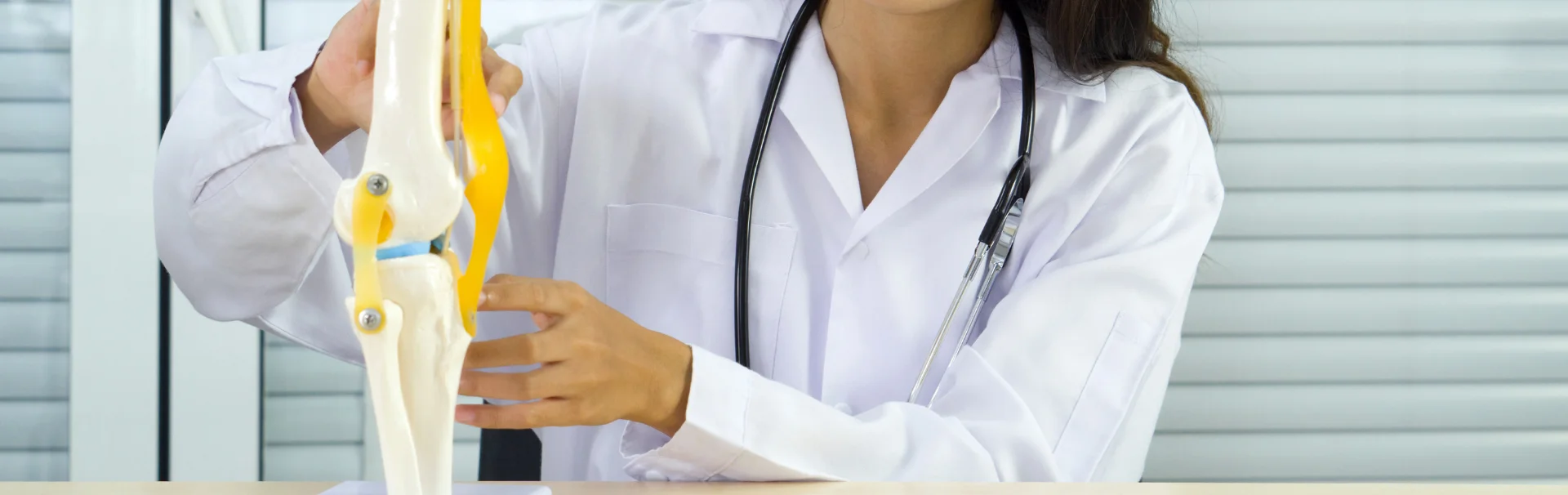
Cruciate ligament rupture is a very common injury that typically occurs in people aged 15-45 years. The knee is a very complex joint, with stability provided by the anterior and posterior knee ligaments. The ligaments are very strong fibrous tissues that connect the tibia and femur in an X shape. Tears very often occur during sports and sudden movements. Cruciate ligament tears are more common in women than in men.
What are the types of cruciate ligament rupture?
We distinguish between anterior and posterior cruciate ligament tears. Tears of the anterior cruciate ligament are more common and are usually the more serious injury, while the posterior cruciate ligament is typically less severely injured.
A cruciate ligament tear can be complete or partial. In the case of a partial tear, the knee can move and bear some weight, but it is painful and unstable. Symptoms may also be accompanied by swelling. In the case of a complete cruciate ligament rupture, there is a popping, crunching sensation in the knee at the moment of injury and sudden severe pain. The patient is often unable to stand on their feet and the knee is often unloaded.
Can cruciate ligament rupture be prevented?
If you have sensitive or loose knee joints, it is recommended that you avoid sports that put a lot of stress on the knee (football, basketball, skiing, tennis, handball). People who play these sports can do a lot to prevent cruciate ligament tears by doing regular physiotherapy to strengthen the muscles around the knee so that they can help stabilise the knee ligaments as effectively as possible. Targeted muscle strengthening is also recommended for older people and amateur athletes
What causes a cruciate ligament tear?
Anterior cruciate ligament tears are typically caused by twisting movements, lateral displacement of the knee joint and over-extension or over-bending of the joint. In about three quarters of cases, the injury occurs during sport. It occurs most often during movements involving sudden stops and changes of direction. Examples include football, basketball, skiing, tennis and handball.
Can it have harmful complications?
If the anterior cruciate ligament tears, the knee joint becomes unstable. Without proper treatment, the cartilage surface is damaged and joint wear (arthritis) can develop. Arthrosis can lead to worsening pain and mobility problems. This is why it is vital that if you notice symptoms of a cruciate ligament tear, you should contact us before to an orthopaedic specialist!
How is a cruciate ligament rupture examined at the Budapest Musculoskeletal Private Clinic?
The specialists of the Budapest Musculoskeletal Private Clinic are teachers and leading physicians of national institutions, who are waiting for their patients with great experience, fast and accurate diagnosis and personalized treatment plan. We have family-friendly, high-quality practices in several locations in Budapest, Buda, Pest and Óbuda. The first step is to make an appointment with one of our orthopaedic specialists by calling +36 1 44 33 433. We can make an appointment for today, tomorrow or over the weekend.
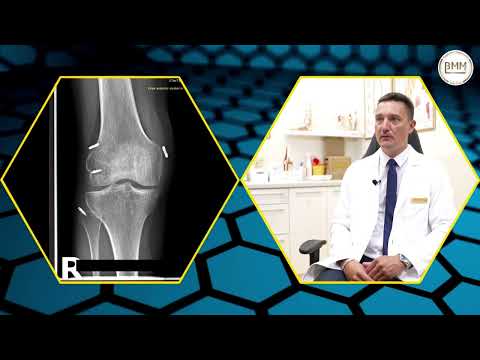
During the medical examination, our orthopaedic specialist will first ask you about your the circumstances in which the injury occurred and the symptoms you experience. Then physical examination checks the mobility and loss of function of the knee. There are also special tests to confirm an anterior cruciate ligament tear. For example, in a test called the Lachman test, the doctor looks at the forward displacement of the tibia, which is higher than average in cases of anterior cruciate ligament tears.
Imaging tests may also be needed to make a diagnosis. Our doctor will look at the scans you have taken and may request additional tests if necessary. In the case of a cruciate ligament tear ultrasound or MR scan is an option, as these methods can be used to examine the condition of soft tissues, including ligaments. MR (magnetic resonance) imaging provides a detailed, high-resolution picture of the condition of joints and ligaments. Our doctor will then a personalised treatment plan will make a proposal to you.
The doctor decides whether surgery is necessary by looking at several aspects. Considerations include the patient's age, lifestyle, body type and physical activity. For example, if the patient plays sports or does physical work that involves the knee, surgery for a torn ligament may be indicated. In addition, surgery is usually recommended if the ligament tear is greater than 50%.
Surgical treatment of cruciate ligament rupture
In the case of a complete tear of the anterior cruciate ligament, there is no chance for the ligament to regenerate on its own. So surgery is the solution. Failure to do so can lead to unstable knee function and premature arthrosis (joint wear). A cruciate ligament tear is typically treated surgically with a procedure called ligamentoplasty. The procedure involves replacing the damaged ligament from a tendon in the thigh.
The operation
During the operation, the surgeon makes a small incision above the tibia in the knee joint and removes two pieces of tendon through it. He then uses a special tube camera to examine the knee joint thoroughly and treat any other injuries. He then drills holes in the tibia and femur and forms an anterior cruciate ligament from the flexor tendon, which he fixes with screws and absorbable pins.
Special surgical procedure for cruciate ligament rupture
We also offer a special surgical technique where we insert the cruciate ligament at the original point of origin. In addition, we use a special fixation technique that secures the implanted ligament very firmly. The advantage of this is that the patient does not need to wear an external brace or unload the leg after the operation. This speeds up the rehabilitation process.
After surgery
Following cruciate ligament rupture surgery, rehabilitation helps to ensure a full recovery. Early onset or excessive exertion and sub-optimal loading can lead to joint damage. For this reason, it is important that the rehabilitation process is monitored by a specialist doctor and physiotherapist. The physiotherapist helps the patient to recover with personalised exercises. The aim is to restore pain-free movement and the original joint range of motion and to prepare for weight-bearing. About 2 months after surgery, most patients can ride a bicycle, and for about six months after surgery they can play all the sports they played before their injury.