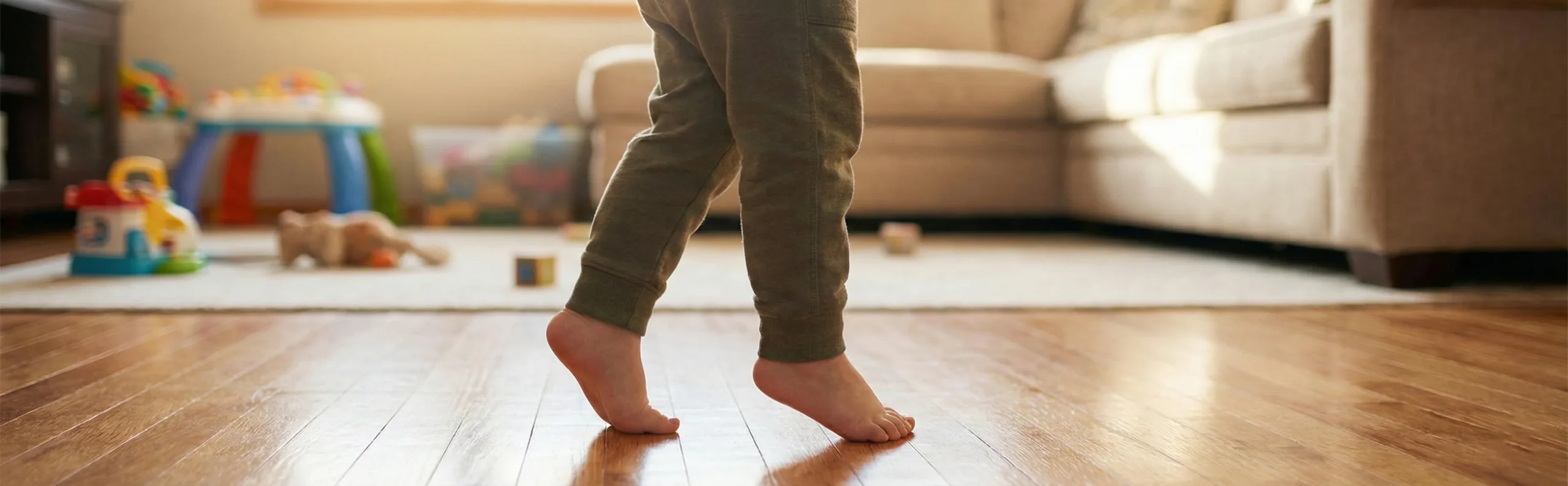
Walking on tiptoe in children - A paediatric orthopaedic perspective
Author Dr. Ákos Morvai | 2026.01.27.


The child walking on tiptoe, commonly known as pee-pee, can be a cause for concern for many parents. When a child walks not on your heels, but primarily to puts the weight on your toes, it is natural to ask whether this gait pattern is part of normal development, or whether it is gfor a paediatric orthopaedic problem refers to. The answer is not always clear-cut, as walking on tiptoe may be a temporary developmental feature, but above a certain age it can be requiring investigation can also be a condition.
What is walking on tiptoe as a child?
Infant toe walking is when the child does not or rarely touches the ground with the heel when walking and puts the weight of the body mainly on the front of the foot. This gait pattern is called during the learning to walk period, especially at one and two years of age, is often a perfectly natural phenomenon. At this age, the nervous system, balance system and motor coordination are still maturing, and therefore walking with a tick-toe may occur temporarily.
However, according to paediatric orthopaedic recommendations over the age of three persistent tiptoeing is no longer a purely age-related phenomenon. If the child regularly walks with a tick-toe and is unable to stand on his or her heels for long periods of time, then a specialised test may be justified to clarify whether it is an idiopathic process or some other underlying discrepancy.
What is idiopathic toe walking?
Infant toe walking is when the child does not or rarely touches the ground with the heel when walking and puts the weight of the body mainly on the front of the foot. This gait pattern is called during the learning to walk period, especially at one and two years of age, is often a perfectly natural phenomenon. At this age, the nervous system, balance system and motor coordination are still maturing, and therefore walking with a tick-toe may occur temporarily.
However, according to paediatric orthopaedic recommendations over the age of three persistent tiptoeing is no longer a purely age-related phenomenon. If the child regularly walks with a tick-toe and is unable to stand on his or her heels for long periods of time, then a specialised test may be justified to clarify whether it is an idiopathic process or some other underlying discrepancy.
How can idiopathic toe walking be distinguished from pee-pee from other causes?
From a paediatric orthopaedic point of view, it is essential to decide whether the pipe-walking is of idiopathic origin or whether it is due to some a neurological, muscular or developmental disorder is behind it. In some diseases, walking on tiptoe may be accompanied by other pathological symptoms, such as muscle tension, muscle weakness, asymmetry, abnormal reflexes or developmental abnormalities.
In Autism Spectrum Disorder, walking on tiptoe is often associated with sensory processing characteristics. In idiopathic toe-walking, these neurological or structural abnormalities are not observed.

Dr. Ákos Morvai
Paediatric and neuro-orthopaedic surgeon
Online appointment booking for Budafoki út:
Please select the appropriate service
For paediatric orthopaedic examinations, please book your appointment with the child's name and with data be fixed.
The follow-up consultation fee is valid for 3 months after the initial examination, for the same complaint.
- 1. Select the service you need from the drop-down box!
- 2. Use the calendar to choose a date that suits you!
- 3. Enter your details to register or login with your previous registration!
- 4. If you would like to make a reservation on behalf of someone else (e.g. your child), please let us know at the location provided.
- 5. Briefly describe your complaints!
- 6. Select the type of consultation: initial examination, control examination or prescription.
- 7. Click on the button to book your appointment. Thank you for choosing BMM!
If you are unable to make the appointment you have already booked, please, at least 24 hours before notify us of your intention to withdraw. This gives other patients the opportunity to get the medical care they need in time. Thank you for your cooperation and understanding!
Resignation: +36 1 44 33 433
If you cannot find an available appointment for your chosen week, please call our call center on +36 1 44 33 433 for assistance. Our staff will be happy to help you make an appointment with the doctor of your choice or another specialist according to your complaint.
Why can idiopathic toe walking develop?
The development of idiopathic toe walking the exact cause is currently unknown. Research suggests that a combination of factors may be involved. There is often a family history, which may indicate a genetic predisposition. In addition, some children may have different body sensation and balance processing, which may influence gait patterns.
Subtle neurological differences in movement control may also contribute to the child's instinctive preference for the front of the foot when walking. Although some recent research is theoretically investigating the role of other systems, these are not currently part of routine paediatric orthopaedic diagnostics.
Can walking on tiptoe cause problems later in life?
In most cases, the idiopathic walking on tiptoe does not lead to serious consequences. However, if peeing persists for many years, secondary abnormalities may develop. These can include a progressive shortening of the Achilles tendon, a increased tightness of the calf muscles, and a reduction in the range of motion of the ankle.
These lesions cause fatigue, leg pain on exertion and gait differences can cause. In addition, a different gait pattern in school can be a psychological burden for the child, especially if he or she receives negative feedback from peers.

When is it appropriate to have a paediatric orthopaedic examination?
Paediatric orthopaedic examination recommended in all cases where walking on tiptoe even after the age of three is a regular occurrence, or even if the child is unable to stand on his or her heels for long periods. An assessment is also warranted if pain, limping, asymmetry or deteriorating gait pattern.
Early detection allows for timely follow-up or treatment if necessary, and prevents subsequent complications.
How is the examination done in paediatric orthopaedics?
The diagnosis of idiopathic toe walking is always made on an exclusion basis. The paediatric orthopaedic examination includes a detailed history and a thorough physical examination and a neurological examination may be carried out if necessary. The aim is to determine whether there are any abnormalities that might explain the gait pattern.
If all other possible causes can be excluded, a diagnosis of idiopathic toe walking can be made.
Treatment options for idiopathic toe walking
The choice of treatment is always based on individual assessment, taking into account the child's age, gait pattern, muscle tension and any secondary abnormalities. Often used physiotherapy and targeted stretching exercises, which can help to maintain ankle range of motion and develop the correct gait pattern.
In some cases, orthoses to support proper foot posture may be an option. In more severe cases, casts or surgery may rarely be warranted, but these are only recommended under strict professional indication.
Experience shows that for many children, walking on tiptoe over time spontaneously disappear, especially with appropriate follow-up and, if necessary, targeted therapy.
What can parents do?
Idiopathic toe-walking is not a fault of upbringing and does not automatically mean a serious illness. Observation of the child's gait, regular monitoring and, if necessary, seeking a paediatric orthopaedic opinion may be sufficient to ensure that the child is followed safely and appropriately. However, if you are unsure or have further questions, book an appointment for a paediatric orthopaedic examination!
This leaflet is based on the findings of several international studies, clinical reviews and systematic literature summaries. Literature. doi: 10.1002/14651858.CD012363.pub2. PMID: 31587271; PMCID: PMC6778693. Bauer JP, Sienko S, Davids JR. Idiopathic Toe Walking: An Update on Natural History, Diagnosis, and Treatment. J Am Acad Orthop Surg. 2022 Nov 15;30(22):e1419-e1430. doi: 10.5435/JAAOS-D-22-00419. epub 2022 Sep 7. PMID: 36084329. Donne J, Farrell MJ, Kolic J, Powell J, Fahey M, Williams C. Two-point discrimination responses in children with idiopathic toe walking: a feasibility fMRI study. Sci Prog. 2022 Oct-Dec;105(4):368504221132141. doi: 10.1177/00368504221132141. PMID: 36373762; PMCID: PMC10306138. de Angeli LRA, Serafim BLC, Masquijo JJ. The Autistic Toe Walking: A Narrative Review for Interventions and Comparison with Idiopathic Toe Walking. Children (Basel). 2025 Sep 8;12(9):1198. doi: 10.3390/children12091198. PMID: 41007062; PMCID: PMC12468364. Pomarino D, Emelina A, Heidrich J, Rostásy K, Schirmer S, Schönfeldt JO, Thren A, Wagner F, Thren JR, Berger N. NGS-Panel Diagnosis Developed for the Differential Diagnosis of Idiopathic Toe Walking and Its Application for the Investigation of Possible Genetic Causes for the Gait Anomaly. Glob Med Genet. 2023 Apr 21;10(2):63-71. doi: 10.1055/s-0043-57230. PMID: 37091313; PMCID: PMC10121371. Shirel T, Sylvanus T, Cho K, Authement A, Krach LE. Efficacy of serial casting protocols in idiopathic toe-walking. J Pediatr Rehabil Med. 2024;17(2):179-184. doi: 10.3233/PRM-230041. PMID: 38669491; PMCID: PMC11307011. Berger N, Bauer M, Hapfelmeier A, Salzmann M, Prodinger PM. Orthotic treatment of idiopathic toe walking with a lower leg orthosis with circular subtalar blocking. BMC Musculoskelet Disord. 2021 Jun 7;22(1):520. doi: 10.1186/s12891-021-04327-0. PMID: 34098918; PMCID: PMC8183056. Brasiliano P, Alvini M, Di Stanislao E, Vannozzi G, Di Rosa G, Camomilla V. Effects of wearing a foot orthosis on ankle function in children with idiopathic toe walking during gait. Heliyon. 2022 Oct 12;8(10):e11021. doi: 10.1016/j.heliyon.2022.e11021. erratum in: Heliyon. 2023 May 08;9(5):e16022. doi: 10.1016/j.heliyon.2023.e16022. PMID: 36281373; PMCID: PMC9587270. Kononova S, Kashparov M, Xue W, Bobkova N, Leonov S, Zagorodny N. Gut Microbiome Dysbiosis as a Potential Risk Factor for Idiopathic Toe-Walking in Children: A Review. Int J Mol Sci. 2023 Aug 25;24(17):13204. doi: 10.3390/ijms241713204. PMID: 37686011; PMCID: PMC10488280.